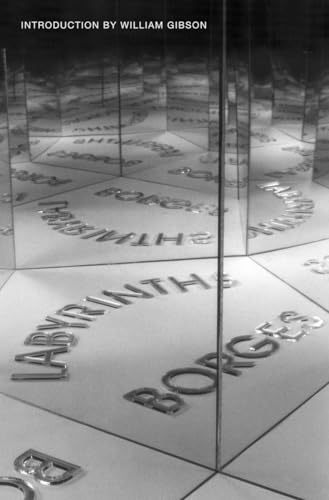
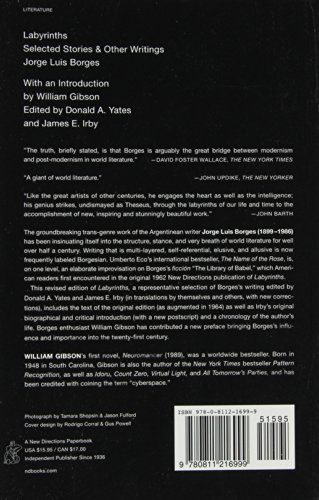


Labyrinths [Borges, Jorge Luis, Yates, Donald A., Irby, James, Gibson, William, Maurois, André] on desertcart.com. *FREE* shipping on qualifying offers. Labyrinths Review: Satisfying estrangement for restless, unsold minds - I imagine in my mind what it would be like to have coffee with Luis Borges on a Sunday afternoon. Borges would be wearing a suit and have little cakes on hand, cane leaning on his armrest, as if nothing out of the ordinary were about to occur. Labyrinths is a useful first book to kick off a lifetime investigation into Borges' writings. Borges is truly original as an author as much for his intent as for his achieving it. Not quite Magic Realist, not quite Existentialist nor Kafkan: no one is Borges' equal in taking established assumptions and turning them into curious, elaborate, eruditely-supported flashing crossroads that defy simplification. Even the most unassuming essays like "The Fearful Sphere of Pascal," a subtle historical resketching, are characteristically erudite, yet sticky and complicate the subject irresistibly from your first reading onward. The prickly thorns reach out for your existing education on the subject and are designed to flesh out the glaring inconsistencies you will have read on the subject. The Garden of Forking Paths is an example of prime Borges storytelling at work. The story itself is a ruse. The first reading-through is not the time you are affected most by Borges, but rather only AFTER you have put the book down, when the Borges' physics of Being begin to gnaw at your world of compact, necessary daily conveniences, even in 2005 when we really ought to be intimately familiar with his universe by now. I think ultimately Borges sets tiny mind bombs set to detonate at exactly the time you seek to superimpose a Newtonian universe upon one of his stories, and ultimately, later, when you seek to superimpose order upon your own human experience. The entrance seems the same, but it has clearly moved by the time you exit the story. You become part of the puzzle, and that is the bedazzling signature of Borges, and his unassailable virtue. Everything solid in the universe of daily lived experience becomes compost and peacefully unsettled, as it originally was, before we came along to fix it up like morticians just before the funeral. Review: Mind expanding - I must admit that Borges is one of those "must read" authors that I had never gotten around to. Don't know why, just hadn't. But now that I have, I understand all the hoopla. His writing shows a classic, authorial imagination par excellence. It is clear that Borges was grandfather to Eco and so many others who write to celebrate and stimulate and challenge the intellect. Labyrinths is a collection of stories revolving--as the planets, the asteroids, et al, do around the sun--around the concept of the labyrinth, whether it be one of time or space or pure imagination. Every story stands on its own; every story illuminates another facet of the cosmic jewel of labyrinth-ness. Have you ever noticed how a wonderful writer gives so much to his audience? Borges certainly proves that hypothesis in this remarkable collection.
| Best Sellers Rank | #28,974 in Books ( See Top 100 in Books ) #2 in Caribbean & Latin American Literature #219 in Short Stories (Books) #1,452 in Literary Fiction (Books) |
| Customer Reviews | 4.5 4.5 out of 5 stars (721) |
| Dimensions | 5.1 x 0.8 x 8.1 inches |
| Edition | Reprint |
| ISBN-10 | 0811216993 |
| ISBN-13 | 978-0811216999 |
| Item Weight | 2.31 pounds |
| Language | English |
| Print length | 240 pages |
| Publication date | May 17, 2007 |
| Publisher | New Directions |
T**R
Satisfying estrangement for restless, unsold minds
I imagine in my mind what it would be like to have coffee with Luis Borges on a Sunday afternoon. Borges would be wearing a suit and have little cakes on hand, cane leaning on his armrest, as if nothing out of the ordinary were about to occur. Labyrinths is a useful first book to kick off a lifetime investigation into Borges' writings. Borges is truly original as an author as much for his intent as for his achieving it. Not quite Magic Realist, not quite Existentialist nor Kafkan: no one is Borges' equal in taking established assumptions and turning them into curious, elaborate, eruditely-supported flashing crossroads that defy simplification. Even the most unassuming essays like "The Fearful Sphere of Pascal," a subtle historical resketching, are characteristically erudite, yet sticky and complicate the subject irresistibly from your first reading onward. The prickly thorns reach out for your existing education on the subject and are designed to flesh out the glaring inconsistencies you will have read on the subject. The Garden of Forking Paths is an example of prime Borges storytelling at work. The story itself is a ruse. The first reading-through is not the time you are affected most by Borges, but rather only AFTER you have put the book down, when the Borges' physics of Being begin to gnaw at your world of compact, necessary daily conveniences, even in 2005 when we really ought to be intimately familiar with his universe by now. I think ultimately Borges sets tiny mind bombs set to detonate at exactly the time you seek to superimpose a Newtonian universe upon one of his stories, and ultimately, later, when you seek to superimpose order upon your own human experience. The entrance seems the same, but it has clearly moved by the time you exit the story. You become part of the puzzle, and that is the bedazzling signature of Borges, and his unassailable virtue. Everything solid in the universe of daily lived experience becomes compost and peacefully unsettled, as it originally was, before we came along to fix it up like morticians just before the funeral.
M**K
Mind expanding
I must admit that Borges is one of those "must read" authors that I had never gotten around to. Don't know why, just hadn't. But now that I have, I understand all the hoopla. His writing shows a classic, authorial imagination par excellence. It is clear that Borges was grandfather to Eco and so many others who write to celebrate and stimulate and challenge the intellect. Labyrinths is a collection of stories revolving--as the planets, the asteroids, et al, do around the sun--around the concept of the labyrinth, whether it be one of time or space or pure imagination. Every story stands on its own; every story illuminates another facet of the cosmic jewel of labyrinth-ness. Have you ever noticed how a wonderful writer gives so much to his audience? Borges certainly proves that hypothesis in this remarkable collection.
J**E
Left dazed...
If I was smarter, more well read, or more philosophical in nature I likely would have given this 5 stars. I can't believe it took me over a week to read 250 pages... this book was *dense* yet thoroughly enjoyable and thought provoking. At some point I had to give up trying to read, understand, and retain each individual story as a whole and begin to focus on and underline specific lines and specific ideas in an attempt to glean just a tiny fraction of what the author was trying to impart to the reader. Even though he and I are, apparently, the same... I was surprised when the collection shifted from short fiction to essays and happy when it shifted again to parables. The short works at the end were, perhaps, the easiest for me to grasp, the essays simply required too much knowledge I did not possess, and the fiction largely just flew over my head. At least until I realized I have not the capacity to fully understand with just a cursory reading. As one who cites The Stranger (Everyman's Library) and Notes from Underground (Everyman's Library) as two of my primary influences, I feel like many of the philosophies espoused here were familiar territory... just presented in an incredibly deep and unique way. I wasn't particularly driven in any new direction by the content of the ideas (as best I could understand them), but the style was breathtaking and mind-bending. I was unprepared for the author's predilection for Cervantes Miguel de, religion, the plight of the Jews, and Zeno's paradoxes, but the redundancy probably helped my ability to follow and pretend that I understood. (Although I hate Zeno's paradoxes it is, perhaps again, because I just don't get it.) My grasp of South American history (both literary and political) is tenuous at best and yet another reason I feel like I have missed a large portion of what the author hoped (hopes?) to give to me. And, God, I wish I had a greater appreciation and understanding of Don Quixote... It sounds like I am complaining, but it was amazing to see some ideas I already held to be presented in such beautiful language. "I reflected that there is nothing less material than money, since any coin whatsoever is, strictly speaking, a repertory of possible futures. Money is abstract, I repeated; money is the future tense." Yes. More, please. To have some things that I knew... yet did not know that I knew put in plain black & white in front of me was a thrill. "...except for man, all creatures are immortal, for they are ignorant of death..." With every turn of the page, I found another phrase burned into my mind. And how I wish I'd begun underlining earlier. I will have to read this again in the near future... To the best of my ability to remember, "The Secret Miracle" and "The Immortal" were probably my two favorite short stories. I think they seemed to be the most straight forward and, perhaps, mundane allowing me to finally feel like I understood something. "The Secret Miracle" particularly stuck with me. What a beautifully succinct and poignant tale... As much as the fictions relied on the knowledge of the reader, (should I have been as happy as I was to pick up on the Raskolnikov reference?) the essays were even more daunting. Not to say that I did not benefit from them, but without the base knowledge, I often found myself lost... Lost and disappointed that the short fictions had ended. Which is why, again, I appreciated the structure of this collection placing the short parables at the end giving me some semblance of understanding. I feel as though I could talk about this for ages all the while saying nothing. I don't feel like I'm worthy to press these keys and push my thoughts into the world. But everything that has happened to me and to the Universe as a whole, thus far, has led to this exact and specific present, which I will now make my past. Which does not exist.
V**.
Good product
A**Y
great book, arrived on time, in new condition to a good price, what more can I say. keep up the good work
N**S
The commonest comment that seems to prevail after being introduced to Borges is "how did I miss him"? or how come I hadn't heard of him before?.He seems to be a literary enigma to some that appears out of nowhere and restores faith in the power of fiction to stimulate the imagination.The stories are surprisingly short,well crafted,and deal in areas that inhabit the boundaries of esoteric knowledge and philosophical thought,and seem to aspire to reinterpret ancient history through the prism of metaphysical thought.
M**O
Gostei muito. Foi para estudo.
V**N
Good book
TrustPilot
1天前
1 周前