We remain fully operational. Our teams are working around the clock to ensure your deliveries continue safely.

下载应用程序




Buy anything from 5,000+ international stores. One checkout price. No surprise fees. Join 2M+ shoppers on Desertcart.
Desertcart purchases this item on your behalf and handles shipping, customs, and support to Hong Kong.
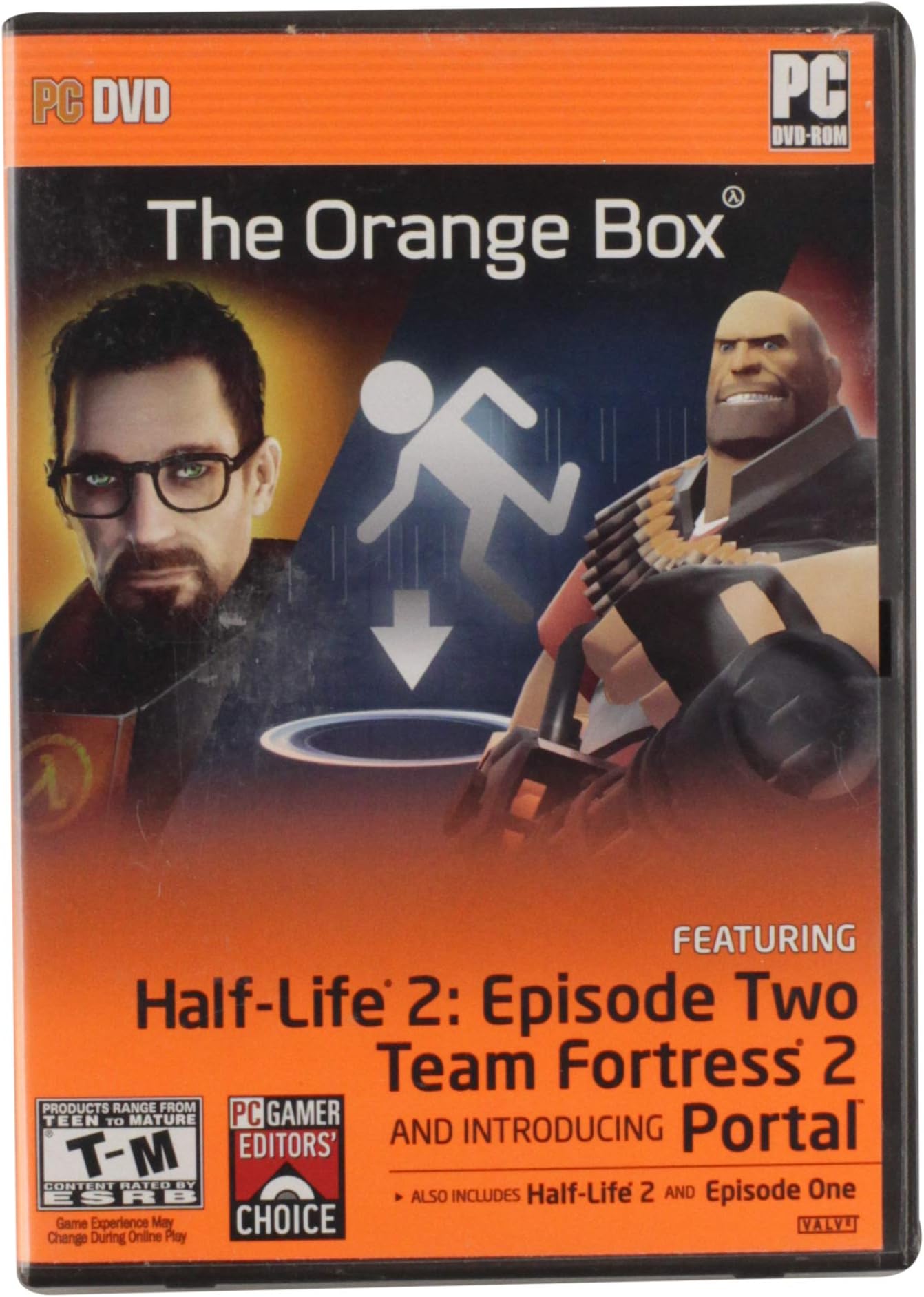
🔥 Level up your gaming legacy with The Orange Box — where innovation meets epic adventure!
The Orange Box for PC bundles five critically acclaimed Valve games, including Half-Life 2 and Portal, delivering cutting-edge AI, physics, and graphics powered by Steam. This mature-rated collection offers a blend of single-player storytelling and multiplayer action, featuring advanced facial animations, realistic environments, and innovative gameplay mechanics that have set industry standards since 2007.
| ASIN | B000PS2XES |
| Best Sellers Rank | #9,784 in Video Games ( See Top 100 in Video Games ) #1,700 in PC-compatible Games |
| Computer Platform | PC |
| Customer Reviews | 3.9 3.9 out of 5 stars (445) |
| Date First Available | April 24, 2007 |
| Global Trade Identification Number | 00014633098525 |
| Is Discontinued By Manufacturer | Yes |
| Item Weight | 4.8 ounces |
| Item model number | 9852 |
| Manufacturer | Electronic Arts |
| Product Dimensions | 7.5 x 5 x 0.75 inches; 4.8 ounces |
| Rated | Mature |
| Release date | October 9, 2007 |
| Type of item | Video Game |
| UPC | 014633098525 |
K**H
Review for Newbies
This review is written only for those who are new to computer gaming or "First-Person Shooter" gaming, or perhaps family members seeking games for those who enjoy that genre. There are hundreds of reviews on Amazon and elsewhere written by and for people who know what they're talking about. This is a review by the clueless for the clueless. I had literally no experience with computer games more sophisticated than Solitaire and Minesweeper. It really is not my thing. But, intrigued by some friends' discussion and the low price of the "Orange Box" special, I decided to take the plunge just to see what they were talking about. Here are some of my impressions; I have tried to note things that would have helped ease some confusion for me if I had known them before buying. WHAT THIS IS: The "Orange Box" is a combo deal on several popular computer games from the same company ("Valve"). The central product is an older game, "Half-Life 2", and two recent follow-up add-ons to it. Also included are Valve's successful games "Portal" and "Team Fortress 2". Thus, the set contains five separate games of three distinct types (the "Half-Life 2" sequence is three games with connected themes and content; the other two are different). All are very popular: "Half Life 2" has often been named the one of the best video games ever made, and swept the industry awards when it was first released; "Portal" is often regarded as one of the most unique and creative games on the market and also won many awards; "Team Fortress 2" has been very popular, and has been described as a unique game of its type. In addition to the games, the disc in the box includes the installation program for "Steam", which is not a game but an online content-management system run by Valve, the software company, which allows them to prevent unauthorized game copying and to provide automatic updates to your games' content. Steam also allows you to purchase further games from Valve for direct download, if you choose, and provides some further functionality (as well as frequent ads and announcements). When you attempt to install the games on the disc, the disc will first install "Steam" and contact the Valve software server; it will then install your games on your computer, register them with Valve, and download any patches or updates. Whenever you start the game, it will contact Valve again. For this reason, you will need a working Internet connection to install the games, and it is preferable to have one when you are playing them; it is possible to play the games offline after they have been registered, but it is useful to keep them updated. The Steam program does seem rather intrusive, but it provides some useful assistance, and if you are not trying to use illegally copied games it does not get in your way. (There are no further fees for using Steam; you must install Steam to get your Orange Box games to work, but you do not have to pay anything more unless you choose to buy games or other merchandise offered online.) Technical note: the games have fast-changing, high-quality imagery and sound, which is partly downloaded and partly generated by your computer as you play; this puts a heavy load on your computer, especially if it is not a current-model "gamer's machine". Most reasonably recent computers will run the games acceptably, but older computers may show slow-downs or choppy images if the computer is not powerful enough to keep up with the software. If this is an issue, using the "Options" command in Steam to reduce your video density setting may help. You may also need to update your audio and video drivers to the latest versions to be able to run the games properly; do this as a first step if you have any problems on installation. Also, close all other software running on the computer while you are playing the game, to help your computer devote all its processing resources to the game software. WHAT IT'S ALL ABOUT: With the exception of "Team Fortress 2", these are what are called "single-player" "first-person shooter" ("FPS") games with "puzzle-solving" elements. As "single-player" games, you play the game by yourself, acting as the main character through whose "eyes" you see the game environment. There are "non-player characters" who populate the game, acting as enemies or supporters, who are controlled by artificial-intelligence programming that gives them (sort of) lifelike behavior and makes the game much more realistic; all of these are computer-generated, however - you are the only human playing the game, through the medium of your player character. (In the "Half-Life" sequence, your player character is a male renegade scientist/guerrilla; in "Portal" you are a young woman trapped in a weird experimental maze.) "First-person" means that, when you play the games, you see the game environment through the eyes of your game character, as if you were that person, actually present in the game setting. (This means that in most cases you never actually see yourself; you see the world through "your" eyes, and occasionally see your hands or body parts but not your own face, just as in real life.) "Shooter" means just what it says: most of these games involve some degree of shooting or other forms of combat, against a variety of enemy characters. It should be said that combat is not the main theme of the "Half-Life" sequence of games, but there is indeed considerable combat and moderate simulated violence. "Team Fortress" is a heavily combat-themed game, although again the tactical element, rather than simple violence, is a major emphasis. "Portal" is very different and involves no military-style combat, emphasizing intelligence and clever problem-solving instead; although you don't actually shoot anybody there, you manipulate a gun-like object to complete non-violent, intriguing, and often humorous tasks, and the player-control techniques required are basically those of an FPS game. The games are "puzzle-solvers" because moving through the game environment in every case requires working out solutions to a variety of complicated problem scenarios: some depend on physics (using a lever or stacking blocks to reach a high point), some involve path-finding (locating valves, handles, buttons, walkways, and so forth to navigate a difficult environment), some involve challenging coordination (moving the character through a difficult path involving running, jumping, balancing, and so forth, or using machines to make a way through an impassable area), and many involve using effective combat techniques or are complicated by being required to solve the puzzles while engaging in combat. For the combat games, it is not always obvious how to find your destination and achieve your objective; those are part of the challenges the player must overcome. In "Portal", the environment is simplified and the action is essentially purely puzzle-solving; there are also no other lifelike characters to interact with. "Team Fortress 2" is very different. It is an online team game: through the "Steam" connection, you are grouped with other players online and organize yourselves into a team, each player taking a distinct role, and cooperate to achieve an objective in the combat game. This provides a different kind of challenge and allows for more complex game-playing; it also offers the opportunity for greater diversity by allowing players to choose from several different types of player characters. It is also the only Orange Box game which does not provide a first-person perspective for the player: each player controls one character in the game, but has a top-down overview of the game environment, including their player and others. Each of the games has a "plot" and a story sequence that makes them highly engaging and entertaining, and often humorous as well. In each case, the game is set in an imaginary world; the player is challenged to move across the landscape and interact with objects, terrain, and other characters to accomplish certain goals. Hints and explanations provided in the games describe the goals and help the player navigate the landscape. In addition, the difficulty level of the game - particularly the intensity of the fighting scenarios - can be adjusted to suit the ability of the player, so those who are less skilled or comfortable with some scenarios can still navigate the game successfully and enjoy themselves, while those who want a greater challenge can play at more difficult levels. PLOTS: The story setting of each of the games is as follows: "Half Life 2": this game is a sequel to Valve's earlier award-winning game, "Half Life". The story in that game was that scientists accidentally opened a "portal" to another universe, allowing the infiltration of Earth by alien creatures bent on domination. The player character, a scientist named Gordon Freeman, had to escape the destroyed laboratory while evading both the non-human attackers and human soldiers attempting to cover up the incident by killing all the scientists. The game was hugely popular, and it established the basic elements of the Freeman character, the attack on Earth by aliens, and the need to race through a damaged landscape fighting human and non-human enemies using a variety of tools and weapons. Note: it is not necessary to have played "Half Life" in order to play "Half Life 2", but the later game incorporates many elements from the earlier one that make it fun for those who did play both; "Half Life 2" is easily understandable and enjoyable for those who did not, however. "Half Life 2" is also more technically advanced and better-looking than the earlier game, and is generally regarded as a better game all around. "Half Life 2" was released 6 years after "Half Life", and the story of this game is essentially a continuation of the earlier story from a later point in time. The player character is again Gordon Freeman, and the setting is an ominous, vaguely Eastern European city under domination by the alien invaders; the game explains that the aliens won the war against Earth and have colonized the planet, keeping humans as an occupied population of collaborators and slaves. Freeman meets members of an underground resistance group who provide weapons and guidance as he attempts to navigate the city and outskirts to achieve various goals related to the resistance. The player crosses many different environments and encounters many kinds of human and non-human enemies, as well as the kinds of puzzle challenges noted above. The player must master a wide variety of objects, tools, weapons, and even vehicles; the action is often fast-paced and dramatic, the combat sequences are exhilarating, and the challenges are intriguing. There are often multiple ways to solve a given problem or to prevail in a combat scenario, so the player has many decisions to make and a variety of skills and tools to use; logical thinking is as important as ability with weapons. The player is guided along a path through the landscape, but the right pathway is often not obvious, and there are side turns that can delay the player or sometimes provide useful or amusing surprises, so a willingness to be flexible is also key. The player is assisted by several artificially intelligent non-player characters that are often fascinating or amusing in themselves, and also interacts with many artificially-intelligent generic characters that play a role in the scenarios. One of the major artificially-intelligent characters, named "Alyx Vance", pops up repeatedly in the story and at times assists the player's character, Freeman. The challenge of the puzzle scenarios, the variety of environments and activities involved, the excitement of the action sequences, the humor and intrigue that are built into much of the plot, and the sheer beauty of the game environment - the environment graphics are outstanding - make for an addictive and rewarding playing experience. "Half Life 2: Episode One" and "Half Life 2: Episode Two" are the two add-ons to "Half Life 2": they are essentially extra games that continue the "Half Life"/"Half Life 2" story further, after the end of "Half Life 2". Instead of releasing a third full game in the "Half Life" sequence, Valve chose to release the sequel to "Half Life 2" as a series of shorter "episodes"; thus, "Episode One" and "Episode Two" are essentially the first two parts of a longer sequel to "Half Life 2", but they are each shorter than a full-length game. (An "Episode Three" has been discussed but not yet released.) These two "episodes" take place in the same environment as "Half Life 2"; "Episode One" begins immediately after the last scene of "Half Life 2", and "Episode Two" continues from the end of "Episode One" - any of the games can be played independently, however. In both of these add-on scenarios, the player character is "Gordon Freeman" again, but the supporting artificial-intelligence character of Alyx Vance plays a major role; advances in programming make the behavior of this programmed character much more lifelike than previously, and the game experience depends heavily on coordination between the player character (Freeman) and the programmed character (Vance). In "Episode One", Freeman and Vance must escape the ruins of the city, after the climactic battle that occurred at the end of "Half Life 2". In "Episode Two", Freeman and Vance are outside the city and must make their way through a wilderness environment populated with a wide range of enemies and hostile monsters. These two settings each provide a different set of challenges and puzzles from those in "Half Life 2". Also, each emphasizes a new development by Valve that makes the episode unique: "Episode One" showcases Valve's improved artificial intelligence and high-definition graphics, and "Episode Two" is set in an open environment with no pre-scripted pathway the player must follow. "Portal" is set in an austere environment described as a "testing laboratory". The game indicates that this lab is part of the "Half Life" environment, set before the alien invasion, but the two game scenarios are essentially unrelated. The player character is a young woman (unnamed in the game, but referred to in the credits as "Chell") who awakens in the lab and begins a sequence of test puzzles that require her to move through increasingly-complex physical layouts. The centerpiece of the game is the "portal gun", which allows the player to open an entrance and an exit portal on flat surfaces in the test environment: what goes in one portal comes out the other, no matter where they are located; thus, if you open one portal in the ceiling and another in the wall, then walk into the wall portal, you will immediately fall out of the ceiling. (An amusing benefit is that the portal gun makes this game the only one in which you can see your own character's body: by opening portals that are within sight of one another, you can watch yourself exiting one portal as you enter the other; careful placement of the portals allows you to see your own face, back, or sides. It turns out that you're kind of hot.) Each puzzle setting requires you to move through one or more rooms in the lab, using the portal gun to get from one place to another; the layouts include various barriers or traps that must be circumnavigated, and machinery that must be manipulated in increasingly complex ways. The player is guided through the tests by the voice of a sardonic artificial-intelligence computer which creates a vaguely ominous setting; there are some other computerized voices as well, but no other human characters in the game. The test scenarios are designed to provide challenges and excitement, and there are small bits of scenery and computer dialogue that make the game more interesting and humorous; however, it is essentially a pure exercise in problem-solving and skill in using the game objects. After completing all the puzzle scenarios in the "test", there is a twist that adds a less structured and more plot-driven sequence to the game, as the player attempts to make their way through challenging and hostile environments using the skills acquired in the testing phase. It also essentially doubles the length of the otherwise short game. Logical thinking, a grasp of basic physics, good three-dimensional spatial orientation, and an advanced ability to maneuver quickly through the game environment are key skills in Portal. Although it seems very simple, the game is funny, challenging, and lots of fun to play. "Team Fortress 2" is a sequel to Valve's earlier "Team Fortress" (or "Team Fortress Classic"); it is not necessary to own or play the earlier game to play this one. TF2 is an online multi-player game: the player must enter the game through the Steam software, where they will be connected to other players also wishing to participate; players may also form groups of friends and contact one another online to play a scheduled game together, and Steam offers a community bulletin board system in which players can discuss the game and arrange to play. The game itself is designed as a combat between two groups of players, each associated with one of two supposed corporations ("RED" and "BLU"), actually mercenary armies which are seeking domination of the entire world. The RED team wears red uniforms and has distinctive reddish-brown buildings to defend; the BLU team wears blue uniforms and has different-looking greyish-blue buildings. All players adopt one of 9 possible player character types, and cooperate with the other players on their team. The character types are military specialists with distinct abilities, weapons, strengths, and weaknesses; some are offensive fighters (Soldier, Scout, and Pyro [flamethrower]); some are defenders (Demoman [demolition], Heavy [heavy weapons], Engineer); some are support characters (Sniper, Medic, Spy). All have fighting ability, but each plays a unique role; players choose which they want to be. The characters are cartoonish and have amusing personal stories and personalities demonstrated in their play (the human player controls their actions, but the game provides some programmed dialogue and behavior). The game offers several different modes of play, with different objectives: to capture and hold territory; capture an enemy objective; transport a bomb into the enemy base; or fight to the death. It also offers a variety of maps or combat territories and scenarios. Thus, there is a great variety of options for play, and, because all major characters on both teams are controlled in real time by actual human players, there is no pre-set script for any of the game scenarios. The game features intense combat and simulated violence; there is a humorous element, and tactics and strategy are key skills, but it is unquestionably a straightforward combat game. WHY IT'S FUN: Because of the combination of characteristic elements, each of the games is exciting and engaging in its own way. Players are faced with increasingly-difficult challenges, and use elements from within the game (weapons, vehicles, and physical objects from the environment) to solve each challenge and move through the game scenario. Failing to solve a puzzle will leave you trapped at that point in the game; making a bad mistake in solving it (like walking off a high roof, falling into fire, mishandling a weapon, etc.) or getting badly injured in combat will result in your character being "killed", and being forced to start the problem over from an earlier point in the game (you re-animate after being killed at the most-recent point at which the game was saved; you do not have to go all the way back to the beginning). Because the game scenarios (except for "Portal") involve a combat environment, your character is faced with the constant possibility of being attacked by enemy forces or by the imaginative monsters that also populate the game; surviving combat scenarios (by running or fighting) is a major puzzle element, and other puzzle elements are complicated by the fact that you can often be attacked while trying to solve them. The success of all these games is the result of the fact that the puzzles are very often intriguing and challenging, and the combat scenarios are exciting and tension-filled; the combination makes for a challenging but also engaging and humorous playing experience. An added bonus are the "Achievements" built into the game: the software acknowledges you for accomplishing certain goals or tasks as you go through the main playing scenario - killing a certain number of monsters, finding certain hidden objects, solving a particular puzzle in the most difficult or creative way, etc. You can learn about these achievements in the "Help" menus or through the Steam software; if you choose to pursue an Achievement, you must then play the relevant portion of the game so as not only to solve the puzzle or overcome the obstacles in that scenario, but to do so while also meeting the terms of the Achievement challenge (e.g., defeating certain enemies using only one particular weapon). This adds to the challenge of the game, and often leads to amusing or engaging circumstances during play; some of the Achievements extend your play in a given part of the game; some lead you to aspects of the game you might otherwise have overlooked, and some are just absurdly difficult. CONSIDERATIONS FOR NEWBIES: If you're new to gaming, some of the conventions used in these games may leave you puzzled until you get the hang of them; entering the gaming world at its most advanced level makes for a steep learning curve. You should spend some time at the beginning of the game getting used to the keyboard commands for movement and (for the combat games) choosing and switching weapons, finding and re-loading ammo, and so on. Some general hints: every puzzle is solvable; sometimes you may have to backtrack a bit; keep an eye out for ammo and supplies as you travel the landscape; side paths and detours may provide valuable resources. The richness of the game environment means that you can do things that aren't directly related to the flow of the plot: I spent half an hour picking up a soda can and trying to place it on things in the first scene of "Half Life 2", before I finally realized that that doesn't accomplish anything - the realism of the graphics means that many objects in the environment can be manipulated, but not all of them are useful. Similarly, you can interact in a limited way with the AI characters, but they don't always help you. And not every aspect of the scenario is programmed - if you can't get through a particular door or opening, you probably aren't meant to (though, at the same time, there are many obscure places that are accessible if you try, and it's often rewarding to do so). In general, clever thinking almost always carries a premium over dramatic action (though there are many fast-paced dramatic sequences, and, in "Portal", some unique physical skills you must master and use). If you're trying to bull through a difficult puzzle, you're probably doing it the hard way; on the other hand, the only way to defeat the big bad monsters is to fight them. If you are buying the game for a youngster, realize that, in the combat games, there are intense scenes of military-style combat, including simulated deaths. It is not gruesome, and overall these games are not nearly as violent as many pure-combat games, but there is a considerable element of violence presented with detailed graphics. The "Portal" game includes no combat-style violence, but it does have a mordant humor that will probably be lost on young children. All the games in the set are probably best for late-teens and upward. OVERALL: By general acclaim, these are some of the best computer games ever released (though all are now somewhat dated, and the follow-on to "Portal" has now recently been released). As a gaming newbie, I can say that these games were tremendously fun and intriguing, and I tremendously enjoyed playing them. Each one took dozens of hours of effort - sometimes frustrating, usually enjoyable, always fascinating. (I gather that experienced gamers can go through them more quickly; for the inexperienced, the learning process is part of playing.) With the flexibility of the scenarios, the various difficulty levels available, and the various achievements or challenges to be faced, each game can be played multiple times with enjoyment. ("Team Fortress", being a group game, essentially never runs out of possibilities.) At the end, I found I still had not become a dedicated gamer - I was not motivated to get involved in gaming seriously after having played these. The fact that I enjoyed them as much as I did is testimony to the quality of these games taken by themselves, and not simply to how well they satisfy standardized expectations regarding games. The package is highly recommended to anyone who is new to computer gaming and would like an intelligent, engaging, challenging, humorous, beautifully scripted and realized, and enjoyable experience in several different types of playing scenarios. Oh, yeah - and for those guys who have played the games and fell in love with Alyx Vance: get a life.
J**N
Orange rhymes with nothing
Great box set, played it all on the 360, and Portal was probably my overall favorite part of the set. But for five full games you cannot go wrong. My only complaint is the fact that you must have Steam to load this game. I made the mistake of buying this game as used copy that was in like new condition and I cannot load it due to the serial number already in use on Steam, and you just cannot request a new one or look them up. I didn't even really think about Steam when getting this. Figured it was a little old for Steam. I personally like getting the disc version of a game to be able to play anywhere online or not. All these new games with the online connection required is pushing me more to my xbox. But all in all it is a good game and the Orange Box has a ton of material included with it. I would just suggest you either get the console version or a new copy.
S**S
Loads of Fun at a Darn Good Price
If you like FPS there is no reason not to have this jewel in your library of games...I can see why so many think a lot of this game..it has a little bit of everything for everyone...and at the offered prices there is no reason not to. It does have a few small glitches though...it would be nice to aim down the sights instead of hip shooting on most weapons...the crossbow is the only one I see so far that allows that and the zoom feature is nice but it acts as a binocular and you can not shoot from that view, also the weapon selection changes from one episode to another and it would have been nice to keep the same format. It is a Steam download thing,you have to have an internet connection, but that went well even for a 6.3mps connection. There are Steam games that download from disks or they allow you to and you can sometimes forgo the internet thing. The beauty even though the game has older graphics is it is no strain on your system and can be played in mostly high settings which is a treat...action is crisp and well thought out..I use a laptop\notebook and it plays like a game should like they all should really. These days unless you go all out and get a dedicated gaming set up what with all the new stuff and such GPU hogs it is just plain fun to have a game that looks good plays good and is no strain on the system..it may strain your brain at times...almost every situation from about half way through HL2 on to parts or episodes 1 and 2 (three total) become more involved in figuring your way out or into other areas...some can be tedious but when you complete 'em you do get a sense of accomplishment...just a fun overall game the way games should be.
J**Y
Game is great of course but beware of "updates" needed to play the games with the Orange Box edition.
Game is awesome of course but expect the following with this "Orange Box" edition. You must download STEAM from steam website, copy is box is not useable and you can expect to download GBs of "updates" before you can even play, I imagine all the games on the disk are the old dated games. Here's the updates needed for each game: 200 MB for Steam 2.2 GB for Halflife 2 1 GB for HL2 Episode 1 1 GB for HL2 Episode 2 2.2 GB for Team Fortress 2.2 GB for Portal yes, almost 10 GB of "updates" before you actually can begin to play all the games and it will do it automatically and put the games in a queue till all are updated. This is not good if you are on a data plan, so I'm figuring in about 4 months I will have downloaded all the "Updates" I need to play all the games.
N**E
9 years later, still the best!
I was not into FPS at all until I played Call of Duty Black Ops. It was just okay. But not my thing. My sister bought me Counter Strike Source later on, which is very old, but she said her friends love it and were addicted to it. CSS came with Half Life 2: Lost Coast, so I tried it out, and played that little 10 minute level of Half Life 2 more than the campaign in Black Ops. So I decided to buy the Orange Box. It is 2013, and Half Life 2 came out in 2004 (I think). The gameplay is far superior to any other FPS. Sure the graphics aren't that great by today's standard, but I still like them. It does not affect the game in a negative way at all. The first episode is really not that good. Really the whole thing was deja vu, because you fight the same enemies in the same setting with the same characters. And the transition from Half Life 2 to the episode was not fluid. The second episode though, was just as good as HL2, and there was a new story with clear objectives and a huge variety in environments and puzzles. Going on to Portal. It is the most unique game I've ever played. And it is the only game that has ever made me laugh. I haven't played Team Fortress 2 though, since I don't like playing multiplayer. The only problem that I had with any of this is the Half Life 2 story confused me from the beginning, since I didn't play the original Half Life. I played it later on, and it makes sense now. But you can save on the original game and download the mod call Black Mesa for free, which Valve approved. It is a remake of the game using new graphics, and was released in 2012. It is nearly identicle to the original.
T**8
Perpetual Game Rental Comes Married to a Migraine-Inducing Internet Service
To start, this is not a review of the game itself, but a review of this particular version of it, the European version, and the way it's put together. All of the included games are great, and definitely deserve more than 1/5 stars on their own. This game requires Steam, an online service that provides downloadable games and verifies that you aren't using pirated copies, among other things. Steam is a very intrusive program. To start playing the games, you have to download Steam, then download the games through the Steam program, which for me, took days. The product page does not say this, nor does the packaging, which is quite misleading. Why package a "game" into a disc if you'll make the customer download it from Steam anyway?? It makes me wonder what even is on the disc other than license agreements. If you can't access the Internet or your Internet is very slow, DO NOT BUY. If you have decent Internet, then don't bother buying this if you can manage to get Half Life 2, its expansions, and Portal downloaded from Steam at an equal or cheaper price (And don't bother getting this just for Team Fortress 2, that game is free downloaded from Steam). Second, Steam will not let you play this game without being connected to the Internet, unless you go through a maddeningly tedious process to enable offline play. If you're still connected to the Internet, Steam will prevent you from playing any games that it sees have updates until you update them. This probably won't happen for the Half Life 2's and Portal since they're pretty much obsolete now, but if you like playing Team Fortress 2, get ready to be forced to wait if there's an update. I cut the Internet off on my Windows partition anyway, so it doesn't affect me much. Another thing is that, at any time, Steam can cut off your service, and these games will no longer be playable at all. These games are really perpetual rentals, not games that you can actually own by buying this product. The people running Steam have made it clear that they DO NOT like people using games that come from different regions, e.g. running a Russian version of the game while located in England, or running a European version while located in the United States of America. They have banned people from using Steam for doing this. Again, if you get banned from Steam, then you can never play these games on this product page, ever again. Oh, and you will not be allowed to use any games that use Steam ever again, either. You won't be playing anything made by Valve on your PC if you get banned for playing a European game while not in Europe. I got a sealed copy of the European version, which did not match the American version that was pictured (this seems to have been fixed now, thankfully). Why this is being sold on Amazon of the USA, I don't know. I wish I knew all of this before buying!
I**G
FOR THOSE PPL THAT DONT READ
DO NOT BUY THIS GAME USED. STEAM GAMES HAVE ACTIVATION THAT IS ONLY VALID FOR 1 ACCOUNT SET UP STEAM ACCOUNT. ACTIVATE IT THEN INSTALL. FOR THOSE PPL THAT DONT GET STEAM. HERE IT IS, THE GAME BASICALLY ISNT ON THE CD. IT IS JUST FOR THE ACTIVATION KEY REALLY. THE GOOD THING BOUT STEAM IS THAT ONCE U ACTIVATED A GAME, IT STAYS IN UR ACCOUNT FOREVER. THE NOT SO GOOD PART IS THAT, U HAVE TO INSTALL IN EACH TIME U PLAY ON ANOTHER COMPUTER IN WHICH U HAVENT INSTALLED THE GAME THERE YET. I HAVE NO PROBLEMS WITH STEAM WHATSOEVER, MAYBE ITS JUST THE PEOPLE THAT CANT FOLLOW INSTRUCTIONS MAKE SURE U HAVE A PRETTY GOOD COMPUTER, MEANING DECENT VIDEO CARD AND PROCESSOR SO U DONT COMPLAIN ON CRAP GRAPHICS. I RUN THIS ON A DELL XPS 7100 PHENOM X6 2.7GHZ ATI RADEON 5870 8GB RAM I HAVE PRO UVERSE INTERNET SO I GET NO LAGS AND I MAXED OUT GRAPHICS SETTINGS WITH NO PROBLEM
A**P
DO NOT BUY USED!
I'll start with the title of my review. Valve's online copy protection system, Steam (they'd call it a content delivery system, but its primary purpose appears to be copy protection) is required to be installed before the game. When a game is installed, the CD key is permanently registered to a Steam account. No other account can install or use the game - and an account is required. Valve will not transfer a license simply because the new user bought the game used. It's in their 'help' information on the Steam site. So, no used games; the game simply won't install. It took 2 hours for the installer to put this on my computer. Most of the time was spent 'preparing files for installation'. What, do they need to pack their suitcases before moving? The installation has only two options - which games to install, and what directory to install them all to. The hard drive requirements are staggering - 18 GB for all the games, and no way to reduce it. My DVD drive is plenty fast enough to load models, textures, sounds, and/or movies between areas, but that's not an option - it's all or nothing. Steam runs in the background at all times; it even runs at computer startup. (Unless you've got WinPatrol or something similar to stop it.) It's a resource hog, too - uses 120 MB memory on my computer, minimized and not being asked to do anything. And it updates every time it starts. After every update it displays ads for other Steam games. It's required to be running to play the games - even if you're not using online content. On a computer with less memory, this may cause problems; my 768 MB seems to handle it ok. As I'm on broadband, I don't know how it reacts to not having a 'net connection. Finally, the games themselves are incredible. The plots (as far as I've gotten, anyway) are excellent. The graphics and physics engine are unbelievable - stacking objects to add weight to an improvised teeter-totter, for example, or seeing the bottlecap on a discarded plastic bottle. Interactions with other characters are excellent also - guards shove you when you get too close, and characters look at you when they talk. You can almost read the lips on the characters, too! So, 5/5 for the quality of the games, but 0/5 for installer and its options, and a good -2 for requiring Steam installation and use and preventing used game sales.