We remain fully operational. Our teams are working around the clock to ensure your deliveries continue safely.

下载应用程序


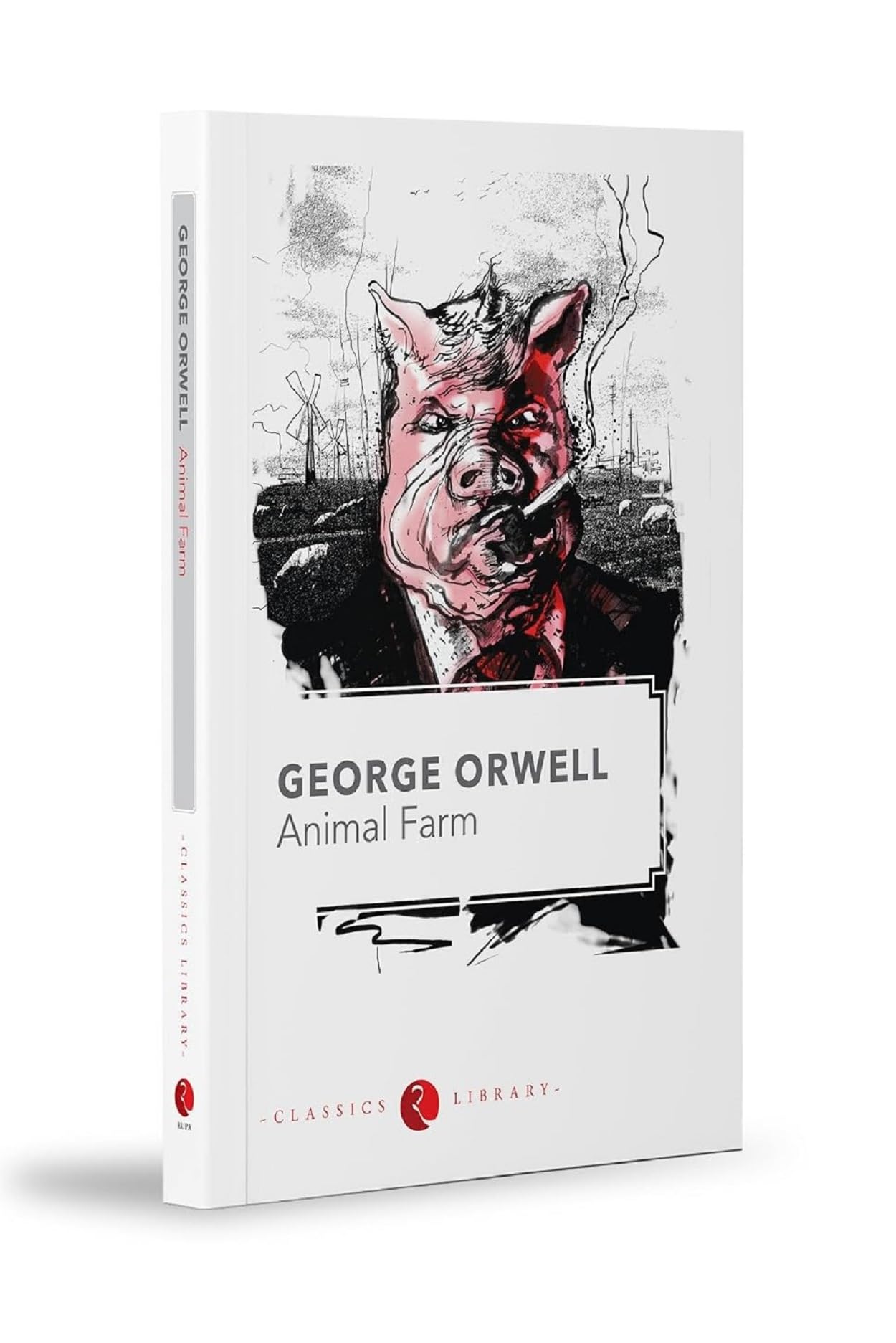
📖 Unlock the revolutionary story that shaped political thought—don’t miss out on the classic everyone’s reading!
Animal Farm by George Orwell is a critically acclaimed satirical novella ranked #13 in Classic Fiction, with over 100,000 readers rating it 4.6 stars. This compact masterpiece uses farm animals to allegorize the rise and corruption of Soviet communism, delivering timeless insights into power, equality, and human nature. Securely packaged and available with free delivery, it’s a must-read for professionals seeking intellectual depth and cultural relevance.


| Best Sellers Rank | #593 in Books ( See Top 100 in Books ) #10 in Classic Fiction (Books) #42 in Contemporary Fiction (Books) |
| Country of Origin | India |
| Customer Reviews | 4.6 4.6 out of 5 stars (104,510) |
| Generic Name | Book |
| ISBN-10 | 812911612X |
| ISBN-13 | 978-8129116123 |
| Importer | Rupa Publications India |
| Item Weight | 100 g |
| Language | English |
| Net Quantity | 1 Piece |
| Packer | Rupa Publications India |
| Print length | 120 pages |
| Publication date | 1 April 2010 |
| Publisher | Rupa |
| Reading age | Customer suggested age: 15 years and up |
A**)
A very good read; political and artistic.
I started reading Animal Farm with a prejudice that I incurred through my academic career as a teacher of English Literature. I mean, the allegory stuff. The matter of solidified criticism in the book is the communist totalitarianism in Europe. However, this view received a serious self-analysis as I reached Chapter-3. I realized that George Orwell has created a marvel of literary art with his animals that ran a farm in England. The animals spoke English too, and like many other instances like hoisting a flag or singing an anthem, it didn't feel odd. The "fairy tale" model has worked immensely for Mr. Orwell. A Fairy Story is the subtitle of Animal Farm,and aptly so. This subtitle not just gives a space for philosophical discussions, but it also renders to the story technical perfection. How efficiently George Orwell represented human realities using animals is the key factor any student of writing might find fascinating and useful in this book. Animal Farm allegorizes many cultural stereotypes and not just political systems. A novella in size, Animal Farmmade George Orwell popular. George Orwell had written books such as Burmese Days (1934), Down and Out in Paris and London (1933), The Road to Wigen Pier (1937) and Coming Up for Air, before Animal Farm. Orwell's life changed, as a writer, with the publication of Animal Farm. Another book that followed asserted his popularity. This book was titled Nineteen Eighty-Four (1949). Animal Farmends with the shattering of hopes and irredeemable desperation. The leaders of the revolution, drained of all the ideological zeal appear to be profit mongering megalomaniacs. They become "too practical", to use a terminology from popular culture. Animal Farmends with an apt scene that exemplifies this. "The creatures from outside looked from pig to man, and from man to pig, and from pig to man again; but already it was impossible to say which was which." This scene narrates a confusion. No confusion, however, can be felt as a reader. It's crystal clear that the leadership of the animals have compromised. They no longer resemble the folk that started it all through the Rebellion. Yes, a rebellion with a capital R. Three philosophical quantum moments mark the body of the Animal Farmwith transcendental wisdom. I am not sure if Orwell had any intention to tell a story that was oriented in higher consciousness and the awareness of the Source. These three philosophical quantum moments help us tune into an unforgettable wavelength of higher consciousness through the story of animals that play human roles. These three quantum moments appear as follows: 1. Rebellion 2. The seven commandments 3. Banquet with humans. The Rebellion with a capital R serves the distinct purpose of establishing the harmony with an awareness that comes to Major through a dream-experience. Remember that this book is nothing else but animals pretending to run a world of humans. Plus, it's an allegory. This means, once we succeed in seeing through the maze of meaning in Animal Farm these concepts and nuggets of awareness can be assimilated into our personal lives too. This, I believe is the great historical value of Animal Farm. One receives the visionary idea about a political system that is going nowhere, but to the doom of its inhabitants, and at the same time can see through the meaning, the essence of human spiritual experience. Animal Farm, in this regard, is a deeply spiritual book. The best example for this experience is the scene of Major giving the lecture to the animals in the barn about an ideal society. The society resembles Thomas Moore's Utopia and Carl Marx's socialist state. However, the spiritual side of the book tells us to look into this scene and see why all those inhabitants find Major's concept of ideal society inviting. A harmony is at play here. The animals of the farm find themselves aligned with Promised Land that until then only existed in Major’s head. In Animal Farm, this Promised Land seems to be within the territory of Manor Farm. Only they have to bring it into life through their active participation. By giving the animals an anthem, Major extols the role of imagining a society where all animals are equal. Major has clearly attained a glance at his higher consciousness. It is from there he receives the dream as well as the anthem song, which he himself affirms to be lost in the chaos of childhood memories. Major represents any individual deriving his or her knowledge from one’s conscience. And conscience, as Dr. Viktor E Frankl points out connects our physical self with higher self. The farm animals feel the resonance with their needs and the dreams shared by Major. The Seven Commandments are written on the wall of the barn where Major first spoke of the dream of a society sustained in equality. This happens after the Rebellion. The Rebellion is a decisive moment that acts like a bridge between a dream and its manifestation into reality. As a result, the excited animals of the farm rename the farm as Animal Farm and assemble under the seven commandments. First commandment reads: “Whatever goes upon two legs is an enemy.” Engraved in the first commandment is the commitment the animals make towards building their new society—destroying humans. At one point, the animals start addressing the way of life they dream for themselves as “animalism”. Battling humans is the central treatise of animalism. Gradually, these set of maxims undergo subtle changes. Although the rest of the farm animals notice the change, they are unable to place their finger on the problem. As the time passes, the seven commandments that served as the semiotic map in preserving the ideal society dreamed by Major, the boar, undergoes manipulation and abandonment. The pigs appear as the ruling class, with Napoleon, a boar as their head. The pinnacle of manipulation appears as the seventh commandment that originally read: “All animals are equal,” is transfigured into “All animals are equal, but some animals are more equal than others.” This scene evidently portrays the death of a realm imagined and attempted by the animals. Animals in this book are not merely animals; they are allegorical figures. This brings the thematic significance of seven commandments and the equality concept closer to human experience. The idea of a grand social order based on justice and equality is pure energy waiting to burst through and manifest into physicality. The manipulation of the seven commandments is the intervention of self-centered thinking and corruption blemishing the original idea. Eventually, the banquet with humans transforms the pigs into human-like, at least in the eyes of the observing animals. This event shuts the doors and puts the seal on the ideal notion of a society where everyone is equal. None of the animals in the farm feel aligned with the new notion that humans are better and that animals should work with them in order to progress. Napoleon announces some staggering changes in the running of the farm as well. Here is the time to unveil the spiritual lesson engraved in George Orwell’s Animal Farm. The pure creative energy that originates from the Source of all Being appears through Major and his dream. However, in its application, the animals fail to access the levels of success they dreamed the project would bring. The result would have been different if the animals had remained truly aligned throughout with the Divine creative energy that creates thoughts and manifests itself through dreams. In other words, instead of letting the Diving creative energy taking control of them, the ruling class of the animal farm takes control of the destiny of the farm animals. Perhaps, the ideal society was just a dream. But one is not sure. Each moment, every one of us covets to take hold of our own ideal worlds. The truth is no one can have it until we let our higher self resonates with the Source energy, call it god, Krishna, or Allah. Only our complete resonance with that energy can let the creation happen with the dreams we had manifested into the physical reality.
R**H
Orwell tells us about how the Soviet regime corrupts socialism with the arrival of Stalin.
Animal Farm is a satirical allegorical novella by George Orwell, first published in England on 17 August 1945. The book tells the story of a group of farm animals who rebel against their human farmer, hoping to create a society where the animals can be equal, free, and happy. "If publishers make an effort not to publish books on acertain subjects, it is not for fear of prosecution, but for fear of public opinion. In this country, intellectual cowardice is the worst enemy a writer or journalist has to face. , and that fact does not seem to have received the opinion it deserves. " - George Orwell A few years ago I read "1984" and was totally fascinated by the originality of the novel written by Orwell. It seemed to me a narrative full of current scenario in a context that does not differ much from what happens in our time. So I decided to continue reading his works and this must be the next one. Animal Farm is a satirical novel. Through an allegory, Orwell tells us about how the Soviet regime corrupts socialism with the arrival of Stalin. Throughout the book we will see how the rebellion evolves and how it gradually ends up becoming a tyrannical dictatorship. The characters are the most successful (based on real), they leave us endearing, eloquent and sometimes even funny moments, all thanks to some exquisite dialogues. It is obvious that this narrative contains a double meaning or a double reading, one of them is about corruption, after the acquisition of power of the pigs they become greedy and totalitarian. What has been most significant to me is the mention of how the pigs (rulers) are changing the commandments of the animals and how they convince them that they were like that from the beginning. Summary of the book: The story goes that Eric Blair, the real name of George Orwell, had a hard time finding a publisher that would dare to publish "Animal Farm." And it was not for less, given that the very particular way in which he satire the Russian Revolution of 1917 and the subsequent rise of communism from which the future Soviet Union would emerge was a challenge that more than one editor did not dare to face. Intelligently, Orwell describes us that through the ideas equipped by a pig nicknamed the Old Commander (Karl Marx), the animals expel the farmer Jones (the Tsar) who controlled his farm normally (Russia) and from the expulsion of the humans in the Battle of the Stable (Bolshevik Revolution) and in which the new system of Animalism (Communism) is established that will lead to the animals now controlling the "Solar Farm", renamed "Animal Farm". In charge of all this rebellion will be the pigs Napoleon (Stalin) and Snowball (Trotsky). They will end up subduing the rest of the lower animals and will control them with an iron hand, they will make them work tirelessly, rationing their food and subjecting them to the hardest and most extreme work. Soon, the difference between Napoleon and Snowball will be evident, as it happened with Trotsky and Stalin. You only have to read a little of how Trotsky ended up after the persecution of Stalin to understand a section of the Farm Rebellion. It is surprising that Orwell has excluded the personification of Lenin in the novel, since he was one of the key elements in the Bolshevik revolution. The animals, victorious and happy, control the farm. Every day the emblematic song Beasts of England (The Internationale) is sung, the seven animal commandments are coined, the speech "Four legs yes, two legs no!" and a green flag (communist red) is raised that identifies all the animals in the center of which they paint a hoof and a horn (the hammer and sickle). The (horror) show is served. The tension will rise, the problems will multiply and what we all know will quickly happen: the pigs, guarded by ferocious dogs that were raised apart by Napoleon to guard his wicked orders, will transform the lives of other animals into a true hell. I am pretty sure that Roger Waters was inspired by this book to compose the songs for the album "Animals," by Pink Floyd and where he divides Humanity into three races: pigs as the leaders who have power, dogs, as an army of fierce guardians and sheep as the submissive enslaved people. In conclusion, Animal Farm is a novel that, like all the classics, transcends time, and does so in a wonderful way. It is contradictory to say, but through a simple group of farm animals, George Orwell represents humanity in all its splendor, with the most tragicomic defects that characterise us. And it certainly makes you think about it. It's amazing what can be developed in a few pages and without pretense of greatness - those are the best writers. read more book reviews @ rajulsingh.in
V**R
Great book
V**G
Great story! Nothing I say in this review can say anything that has not already been said better by so many people before me. Therefore I will just say that this specific clothbound classic edition is of the quality and beauty worthy of this classic story!
A**O
Story line is really fascinating in terms of how Orwell built the whole imaginary world but yet logical and convincing.
A**D
A must read. It will make reader to ponder and reflect.
N**D
Animal Farm by George Orwell is a literary gem that continues to captivate and resonate with readers even decades after its initial publication. This brilliant allegorical novella takes you on a thought-provoking journey into a farm where animals revolt against their human oppressors, only to discover that power corrupts absolutely. Orwell's writing is both accessible and profound, making it a must-read for all ages. The characters, though animals, are brilliantly crafted to represent various facets of human nature and society. As the story unfolds, you'll find yourself drawn into the struggles, triumphs, and ultimately, the tragic consequences of the animals' pursuit of freedom and equality. What truly sets Animal Farm apart is its timeless relevance. Orwell's critique of totalitarianism, propaganda, and the corrupting influence of power is as pertinent today as it was when the book was first published. This book serves as a stark reminder of the dangers of political manipulation and the importance of remaining vigilant in the face of oppressive regimes. In addition to its thought-provoking content, Animal Farm is a quick and engaging read. It's perfect for those who appreciate allegorical storytelling that challenges the status quo. Whether you're a literature enthusiast or someone looking to explore the darker aspects of human nature and politics, Animal Farm deserves a place on your bookshelf. It's a powerful, haunting, and brilliantly crafted work that will leave you pondering its message long after you've turned the final page. Highly recommended!
TrustPilot
2 周前
2天前