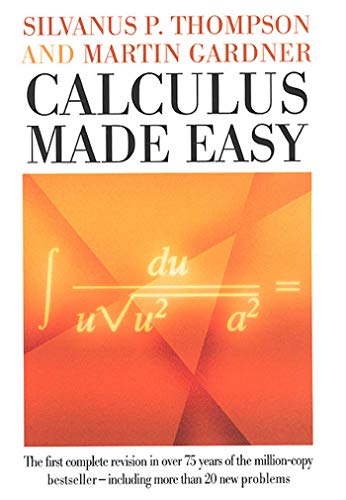


Buy Calculus Made Easy on desertcart.com ✓ FREE SHIPPING on qualified orders Review: The best introduction to calculus - Calculus Made Easy is deeply important to me. I often buy it as a gift, for any young, bright people I am fortunate to know. In school, math had always come easily to me, which is unfortunate -- instead of developing a good attitude toward school, I instead developed inconsistent study habits and a mile-wide lazy streak. By the time I got to calculus in my senior year, my relationship with my math teacher had deteriorated badly. When we got to the section on limits (a core concept in modern calculus), I protested. It did not make sense to me. I became frustrated, and being 17 years old, immature, and unaccustomed to making an effort in school, I quit. I gave up. I went through the motions for the rest of the school year, and learned to hate math class. That one moment altered the course of my life (some for the better, some for the worse). I found Calculus Made Easy several decades later. I took one look at it and knew it was the explanation that I had asked for, all those years earlier. It teaches calculus the way it was originally developed, by Issac Newton and Gottfried Leibniz in the 1600s. I later learned that calculus was revised extensively after it was originally developed, in large part due to a war (both literal and ideological) between Catholics and Protestants during the Reformation and Counter-Reformation. The two religious groups were fighting over territory and followers, including over control of education. The Jesuit (Catholic) education system prohibited the teaching of the Newton-Leibniz method of Calculus, and instead developed a different method (which they contended was more logically rigorous). This fascinating history is recounted in a wonderful book called Infinitesimal, by Amir Alexander. Highly recommended. Calculus Made Easy returns to the Newton-Leibniz way. It is a perfect introduction to the topic. They were the men who invented it, after all! My high school math teacher had been a Catholic nun. She had, naturally, learned math at a Jesuit school, an educational institution that, centuries before either of us were born, had rejected the Newton-Leibniz method of Calculus. In other words, I had difficulty in Calculus class in the late 20th century because of the lingering effects of the Protestant Reformation. This book helped me gain an entirely new perspective on the world, my life, and opened up a host of insights into the world of math, science and history. And the writing is excellent. The book truly does make calculus "easy." It takes all of the fear, frustration and difficulty out of learning calculus, and replaces them with levity, curiosity, and delight. Review: Solid book - This is a solid book meant to teach you the basics of Calculus and hopefully leave you with better understanding than you had before it. It starts out by defining some things that are absolutely critical in understanding in higher mathematics, such as, What is a function?, if you wish to do well in higher mathematics then you must understand the concept of a function quite well. The book is written in somewhat informal language to make you feel more comfortable, which I think is good for everyone, because if you can't explain something simply then either you don't understand it or you have horrible communication skills, either way, you need to improve. Though this book does a great job at teaching calculus in a down-to-earth sort of way, it may be too much for you still if you aren't competent in algebra and basic trigonometry. So I would recommend brushing up on those two things before really hitting this book hard. Whenever you find a concept difficult, look up alternative explanations to see if they help (for example khanacademy videos help many people), you still are having difficulty with something after working through other explanations, then you must analyze yourself in conjunction with the problem to pinpoint exactly what is preventing you from understanding it, then master that point and come back to the original with better understanding. Also sometimes it just takes time for new concepts to sink-in (for your brain to process and organize them in relation to already known things). If you don't know how to read analytically, then you must learn, because that is important to teaching yourself things. One book I would recommend highly concerning reading skills is "How to read a book" by Mortimer A. Adler. It walks you through the various stages of reading. Another tool that you can use to improve your reading skills, which are critical in learning anything including mathematics, is the sq3r or psq5r method. You can google these for a better explanation but they stand for this: sq3r, skim/survey, question, read, recite, review, and psq5r, purpose, survey, question, read-selectively, recite, reduce/record, reflect, review. You can google those for a more complete understanding of them and how to apply them to your reading, but know this, if you want to be able to teach yourself anything, then you must improve your reading skills. Reading for understanding and reading for pleasure or entertainment are completely different task. Forgive my clumsy writing, but I learnt to read later than normal because the school system failed me and I had to teach myself, which is why I know the difference between reading for entertainment and reading for understanding, these types of reading must be approached differently. My writing skills have a long way to go, but I'm more focused on mathematics and general knowledge right now. Oh, I just remembered another book that is really helpful in problem sovling "How to solve it" by George Polya, I highly recommend that book for general problem solving strategies esp. for mathematics. So, if you want to be able to teach yourself things as well as possible then buy these two books: How to read a book How to solve it Find useful resources like Khanacademy and forums concerning your issue and ask questions Think and work through the problem, if you get stuck, then analyze it and isolate the thing that is causing you trouble, research that thing and practice it until you feel confident then come back to the original problem. Questions you can ask yourself when you get stuck are: Do I really understand the problem? Which part of the problem is causing me trouble? Is there a problem from my past that is similar in part or whole that can help me with this one? What do I know about the problem? What is/are the unknown/s Can I break the problem down into a series of simpler problems that I can solve? Those are some general questions you could ask yourself while trying to solve problems, you will learn those type of questions in "How to solve it". As Francis Bacon said "A prudent question is one half of wisdom". Asking questions is very important in the learning process and asking the right questions even more so, it forces you to think deeper and reading more actively. Good luck to all.
| Best Sellers Rank | #22,377 in Books ( See Top 100 in Books ) #1 in Differential Equations (Books) #8 in Calculus (Books) #81 in Study Guides (Books) |
| Customer Reviews | 4.6 4.6 out of 5 stars (807) |
| Dimensions | 5.9 x 1.1 x 8.6 inches |
| Edition | Revised, Updated, Expanded |
| ISBN-10 | 0312185480 |
| ISBN-13 | 978-0312185480 |
| Item Weight | 1.1 pounds |
| Language | English |
| Print length | 336 pages |
| Publication date | October 15, 1998 |
| Publisher | St. Martin's Press |
G**E
The best introduction to calculus
Calculus Made Easy is deeply important to me. I often buy it as a gift, for any young, bright people I am fortunate to know. In school, math had always come easily to me, which is unfortunate -- instead of developing a good attitude toward school, I instead developed inconsistent study habits and a mile-wide lazy streak. By the time I got to calculus in my senior year, my relationship with my math teacher had deteriorated badly. When we got to the section on limits (a core concept in modern calculus), I protested. It did not make sense to me. I became frustrated, and being 17 years old, immature, and unaccustomed to making an effort in school, I quit. I gave up. I went through the motions for the rest of the school year, and learned to hate math class. That one moment altered the course of my life (some for the better, some for the worse). I found Calculus Made Easy several decades later. I took one look at it and knew it was the explanation that I had asked for, all those years earlier. It teaches calculus the way it was originally developed, by Issac Newton and Gottfried Leibniz in the 1600s. I later learned that calculus was revised extensively after it was originally developed, in large part due to a war (both literal and ideological) between Catholics and Protestants during the Reformation and Counter-Reformation. The two religious groups were fighting over territory and followers, including over control of education. The Jesuit (Catholic) education system prohibited the teaching of the Newton-Leibniz method of Calculus, and instead developed a different method (which they contended was more logically rigorous). This fascinating history is recounted in a wonderful book called Infinitesimal, by Amir Alexander. Highly recommended. Calculus Made Easy returns to the Newton-Leibniz way. It is a perfect introduction to the topic. They were the men who invented it, after all! My high school math teacher had been a Catholic nun. She had, naturally, learned math at a Jesuit school, an educational institution that, centuries before either of us were born, had rejected the Newton-Leibniz method of Calculus. In other words, I had difficulty in Calculus class in the late 20th century because of the lingering effects of the Protestant Reformation. This book helped me gain an entirely new perspective on the world, my life, and opened up a host of insights into the world of math, science and history. And the writing is excellent. The book truly does make calculus "easy." It takes all of the fear, frustration and difficulty out of learning calculus, and replaces them with levity, curiosity, and delight.
K**O
Solid book
This is a solid book meant to teach you the basics of Calculus and hopefully leave you with better understanding than you had before it. It starts out by defining some things that are absolutely critical in understanding in higher mathematics, such as, What is a function?, if you wish to do well in higher mathematics then you must understand the concept of a function quite well. The book is written in somewhat informal language to make you feel more comfortable, which I think is good for everyone, because if you can't explain something simply then either you don't understand it or you have horrible communication skills, either way, you need to improve. Though this book does a great job at teaching calculus in a down-to-earth sort of way, it may be too much for you still if you aren't competent in algebra and basic trigonometry. So I would recommend brushing up on those two things before really hitting this book hard. Whenever you find a concept difficult, look up alternative explanations to see if they help (for example khanacademy videos help many people), you still are having difficulty with something after working through other explanations, then you must analyze yourself in conjunction with the problem to pinpoint exactly what is preventing you from understanding it, then master that point and come back to the original with better understanding. Also sometimes it just takes time for new concepts to sink-in (for your brain to process and organize them in relation to already known things). If you don't know how to read analytically, then you must learn, because that is important to teaching yourself things. One book I would recommend highly concerning reading skills is "How to read a book" by Mortimer A. Adler. It walks you through the various stages of reading. Another tool that you can use to improve your reading skills, which are critical in learning anything including mathematics, is the sq3r or psq5r method. You can google these for a better explanation but they stand for this: sq3r, skim/survey, question, read, recite, review, and psq5r, purpose, survey, question, read-selectively, recite, reduce/record, reflect, review. You can google those for a more complete understanding of them and how to apply them to your reading, but know this, if you want to be able to teach yourself anything, then you must improve your reading skills. Reading for understanding and reading for pleasure or entertainment are completely different task. Forgive my clumsy writing, but I learnt to read later than normal because the school system failed me and I had to teach myself, which is why I know the difference between reading for entertainment and reading for understanding, these types of reading must be approached differently. My writing skills have a long way to go, but I'm more focused on mathematics and general knowledge right now. Oh, I just remembered another book that is really helpful in problem sovling "How to solve it" by George Polya, I highly recommend that book for general problem solving strategies esp. for mathematics. So, if you want to be able to teach yourself things as well as possible then buy these two books: How to read a book How to solve it Find useful resources like Khanacademy and forums concerning your issue and ask questions Think and work through the problem, if you get stuck, then analyze it and isolate the thing that is causing you trouble, research that thing and practice it until you feel confident then come back to the original problem. Questions you can ask yourself when you get stuck are: Do I really understand the problem? Which part of the problem is causing me trouble? Is there a problem from my past that is similar in part or whole that can help me with this one? What do I know about the problem? What is/are the unknown/s Can I break the problem down into a series of simpler problems that I can solve? Those are some general questions you could ask yourself while trying to solve problems, you will learn those type of questions in "How to solve it". As Francis Bacon said "A prudent question is one half of wisdom". Asking questions is very important in the learning process and asking the right questions even more so, it forces you to think deeper and reading more actively. Good luck to all.
Z**R
Great as a Supplement
I agree with the other reviewers that this book is easier to understand than your average calculus textbook used in colleges today, and it's much cheaper. You will understand calculus concepts after reading this book (limits, derivatives, etc.). Unfortunately I have to recommend it as a supplement rather than a substitute for those other books because it doesn't have practice problems in it, and to really "get" calculus enough to pass exams you need to do a lot of practice problems. Calculus students can usually understand the new concepts after a time, but what makes it hard is how they throw algebra and trigonometry into those concepts that make them complex and hard to break down into manageable pieces. On exams, instead of doing a derivative of x², it will be a derivative of ½ sin φ² or something messy, and then you have to remember your trig identities and in what order you apply exponents and so forth before you even get to the derivative. This book doesn't really introduce you to things like that, which is both a strength and a weakness. If you need a textbook to go with it, I thought Calculus with Early Transcendentals by Howard Anton, et. al was pretty decent.
D**S
You might think that a book on calculus is going to be a snooze fest. I actually ENJOYED reading this book. How is that possible you ask? Well apart from being very easy to read, it also gives you examples and works through the maths in a nice way. He isn't trying to impress you with the standard Maths books do but actually provides useful information that can be used for the harder stuff later on. It is laying the foundations if you like. I would imagine that this book would work better if you use it alongside another text book. So if you have problems with the Product Rule for example read this book, try the worked examples and then go onto another book and try some more examples. Only through repetition and practice will you nail calculus. Calculus is as hard as the situation in which it is utilised. Calculus can be used to find the maximum area of a rectangle of sides a and b which is rather simple. It can also be used to work out the inner workings of space-time and that IS difficult. You just need to understand that you need to learn to crawl before you can walk and run. This book will give you the confidence to take the next step. I highly recommend this book, plus it is relatively inexpensive but if you can find a second/third hand one then I'd do that.
C**S
This is not another book on Calculus, this is possibly the only book on Calculus you need!!!
A**R
The most simplest explanation of calculas. Must read book. However, I have bought it for Rs. 1500/- from Amazon.
M**A
Extremely clear explanations, lots of examples and exercises.
A**R
product as described, thanks
TrustPilot
3 周前
1 周前