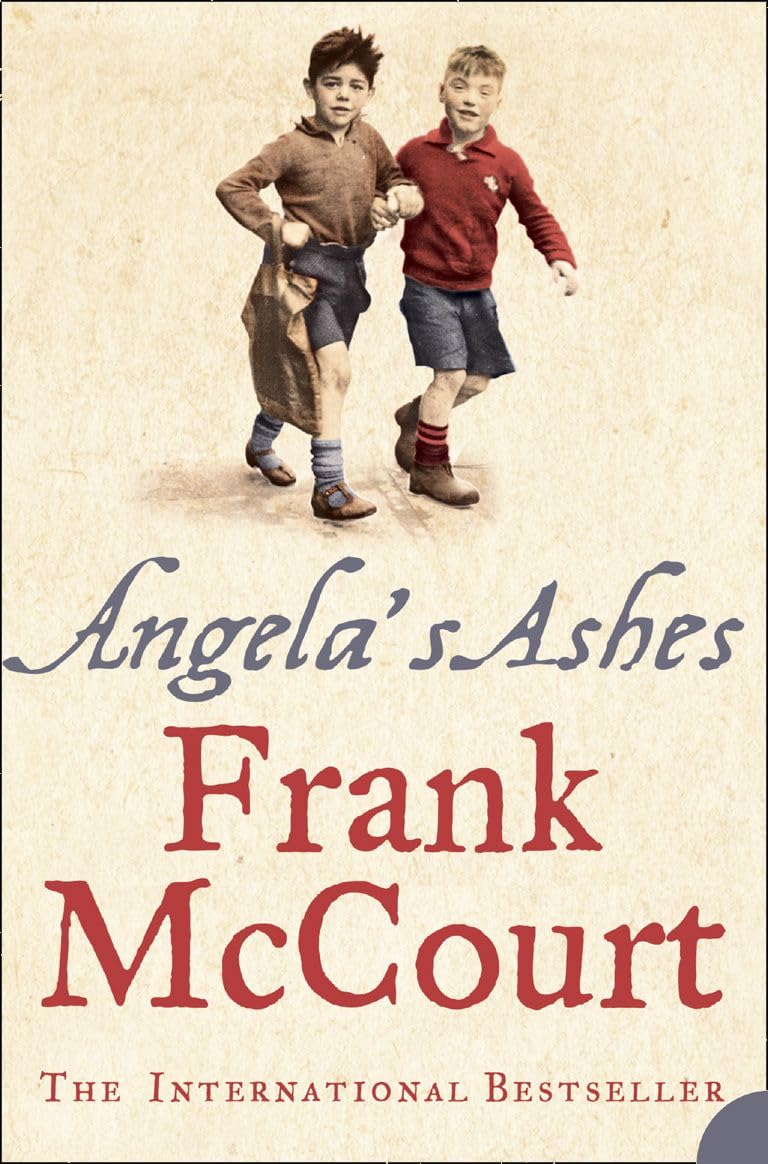
Harper Perennial Angela’s Ashes : McCourt, Frank: desertcart.ae: Books Review: The best book I've read this year. If Neil Simon were to have written a novel it may have well looked like this book. A unique voice and style applying humor in all of the right ways for a reader to absorb the sad tragedy of growing up poor, Irish, and Catholic during the depression years, in America, and Ireland. Frank McCourt is able to overcome the pathos of his poignant, sad, and often disturbing memoir of growing up as the oldest son of a poor Irish Catholic family, through use of voice. In Angela’s Ashes, Frank McCourt presents his memoir though the limited first person view of a young boy. He creates comic relief in using the voice of a small child, as he grows up, first in New York, and then in Limerick, Ireland, during the time of the depression, and its aftermath. McCourt presents a tragic account of his family that would generally overwhelm any reader, unless presented through the eyes of a child, who often does not realize the hardship he has undergone, and whose innocent, limited view allows him (and the reader) to keep going. McCourt pushes the reader through the grief of near starvation, the upbringing by an alcoholic father, misguided mother, loss of younger siblings, and the stigma of growing up, poor, Irish, and Catholic, at a time when all three were considered an affliction, like some disease, rather than circumstance. He manages to hold the reader’s interest, without overwhelming her with pathos, by his character’s youthful voice, through artful dialogue, carefully crafted to allow the reader to see the lighter side of his tragic life. His choice of colloquial terms of endearment unique to the Irish of this era, calling his mother “Mam” instead of mom and using “Och” at the start of dialogue summary of the characters who likely had an Irish accent. In the very first paragraph, the author lets the voice of the narrator, pick up the easy ebb and flow of the Irish manner of speaking, and use of the vernacular of an American Irish immigrant, to recall his humble beginnings. “My father and mother should have stayed in New York where they met and married and where I was born. Instead, they returned to Ireland, when I was four, my brother, Malachy, three, the twins, Oliver and Eugene, barely one, and my sister, Margaret, dead and gone.” (McCourt, 11). The reader can almost picture an Irishman speaking as the story begins. McCort introduces comedy into his narrative voice, an older, more mature, man looking back on his life, when he recalls his father: Malachy McCourt, was born on a farm in Toome, County, Antrim. Like his father before, he grew up wild, in trouble with the English, or the Irish, or both. He fought with the Old IRA and for some desperate act he wound up a fugitive with a price on his head. [] When I was a child I would look at my father, the thinning hair, the collapsing teeth, and wonder why anyone would give money for a head like that. (McCourt, 12) This establishes the comic tone of the story through the voice of the character, recalling through his inner thoughts as a child, later through narrative summary, what he was told by his grandmother when he was thirteen; “as a wee lad, your poor father was dropped on his head. It was an accident, he was never the same after, and you must remember that people dropped on their heads can be a bit peculiar.” (McCourt, 12). This revelation becomes more humorous when the reader reconciles it with the story of how the grandmother’s brother, Patrick “Ab” Sheean, became retarded, after his alcoholic father dropped him on his head, when he was a baby. (McCourt, 13). Living with an alcoholic father, even one that is not necessarily abusive, can be a rather difficult subject matter for any reader to plow through, particularly where his alcoholism leave the family so impoverished that his family is near starvation, while he spends what little money on ale however, McCourt’s use of a limited first person view through a child’s eyes, the reader is given an account that is both tolerable, and sometimes funny. Here the voice of the child character portrays the tragic account of life in an impoverished alcoholic family with both catharsis, and humor. He uses word choices indicative of an Irish child, and through creative use of point of view, and method of speaking like a child, he says: When Dad gets a job Mam is cheerful and she sings, Anyone can see why I wanted your kiss, It had to be and the reason is this Could it be true, that someone like you Could love me, love me? When Dad brings home the first weeks wages, Mam is delighted, she can pay the lovely Italian man in the grocery shop and she can hold her head up again because there’s nothing worse in the world than to owe and be beholding to anyone. She cleans … she buys … and … on Friday night we know the weekend will be wonderful. … Mam will boil the water on the stove and wash us in the great tin tub and Dad will dry us. Malachy will turn around and show his behind. Dad will pretend to be shocked and we’ll all laugh …(but) when Dad’s job goes into the third week he does not bring home the wages… we know Mam won’t sing anymore one can see why I wanted your kiss. She sits at the kitchen table talking to herself… and Dad rolls up the stairs singing Roddy McCorley. [By the fourth week] Dad loses his job…(McCourt, 23-28). When his new baby sister, Margaret, dies, and his mother shuts down and stares at the wall, the use of a child’s voice enables the reader to somehow cope with the description of neglect of the other small children living in a roach infested apartment, with no food, and having to fend for themselves while their alcoholic father is still out at the pub. Later, when Oliver, one of the twins dies of pneumonia, followed by his brother, Eugene, McCourt’s use of his child’s voice, delivering death of his brothers, and baby sister Margaret into that child’s view that is both tolerable, and hopeful, despite the tears it brings to the reader’s eyes. Malachy and I are back in the bed where Eugene died. I hope he’s not cold in that white coffin in the graveyard though I know he’s not there anymore because angels come to the graveyard and open the coffin and he’s far from the Shannon (River) dampness that kills, up in the sky in heaven with Oliver and Margret where they have plenty of fish and chips and toffee and no aunts to bother you, where all the fathers bring home the money from the Labour Exchange and you don’t have to be running around to pubs to find them. (McCourt, 90). By using comic relief, McCourt is able to keep the reader from being too overwhelmed with pathos for the despair that so many tragic events, death, starvation, alcoholism, poverty and the disdain of insensitive people. He delivers the relief in the familiar family situations that bring smiles, along with the tears. Like when the mischievous brothers climb downstairs when their parents are sleeping and try on the false teeth that sit on the shelf by the sink, and Malachy is unable to remove his father’s big teeth from his mouth and has to go to the hospital. Although a near tragic event, McCourt is able to find the humor in the situation, and relay it to the reader in a believable child’s voice, telling the story. McCort’s portrayal of the family living upstairs in a house where they are unable to live downstairs because of the overwhelming odor from the sewage of many other families which is dumped near their front door, although not funny, is made humorous where the inspectors for the Saint Vincent De Paul Society are told by Malachy, still a child, that his family lives in “Italy” a term they have dubbed the upstairs part of the house where they live. (McCourt, 104). Additionally, when the grandmother stops talking to, and supporting the family, the tragic effect of this fact is reduced when the reason is provided in an anecdote where the main character reveals it was because he puked up God in her backyard after he came home from his first communion, (McCourt, 129), and where he had “God stuck to the roof of (his) mouth.” (McCourt, 128). The reader is compelled to laugh at the thoughts of a child, over a potentially touchy situation that interferes with the grandmother’s faith, and causes a serious rift in the family. Even when the main character’s mother lies dying, and he and his brothers are brought to their aunt’s house, McCourt creates a moment of levity to relive the reader of her heavy heart when he hears his fat aunt in the other room tinkling, and he is afraid to tell his brothers because he thinks they will all break out laughing: “at the picture in our heads of Aunt Aggie’s big white bum perched on a flowery little chamber pot.” (McCourt, 242). Later, when he delivers a message to an Englishman, is dragged into the house, forced to drink sherry and ends up puking on the rose bush belonging to the man’s wife, and is later dismissed from his job, where he is saving to go to America, the reader is spared the severe disappointment by the humor in the story, and a voice that keeps comic relief in everything it describes. (McCourt, 328-329). The book ends on a note of hilarity where the main character, on his way to America, is about to have sex, and a priest comes to his door. “The bad women bring out sandwiches and pour more beer and when we finish eating they put on Frank Sinatra records and ask if anyone would like to dance. No one says yes because you’d never get up and dance with bad women in the presence of a priest …” Despite all of his suffering, McCourt is as entertaining as his is hilarious. He has an enviable voice, Angela’s Ashes is a tribute to any mother’s memory. # __________________ McCourt, Frank. Angela’s Ashes. Scribner. New York. 1996. Review: bellissimo, giusto, arrivato subito
| Best Sellers Rank | #122,195 in Books ( See Top 100 in Books ) #26 in Biographies of Educators #86 in Emergency Medicine #143 in Post-Traumatic Stress |
| Customer reviews | 4.6 4.6 out of 5 stars (982) |
| Dimensions | 12.9 x 2.9 x 19.8 cm |
| Edition | New Ed |
| ISBN-10 | 0007205236 |
| ISBN-13 | 978-0007205233 |
| Item weight | 1.05 Kilograms |
| Language | English |
| Print length | 432 pages |
| Publication date | 3 October 2005 |
| Publisher | Harper Perennial |
F**L
The best book I've read this year. If Neil Simon were to have written a novel it may have well looked like this book. A unique voice and style applying humor in all of the right ways for a reader to absorb the sad tragedy of growing up poor, Irish, and Catholic during the depression years, in America, and Ireland. Frank McCourt is able to overcome the pathos of his poignant, sad, and often disturbing memoir of growing up as the oldest son of a poor Irish Catholic family, through use of voice. In Angela’s Ashes, Frank McCourt presents his memoir though the limited first person view of a young boy. He creates comic relief in using the voice of a small child, as he grows up, first in New York, and then in Limerick, Ireland, during the time of the depression, and its aftermath. McCourt presents a tragic account of his family that would generally overwhelm any reader, unless presented through the eyes of a child, who often does not realize the hardship he has undergone, and whose innocent, limited view allows him (and the reader) to keep going. McCourt pushes the reader through the grief of near starvation, the upbringing by an alcoholic father, misguided mother, loss of younger siblings, and the stigma of growing up, poor, Irish, and Catholic, at a time when all three were considered an affliction, like some disease, rather than circumstance. He manages to hold the reader’s interest, without overwhelming her with pathos, by his character’s youthful voice, through artful dialogue, carefully crafted to allow the reader to see the lighter side of his tragic life. His choice of colloquial terms of endearment unique to the Irish of this era, calling his mother “Mam” instead of mom and using “Och” at the start of dialogue summary of the characters who likely had an Irish accent. In the very first paragraph, the author lets the voice of the narrator, pick up the easy ebb and flow of the Irish manner of speaking, and use of the vernacular of an American Irish immigrant, to recall his humble beginnings. “My father and mother should have stayed in New York where they met and married and where I was born. Instead, they returned to Ireland, when I was four, my brother, Malachy, three, the twins, Oliver and Eugene, barely one, and my sister, Margaret, dead and gone.” (McCourt, 11). The reader can almost picture an Irishman speaking as the story begins. McCort introduces comedy into his narrative voice, an older, more mature, man looking back on his life, when he recalls his father: Malachy McCourt, was born on a farm in Toome, County, Antrim. Like his father before, he grew up wild, in trouble with the English, or the Irish, or both. He fought with the Old IRA and for some desperate act he wound up a fugitive with a price on his head. [] When I was a child I would look at my father, the thinning hair, the collapsing teeth, and wonder why anyone would give money for a head like that. (McCourt, 12) This establishes the comic tone of the story through the voice of the character, recalling through his inner thoughts as a child, later through narrative summary, what he was told by his grandmother when he was thirteen; “as a wee lad, your poor father was dropped on his head. It was an accident, he was never the same after, and you must remember that people dropped on their heads can be a bit peculiar.” (McCourt, 12). This revelation becomes more humorous when the reader reconciles it with the story of how the grandmother’s brother, Patrick “Ab” Sheean, became retarded, after his alcoholic father dropped him on his head, when he was a baby. (McCourt, 13). Living with an alcoholic father, even one that is not necessarily abusive, can be a rather difficult subject matter for any reader to plow through, particularly where his alcoholism leave the family so impoverished that his family is near starvation, while he spends what little money on ale however, McCourt’s use of a limited first person view through a child’s eyes, the reader is given an account that is both tolerable, and sometimes funny. Here the voice of the child character portrays the tragic account of life in an impoverished alcoholic family with both catharsis, and humor. He uses word choices indicative of an Irish child, and through creative use of point of view, and method of speaking like a child, he says: When Dad gets a job Mam is cheerful and she sings, Anyone can see why I wanted your kiss, It had to be and the reason is this Could it be true, that someone like you Could love me, love me? When Dad brings home the first weeks wages, Mam is delighted, she can pay the lovely Italian man in the grocery shop and she can hold her head up again because there’s nothing worse in the world than to owe and be beholding to anyone. She cleans … she buys … and … on Friday night we know the weekend will be wonderful. … Mam will boil the water on the stove and wash us in the great tin tub and Dad will dry us. Malachy will turn around and show his behind. Dad will pretend to be shocked and we’ll all laugh …(but) when Dad’s job goes into the third week he does not bring home the wages… we know Mam won’t sing anymore one can see why I wanted your kiss. She sits at the kitchen table talking to herself… and Dad rolls up the stairs singing Roddy McCorley. [By the fourth week] Dad loses his job…(McCourt, 23-28). When his new baby sister, Margaret, dies, and his mother shuts down and stares at the wall, the use of a child’s voice enables the reader to somehow cope with the description of neglect of the other small children living in a roach infested apartment, with no food, and having to fend for themselves while their alcoholic father is still out at the pub. Later, when Oliver, one of the twins dies of pneumonia, followed by his brother, Eugene, McCourt’s use of his child’s voice, delivering death of his brothers, and baby sister Margaret into that child’s view that is both tolerable, and hopeful, despite the tears it brings to the reader’s eyes. Malachy and I are back in the bed where Eugene died. I hope he’s not cold in that white coffin in the graveyard though I know he’s not there anymore because angels come to the graveyard and open the coffin and he’s far from the Shannon (River) dampness that kills, up in the sky in heaven with Oliver and Margret where they have plenty of fish and chips and toffee and no aunts to bother you, where all the fathers bring home the money from the Labour Exchange and you don’t have to be running around to pubs to find them. (McCourt, 90). By using comic relief, McCourt is able to keep the reader from being too overwhelmed with pathos for the despair that so many tragic events, death, starvation, alcoholism, poverty and the disdain of insensitive people. He delivers the relief in the familiar family situations that bring smiles, along with the tears. Like when the mischievous brothers climb downstairs when their parents are sleeping and try on the false teeth that sit on the shelf by the sink, and Malachy is unable to remove his father’s big teeth from his mouth and has to go to the hospital. Although a near tragic event, McCourt is able to find the humor in the situation, and relay it to the reader in a believable child’s voice, telling the story. McCort’s portrayal of the family living upstairs in a house where they are unable to live downstairs because of the overwhelming odor from the sewage of many other families which is dumped near their front door, although not funny, is made humorous where the inspectors for the Saint Vincent De Paul Society are told by Malachy, still a child, that his family lives in “Italy” a term they have dubbed the upstairs part of the house where they live. (McCourt, 104). Additionally, when the grandmother stops talking to, and supporting the family, the tragic effect of this fact is reduced when the reason is provided in an anecdote where the main character reveals it was because he puked up God in her backyard after he came home from his first communion, (McCourt, 129), and where he had “God stuck to the roof of (his) mouth.” (McCourt, 128). The reader is compelled to laugh at the thoughts of a child, over a potentially touchy situation that interferes with the grandmother’s faith, and causes a serious rift in the family. Even when the main character’s mother lies dying, and he and his brothers are brought to their aunt’s house, McCourt creates a moment of levity to relive the reader of her heavy heart when he hears his fat aunt in the other room tinkling, and he is afraid to tell his brothers because he thinks they will all break out laughing: “at the picture in our heads of Aunt Aggie’s big white bum perched on a flowery little chamber pot.” (McCourt, 242). Later, when he delivers a message to an Englishman, is dragged into the house, forced to drink sherry and ends up puking on the rose bush belonging to the man’s wife, and is later dismissed from his job, where he is saving to go to America, the reader is spared the severe disappointment by the humor in the story, and a voice that keeps comic relief in everything it describes. (McCourt, 328-329). The book ends on a note of hilarity where the main character, on his way to America, is about to have sex, and a priest comes to his door. “The bad women bring out sandwiches and pour more beer and when we finish eating they put on Frank Sinatra records and ask if anyone would like to dance. No one says yes because you’d never get up and dance with bad women in the presence of a priest …” Despite all of his suffering, McCourt is as entertaining as his is hilarious. He has an enviable voice, Angela’s Ashes is a tribute to any mother’s memory. # __________________ McCourt, Frank. Angela’s Ashes. Scribner. New York. 1996.
M**O
bellissimo, giusto, arrivato subito
S**S
I first heard about “Angela’s Ashes” from The New York Times’ best 50 memoirs. Though there were 50, I narrowed it down to 6. Angela’s Ashes is one of them. I’m glad I picked it. Also, I didn’t know that it has won the Pulitzer Prize, so there was an extra layer of welcome to read the book. The book is kind of slow to start with even though the narrative is fast. It starts with a brief history of the family. After that it is poverty all the way through and how he and his family scrape through. Despite the never-ending poverty, what makes it readable in the richness in writing. The book is very engaging and only half way through the book, I decided that I need to read his sequel, “’Tis”. Also, the sequel’s sequel “The Teacher Man”. The only other time I ever wanted a sequel was to “The Girl with the Dragon Tattoo” movie. At a chapter, when he is 13 going on 14 and he and his family is living in another person’s house, there are some really humiliating and embarrassing scenes which I bet will leave you teary eyed. But also, the writer doesn’t write it seriously. It’s not used as a crescendo moment. It’s the first time where I really discovered the Tragicomic aspect in a book. Its magical to say the least. You feel sad but at the same time appreciate the writing, which kind of makes you even. I like the way the book ended. The chapters in the book simply start with Roman numerals and doesn’t contain any heading. The last chapter of the book is simply “’Tis” which is the sequel. It’s a nice bit of touch. The only other time I ever appreciated the naming of the chapters in a book is “Open”, the first chapter is “The End” and the last chapter is “The Beginning”. Strange, but you will understand when you read that book. The best thing about a memoir is that you become emotionally invested in the lead character. There is so much of emotions to relate and it can really be a trip down the memory lane, no matter how weak your memory is. Also, reading about the hard times, you will get to appreciate your life even more.
T**E
Fabulous memoir
A**R
A classic. It's difficult to blend misery and humor without it turning into caricature. Frank's portrayal of Ireland is rich, sensitive, brilliantly written. A page turner due to the empathy one has for Frank throughout, and the hope that he will survive.
TrustPilot
1 个月前
1 个月前