We remain fully operational. Our teams are working around the clock to ensure your deliveries continue safely.

下载应用程序


🔊 Measure with confidence, monitor with style.
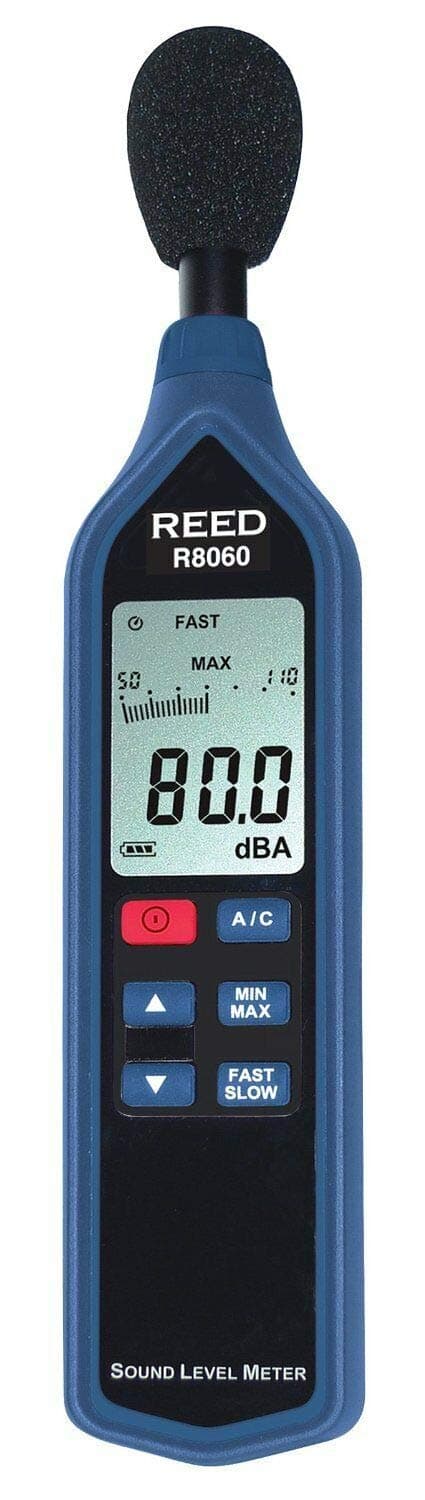
The R8060 is a professional-grade sound level meter designed to meet IEC Type 2 standards with ±1.4 dB accuracy. It features a triple range measurement system covering a 60dB dynamic range, supports both A & C frequency weighting, and offers fast/slow time weighting options. Equipped with a large LCD, digital analog bargraph, Min/Max data hold, and tripod mount, it’s ideal for precise, long-term sound monitoring in professional environments.


| Customer Reviews | 3.9 out of 5 stars 77 Reviews |
J**T
Does exactly what it's designed to do.
I'm very pleased with my Reed R8060 Sound Meter. It does exactly what it is designed to do, accurately measure sound levels. If you want to be very accurate you need to buy the Reed R8090 Sound Level Calibrator. My R8060 meter came within specs but I was able to improve its accuracy with the R8090. If you want to be super accurate industry best practice is to calibrate every time you are going to use the sound meter then check the calibration again after taking measurements.
A**E
Basic Sound Level Meter
Price OK for a very basic Class 2 meter. Companion calibration tool way too expensive. You can get another brand for half the price elsewhere. Bar graph is worthless. In general, it yields slightly higher, but relatively comparable, dB(A) levels to a cheapo meter that we had, but wasn't "Class 2." If County accepts the data from the Reed meter and enforces the local noise ordinance, it will be well worth the price. In that event, I'll increase rating to 5.
R**R
Nice features, battery door problems, may be overpriced
Others have noted receiving used meters. Mine didn't have the battery installed when it arrived, which is a good sign. It still had the protective plastic on the display, but that plastic was massively scuffed up and looked like it had literal fingernail marks on it where someone maybe was trying to get it off and failed. I was on the verge of returning it. But when I did get the protective plastic off, the display looked okay, so I decided to forego the hassle of returning. Next problem is the battery. It's kind of lame that it uses a 9V battery at all, because they are kind of rarer these days, and the clip is a failure point. But the main issue here is that a standard 9V battery doesn't fit in the case. The one they supplied with the unit doesn't fit, and I checked a Duracell battery and found it to be larger than theirs, so it would be worse. There were 3 orientations of the battery in the compartment that might work, and the cover doesn't go on properly with any of them. I finally got it to stay on, but I'm thinking there's a good chance the plastic clip is going to fail, because it's bulging out and loose, and if you bump it too hard it pops off. I had a calibrator already (which you can get for a fairly low price actually, so don't get cheated by an expensive bundle). The meter I received was reading almost 1 dB too high per the calibrator, but it had enough calibration range to correct that. I can only hope it's relatively accurate enough so that the readings will be reliable after calibrating. I use a sound-level meter for listening to music on a high-end stereo system. I like to set it so I'm listening at a level that isn't going to hurt my ears long term but still sounds big. With a large, clean-sounding speaker system in a treated room, it can be hard to gauge this without a meter. So I like to leave the meter on while listening and keep an eye on it. With my other meter, an ExTech, its problem is it autoranges, and every time it hits the range edge at 80 dBA, it gives one bogus high reading when it ranges up. If I have it on max hold, that bogus reading will hold, and then it's useless. I like that this meter has settable ranges, and there is a range that maxes at 90, which is higher than I normally want to listen. So I can leave it on that range and hopefully not get glitchy readings. The bargraph will be useful for me. It looks like each larger dot represents 10 dB, so there's not a lot of accuracy there, but it's very good for watching the level trends, and I can easily spot when it starts to climb to well over the levels I want to aim for and stay there too long. Shorter peaks at higher levels are okay, so being able to see the movement of a bargraph is very helpful. All in all, this meter seems overly expensive for how cheap the battery case is, and given the problems others seem to have had with it failing or not being able to be calibrated, and it does seem they are probably selling a lot of returns as if they are new, but it has some nice features that my ExTech doesn't have, and I'm hoping it will be useful. If I didn't already have it, I'd probably look for a different brand.
R**N
A well made instrument
I've learned a lot about sound by using this meter. Speakers are always measured by their volume at one meter with one watt of input. That's commonly between 85 and 90 dB, but I was surprised to measure how dramatically that volume decreases by the time I get to my sofa. I particularly like its ability to lock on either the minimum or maximum volume when I'm monitoring traffic and trying to decrease the noise that makes it into our house.
A**.
Helping employees protect their hearing
The R8060 sound level meter is very easy to use and very accurate. I use it to measure the sound level in a sheet metal manufacturing shop and has help me very much on knowing what areas are louder than others and implement ear plug use for the safety of all employees. I highly recommend this product for any type of environment.
B**N
Does not seem worth the price.
Maybe there is more that goes into this than meets the eye but it does not seem like it is worth $180. Teh battery compartment door is hanging on to dear life. Product arrived with a scuffed up screen indicating it has prob been used before. With the mass production capabilities that exist these days, including the pcb printing and assembly....I just don't see how this is worth what they are selling it for.
J**K
Failed after just 2 years
I'm surprised to find that this meter read 10+dB low suddenly after just 2 years. It was rarely used and has been stored carefully. In an attempt to recalibrate it (since the meter itself still looks brand new) I bought a calibrator and followed the instructions. Unfortunately it won't calibrate as the max adjustment is only 3dB and this meter is more than 10dB off! Very disappointed!
S**Y
Probably precise, but too expensive
In a hurry, I compared 3 meters. A not comprehensive table of the results is as following: Tadeto SL720 Reed R8060 TopTes TS-501B ---------------------------------------------- max dB-A 68.1 68.1 68.8 71.7 69.3 70.0 72.9 71.6 71.2 79.0 75.9 77.8 80.1 80.3 77.7 116.1 96.9 102.7 max dB-C 78.0 76.7 75.8 82.7 78.8 78.8 86.5 85.4 84.9 When the noise is within 60-90 dB, the 3 meters produce about the same results, when outside of that range, I have doubts that the meters are precise. Reed feels to be closer to reality out of three, but price wise it's 6x more. Somehow I liked TopTes the most, probably because it's not too far from Reed, but the interface is much better. On the downside, when it's quiet, TopTes shows 35 dB, when in reality it's probably 10 dB or so.