We remain fully operational. Our teams are working around the clock to ensure your deliveries continue safely.

下载应用程序


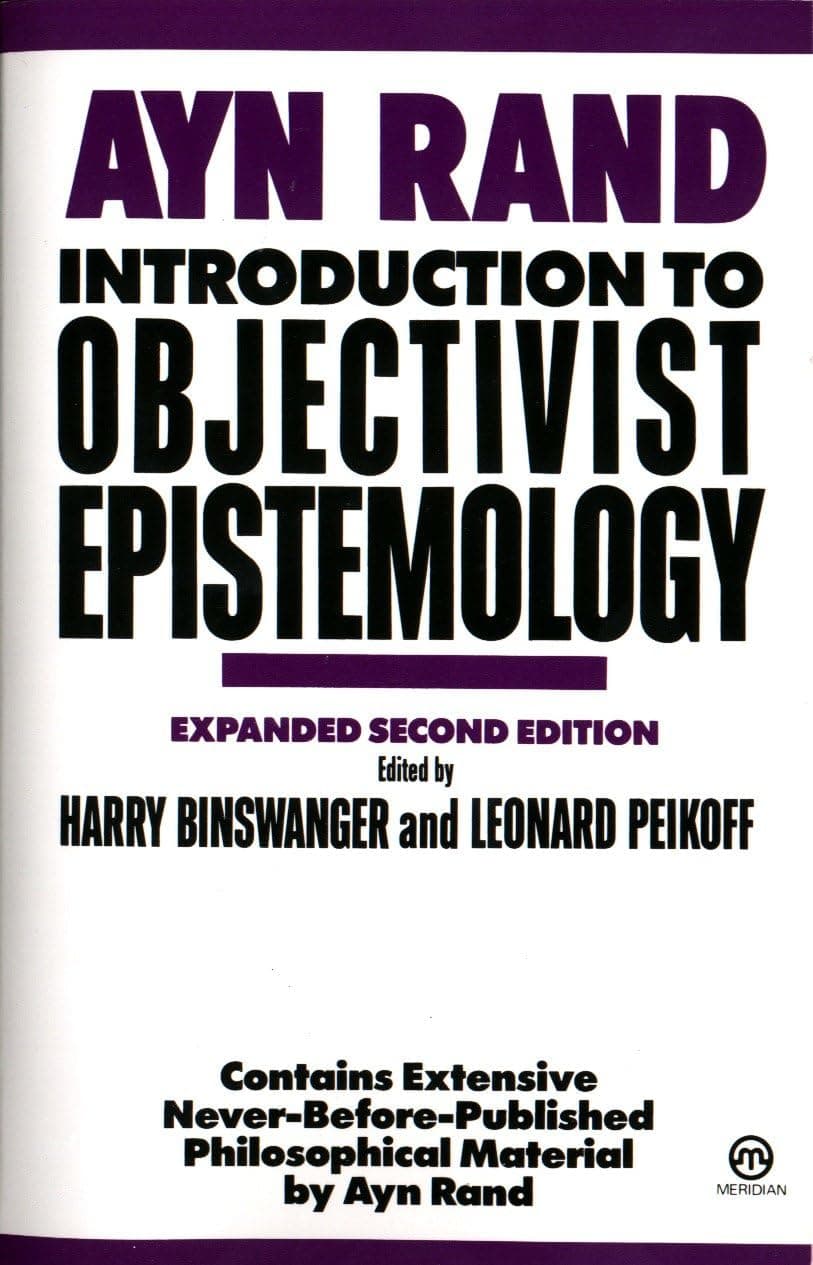
Introduction to Objectivist Epistemology: Expanded Second Edition [Rand, Ayn, Binswanger, Harry, Peikoff, Leonard] on desertcart.com. *FREE* shipping on qualifying offers. Introduction to Objectivist Epistemology: Expanded Second Edition Review: Absolutely Exceptional - Thought may be merely philosophical or it may be true philosophy, in a rigorous and disciplined sense. Anyone who has read Ayn Rand’s masterpieces, “Atlas Shrugged” and “The Fountainhead,” is inclined to think it is the latter of these; but it is in this work, “Introduction to Objectivist Epistemology” in which one sees, in classic philosophic expositional form, the thoroughgoing rigor of her thought. Rand’s clarity in prose and precise, simple, yet elegant style make for a relatively easily digested set of ideas. I say “relatively” because the subject matter is by no means extraordinarily easy to handle to the typical reader of Rand’s novels –and this is perhaps why Rand has been so influential, having been capable of canalizing her ideas into the genre of fiction. However, for those with any kind of exposure to proper philosophy will find the ideas presented amazingly clear and straightforward. The average reader, in the end, with some reasonable amount of effort, should be able to get a handle of this works central and most prominent parcels of ideas. The appendix of discursive intercourse should further assimilation of Rands points presented in the main body of the text. The value in doing this, so far as the layperson is concerned, is that this work provides the groundwork for the entire Objectivist philosophy, and it provides immediate insight into Rand’s position on each of the major branches of philosophy. In short, her idea is that language and existence has been artificially separated by philosophers, as she employs with appropriate snarkiness phrases like “floating terms.” Peikoff’s supplement is amazingly well chosen and, in my opinion, a necessary addition to Rand’s work. For the philosophically trained pupil and expert, I find it inconceivable that this text could be presented without it. The article that Peikoff supplies is on the analytic-synthetic divide, and he employs Rand’s theory to show why exactly this is an erroneously contrived dichotomy. Without going into any detail, the Rand text and Peikoff supplement provides a response to a long tradition of post-Kantians and “mini-Kantians” (e.g., pragmatists and logical positivists); and this, in itself, should make the work interesting enough for students of philosophy and philosophers to have a peek, if not study it thoroughly. The text, as a whole, is so rich and thought provoking, and so compelling, that I feel it is among the more important works in epistemology ever written. A final word about the status of this book as an “introduction,” since I have read complaints in reviews elsewhere. This book is not an introduction, in the sense of remediality and oversimplification; that is, it is not a reworking of a set of ideas so as to make them more readily available. It is an introduction in the sense that Rand realized that her system of epistemology is incomplete, requiring a resolution to the problem of induction, etc. Attempts toward this end can be found in Peikoff’s lectures, “Induction in Philosophy and Physics,” Peikoff’s book, “DIM Hypothesis,” and David Harriman’s “The Logical Leap: Induction in Physics.” In other words, Rand was fully aware that her epistemological framework described well concept formation, but similarly acknowledged that this didn’t explain how universal generalization is possible from particulars, as it is done in the physical sciences. It is in this regard, awaiting a fuller and complete epistemology, that Rand entitled the work an “introduction.” Review: Brilliant - A critical reviewer writes: "Either universals exist outside the mind or they do not. If they exist outside the mind, there remains the question of where and how they exist, despite the changing nature of all particulars we experience, and how they get into the mind, since we experience only transitory particulars. If they exist only inside the mind, we have to confront the problem that knowledge is disconnected from reality." This is an excellent summary of the historical dichotomy Ayn Rand sets out to overturn in Introduction to Objectivist Epistemology. Philosophers have long assumed that if there are no universals "out there" in external reality, in some sense existing independently of human cognition, then our abstractions or concepts represent some kind of fiction, and our conceptual knowledge is fundamentally cut off from reality ("I have seen many men, but I have never seen man."). In ITOE, Ayn Rand rejects this assumption and proceeds to offer the alternative no other philosopher had been able to conceive. No, there are no such things as universals, she answers; there are only particulars. But that does not mean our concepts are in any way a distortion of what exists. Concepts are our FORM of grasping reality. We group concretes together into abstract concepts, but we do not do so arbitrarily, nor does doing so prevent us from knowing that in reality all that exists are particulars, and that when we think, we are merely using concepts to think about particulars. Why are our conceptualizations not arbitrary? Because they reflect the factual, mathematical relationships among concretes. We group together concretes that are similar, and similarity is a quantitative relationship. Initially, this relationship is given in perception (recognizing it does not, as some reviewers have claimed, require any already held concepts): two concretes are perceived as similar when they differ significantly less from each other along some axis of measurement (e.g., shape) than they do from some third thing. For example, one does not need to possess the concepts 'chair,' 'table,' or 'shape' to perceive that the shapes of two chairs are similar in comparison to that of the table they're next to. Infants can perceive that, and so can animals (which accounts for the associations they're are able to form). In this way, Rand solves the difficult problem of how human beings are able to rise from the perceptual level of awareness to the conceptual. From there she moves on to higher-level "abstractions from abstractions," and explains that as we move up the conceptual chain (that is, further and further from the perceptual level) the possibility of error increases. That's right, Rand holds that one's concepts and definitions can be WRONG. A major reason for the need of a theory of concepts is that we need guidance in forming our concepts. To this end, Rand offers several conceptual and definitional rules. The reader comes to see what she meant in saying that concepts are OBJECTIVE. Her writings on this topic do not, as various reviewers have claimed, encroach on what ought to be the province of child psychology. Her discussions of the concept-forming processes of infants and young children are based on an understanding of (1) the mental processes that are implied by the learning of language and (2) the logically necessary order of learning concepts. (1) A scientist can observe how children behave when they're learning to speak, but only through "arm chair," philosophical reasoning can a thinker come to grasp what it is that is going on when a child reaches the ability to identify the tree in the front yard, the tree in the backyard, and the Christmas tree in the living room as all "trees." What is it about those three objects that enables one to call each a "tree," and what implicit mental processes must therefore be occuring? There is a reason no cognitive psychologist has ever solved the problem of universals. (2) Rand is able to infer a lot about how children form concepts from her understanding that concepts must be learned in a specific, logical order (which is not to say there are not options within the logical restrictions). It is logically impossible, for example, to grasp the concept "living organism" before one has grasped such concepts as "animal" and "plant." It is logically impossible to grasp the concept "orphan" before one has grasped the concept "parent." That does not mean a child can't parrot those words in the opposite order, but if he did his meaning in using the word (if any) would not be the same as ours. He would have the word but not the concept. ITOE is a rich philosophical tour de force, containing the solution to the problem of universals.
| Best Sellers Rank | #365,943 in Books ( See Top 100 in Books ) #63 in Epistemology Philosophy #185 in Modern Western Philosophy #871 in Classic American Literature |
| Customer Reviews | 4.7 4.7 out of 5 stars (293) |
| Dimensions | 5.47 x 0.83 x 8.19 inches |
| Edition | 2nd Expanded ed. |
| ISBN-10 | 0452010306 |
| ISBN-13 | 978-0452010307 |
| Item Weight | 10.4 ounces |
| Language | English |
| Print length | 320 pages |
| Publication date | April 26, 1990 |
| Publisher | Penguin Publishing Group |
D**N
Absolutely Exceptional
Thought may be merely philosophical or it may be true philosophy, in a rigorous and disciplined sense. Anyone who has read Ayn Rand’s masterpieces, “Atlas Shrugged” and “The Fountainhead,” is inclined to think it is the latter of these; but it is in this work, “Introduction to Objectivist Epistemology” in which one sees, in classic philosophic expositional form, the thoroughgoing rigor of her thought. Rand’s clarity in prose and precise, simple, yet elegant style make for a relatively easily digested set of ideas. I say “relatively” because the subject matter is by no means extraordinarily easy to handle to the typical reader of Rand’s novels –and this is perhaps why Rand has been so influential, having been capable of canalizing her ideas into the genre of fiction. However, for those with any kind of exposure to proper philosophy will find the ideas presented amazingly clear and straightforward. The average reader, in the end, with some reasonable amount of effort, should be able to get a handle of this works central and most prominent parcels of ideas. The appendix of discursive intercourse should further assimilation of Rands points presented in the main body of the text. The value in doing this, so far as the layperson is concerned, is that this work provides the groundwork for the entire Objectivist philosophy, and it provides immediate insight into Rand’s position on each of the major branches of philosophy. In short, her idea is that language and existence has been artificially separated by philosophers, as she employs with appropriate snarkiness phrases like “floating terms.” Peikoff’s supplement is amazingly well chosen and, in my opinion, a necessary addition to Rand’s work. For the philosophically trained pupil and expert, I find it inconceivable that this text could be presented without it. The article that Peikoff supplies is on the analytic-synthetic divide, and he employs Rand’s theory to show why exactly this is an erroneously contrived dichotomy. Without going into any detail, the Rand text and Peikoff supplement provides a response to a long tradition of post-Kantians and “mini-Kantians” (e.g., pragmatists and logical positivists); and this, in itself, should make the work interesting enough for students of philosophy and philosophers to have a peek, if not study it thoroughly. The text, as a whole, is so rich and thought provoking, and so compelling, that I feel it is among the more important works in epistemology ever written. A final word about the status of this book as an “introduction,” since I have read complaints in reviews elsewhere. This book is not an introduction, in the sense of remediality and oversimplification; that is, it is not a reworking of a set of ideas so as to make them more readily available. It is an introduction in the sense that Rand realized that her system of epistemology is incomplete, requiring a resolution to the problem of induction, etc. Attempts toward this end can be found in Peikoff’s lectures, “Induction in Philosophy and Physics,” Peikoff’s book, “DIM Hypothesis,” and David Harriman’s “The Logical Leap: Induction in Physics.” In other words, Rand was fully aware that her epistemological framework described well concept formation, but similarly acknowledged that this didn’t explain how universal generalization is possible from particulars, as it is done in the physical sciences. It is in this regard, awaiting a fuller and complete epistemology, that Rand entitled the work an “introduction.”
S**T
Brilliant
A critical reviewer writes: "Either universals exist outside the mind or they do not. If they exist outside the mind, there remains the question of where and how they exist, despite the changing nature of all particulars we experience, and how they get into the mind, since we experience only transitory particulars. If they exist only inside the mind, we have to confront the problem that knowledge is disconnected from reality." This is an excellent summary of the historical dichotomy Ayn Rand sets out to overturn in Introduction to Objectivist Epistemology. Philosophers have long assumed that if there are no universals "out there" in external reality, in some sense existing independently of human cognition, then our abstractions or concepts represent some kind of fiction, and our conceptual knowledge is fundamentally cut off from reality ("I have seen many men, but I have never seen man."). In ITOE, Ayn Rand rejects this assumption and proceeds to offer the alternative no other philosopher had been able to conceive. No, there are no such things as universals, she answers; there are only particulars. But that does not mean our concepts are in any way a distortion of what exists. Concepts are our FORM of grasping reality. We group concretes together into abstract concepts, but we do not do so arbitrarily, nor does doing so prevent us from knowing that in reality all that exists are particulars, and that when we think, we are merely using concepts to think about particulars. Why are our conceptualizations not arbitrary? Because they reflect the factual, mathematical relationships among concretes. We group together concretes that are similar, and similarity is a quantitative relationship. Initially, this relationship is given in perception (recognizing it does not, as some reviewers have claimed, require any already held concepts): two concretes are perceived as similar when they differ significantly less from each other along some axis of measurement (e.g., shape) than they do from some third thing. For example, one does not need to possess the concepts 'chair,' 'table,' or 'shape' to perceive that the shapes of two chairs are similar in comparison to that of the table they're next to. Infants can perceive that, and so can animals (which accounts for the associations they're are able to form). In this way, Rand solves the difficult problem of how human beings are able to rise from the perceptual level of awareness to the conceptual. From there she moves on to higher-level "abstractions from abstractions," and explains that as we move up the conceptual chain (that is, further and further from the perceptual level) the possibility of error increases. That's right, Rand holds that one's concepts and definitions can be WRONG. A major reason for the need of a theory of concepts is that we need guidance in forming our concepts. To this end, Rand offers several conceptual and definitional rules. The reader comes to see what she meant in saying that concepts are OBJECTIVE. Her writings on this topic do not, as various reviewers have claimed, encroach on what ought to be the province of child psychology. Her discussions of the concept-forming processes of infants and young children are based on an understanding of (1) the mental processes that are implied by the learning of language and (2) the logically necessary order of learning concepts. (1) A scientist can observe how children behave when they're learning to speak, but only through "arm chair," philosophical reasoning can a thinker come to grasp what it is that is going on when a child reaches the ability to identify the tree in the front yard, the tree in the backyard, and the Christmas tree in the living room as all "trees." What is it about those three objects that enables one to call each a "tree," and what implicit mental processes must therefore be occuring? There is a reason no cognitive psychologist has ever solved the problem of universals. (2) Rand is able to infer a lot about how children form concepts from her understanding that concepts must be learned in a specific, logical order (which is not to say there are not options within the logical restrictions). It is logically impossible, for example, to grasp the concept "living organism" before one has grasped such concepts as "animal" and "plant." It is logically impossible to grasp the concept "orphan" before one has grasped the concept "parent." That does not mean a child can't parrot those words in the opposite order, but if he did his meaning in using the word (if any) would not be the same as ours. He would have the word but not the concept. ITOE is a rich philosophical tour de force, containing the solution to the problem of universals.
M**D
exceeded expectations
Great book!
R**S
Just what I ordered and in good shape and on time.
D**A
Your first steps in deciphering the philosophy of Ayn Rand, Objectivism. Dive in and you won't regret it! Enjoy the ride!
A**R
Starmer would do well to read this.
V**V
Good book but difficult to understand the language
R**I
I am a big fan of Ayn Rand novel and some other book (the romantic manifesto or Philosophy who need it for example). But this book is about BS philosophy not real one. If you like book talking about what is a measure ? What is a definition ? What is a concept ? You will definitely love this book. But if you like real subject instead (like politics, economics, arts, etc) you will hate this book
TrustPilot
1天前
1 个月前