We remain fully operational. Our teams are working around the clock to ensure your deliveries continue safely.

下载应用程序



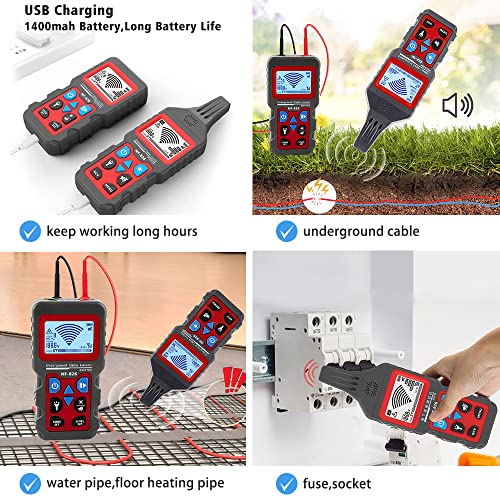


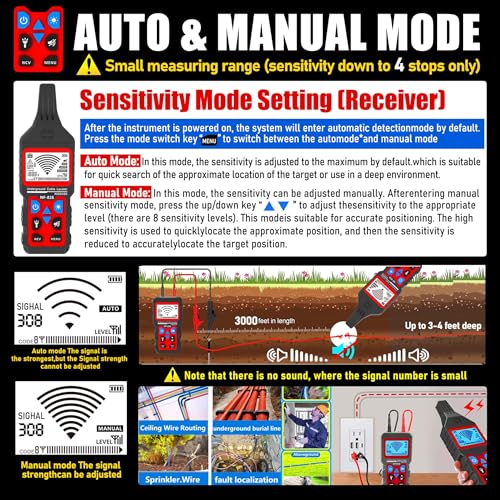


⚡ Never lose a wire in the dark again — track, detect, and conquer!
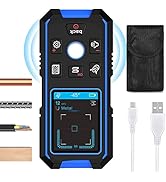
The NOYAFA NF-826 is a professional-grade underground cable locator and wire fault detector featuring advanced digital circuitry, adjustable sensitivity, and a built-in flashlight. It accurately detects breaks, shorts, and voltage in cables buried up to 4 feet deep, making it an essential tool for electricians, maintenance pros, and DIY enthusiasts aiming for precision and reliability in cable and pipeline diagnostics.




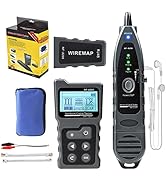


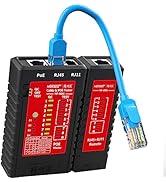


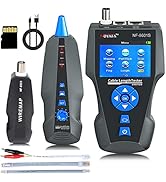
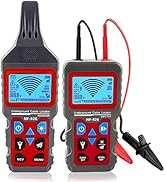


| ASIN | B0BK4BQNLQ |
| Batteries Required? | No |
| Batteries included? | No |
| Customer Reviews | 4.4 4.4 out of 5 stars (112) |
| Date First Available | 23 Dec. 2022 |
| Included components | Underground Cable Tester |
| Item Package Quantity | 1 |
| Item Weight | 454 g |
| Item model number | NF-826 |
| Manufacturer | NOYAFA |
| Measurement Accuracy | 0.001mm |
| Package Dimensions | 26.29 x 19.1 x 6.4 cm; 453.59 g |
| Part number | nf-826 |
| Power source type | Battery Powered |
| Style | Classic |
T**D
Awesome equipment for the money. Works as well as some much more expensive gear.
D**Y
Works excellent. Very sensitive. Make sure you set receiver to manual and keep on lowest bars possible and turn up sensitivity only as needed. By doing this you will know where the wire is within 1-3 inches. If you have on high sensitivity the signal is to distributed and you will think it’s broken. We are in clay soil and the wire is 4ft down. It’s 8 awg soow wire. Wire has been there 10 years. Worth the money.
K**N
This is awsome!
G**T
This product is fully capable of finding buried electrical wires buried 3 feet down. Probably even further. There is a bit of a learning curve in understanding how to use it. I was thrilled that it allows the user to recharge the batteries. The radio signal the transmitter sends works quite well. I was able to follow an underground buried wire one thousand feet away from the transmitter with relative ease. Will enjoy many years of using this product to solve any time I require tracing unknown locations of wires or other related issues. I definitely would recommend all to purchase and add to their tool box.
U**I
True and nothing more so if you're considering this, read the WHOLE review! I needed to label a mess of an electrical panel and sub panel that someone added to many times... to be most polite, they should never touch electrical again! Not even in their own house. Especially in their own house. (Ever see two triple-taps of 12 under a DP70A running to an outdoor breaker panel to underground 30A to a garage..?) Being the most, errr, "complicated" house I ever mapped, I finally bought a Klein ET450. I'd say it's pro, cheaper than an Ideal at around four times the price... but still about $250. I did the job, and it was still a nightmare; the Klein is accurate, mostly, when transmitting on a powered line AND grounded AND reading at the panel. Easy enough for receptacles. But, this is annoying when trying to locate a lighting circuit; who wants to run around the house unscrewing bulbs to hook up a transmitter adapter. And the signal seems to evaporate if not grounded. I thought I could use it to transmit at the panel into the line, even dead, then run around the house tracing the signal to the receptacles, switches etc that it fed. I understood that I could literally trace, say, NM cable through the walls! But no matter how I tried, I got sketchy results at best. (I'm assuming that the Ideal would do it at $1200..?) Enter the NOYAFA NF-826. I thought I'd try so I ordered it anyway. Yes "cheap chinese crap etc". In my opinion it blew away the Klein! I saw many reviews stating that it doesn't work, the instructions are stupid, buttons don't make sense yada yada. Maybe someone did get a bad unit; it happens, that's life. I agree the instructions are translated a few times and badly. The buttons/functions could be better, but I definitely understood how it functioned; I barely looked at the manual (more on that later!) Since I already finished the job with the ET450, I finally opened the Noyafa tonight to play with it; I was really planning to send it back but was curious. So I played with it... in my own house, that I personally wired, including a new panel and circuits throughout when I moved in, adding to old KT and recently adding a sub-panel and more new circuits... so I know where _everything is! Not only did it pick out breakers at the panel, but I _was able to reverse it as I'd hoped by injecting the signal at the panel and finding the receptacle upstairs... from a few feet away! Know this before you buy so you won't send it back saying "it doesn't work." Like many similar items including true pro level, there IS some signal cross-talk between conductors, circuits etc. Always. Seems worse on live circuits and parallel stuff like NM (Romex). That's why many people said things like "I plugged into an outlet and it (Noyafa) showed was several breakers; turned them off and the outlet was still on!" Well... I got that with the Klein sometimes! Here's the thing. You need to understand the tool. I could never affords the best (ideal?) so I don't know how it might handle this, but the Noyafa not only has 3 levels of transmitting strength but 8 levels of detection strength. There are also ways to mitigate cross-talk and similar problems. By setting high TX at the panel and starting high RX I was able to walk around my house with the receiver at waist height and spin around every few feet to hit the right receptacle! Errr, but I still got some signal at various nearby switches, other outlets etc. As I lowered the RX sensitivity and started to narrow it down, those 'false' signals vanished. Other similar tests showed I could read the hot wire in the Romex (open basement joists); literally, by adjusting the TX & RX levels, sometimes with the line dead at the breaker, I could move the tip of the receiver to each side of the NM sheath and _every _time get the signal on the one same edge ONLY. That is impressive!! I also traced the same line (I KNOW where it is in the basement ceiling stapled three inches down along the main joist) through the floor above! I don't know if the naysayers got bad units, don't understand how it works, or are not patient. It works. (Can't vouch for underground landscape wiring; didn't try. Don't see how would be any different than the tests I _did run; this thing is _strong and _sensitive.) Finally, the manual. Yes it's crap. But mostly OK English. When I finally read it, a few things jumped out at me that _really impressed: First, they pointed out a method (with diagrams) where (if you spring for a second transmitter) you can trace a break in a cable (they show through walls and that's the whole point of this thing primarily) by using a TX at each known end on a DIFFERENT channel..! Get this; as you trace the cable, the receiver will suddenly tell you that it's reading the other channel, and that's the break in the line! Yes, you can use up to 6 TX units each on a separate signal and the RX unit tell you... wow I wish I could afford five more - I could plug all six into a house's second floor, run to the panel, and identify six circuits at once, or see that several rooms are on the same! Or reverse that at the panel, on _live circuits, take a note pad through the house, and map dozens of lights, switches, outlets in one go! Oh yes... it's about a hundred LESS than the Klein. Not knocking the Klein, but, guys at Klein, you could learn a few things from Noyafa...