We remain fully operational. Our teams are working around the clock to ensure your deliveries continue safely.

下载应用程序


Buy anything from 5,000+ international stores. One checkout price. No surprise fees. Join 2M+ shoppers on Desertcart.
Desertcart purchases this item on your behalf and handles shipping, customs, and support to Hong Kong.
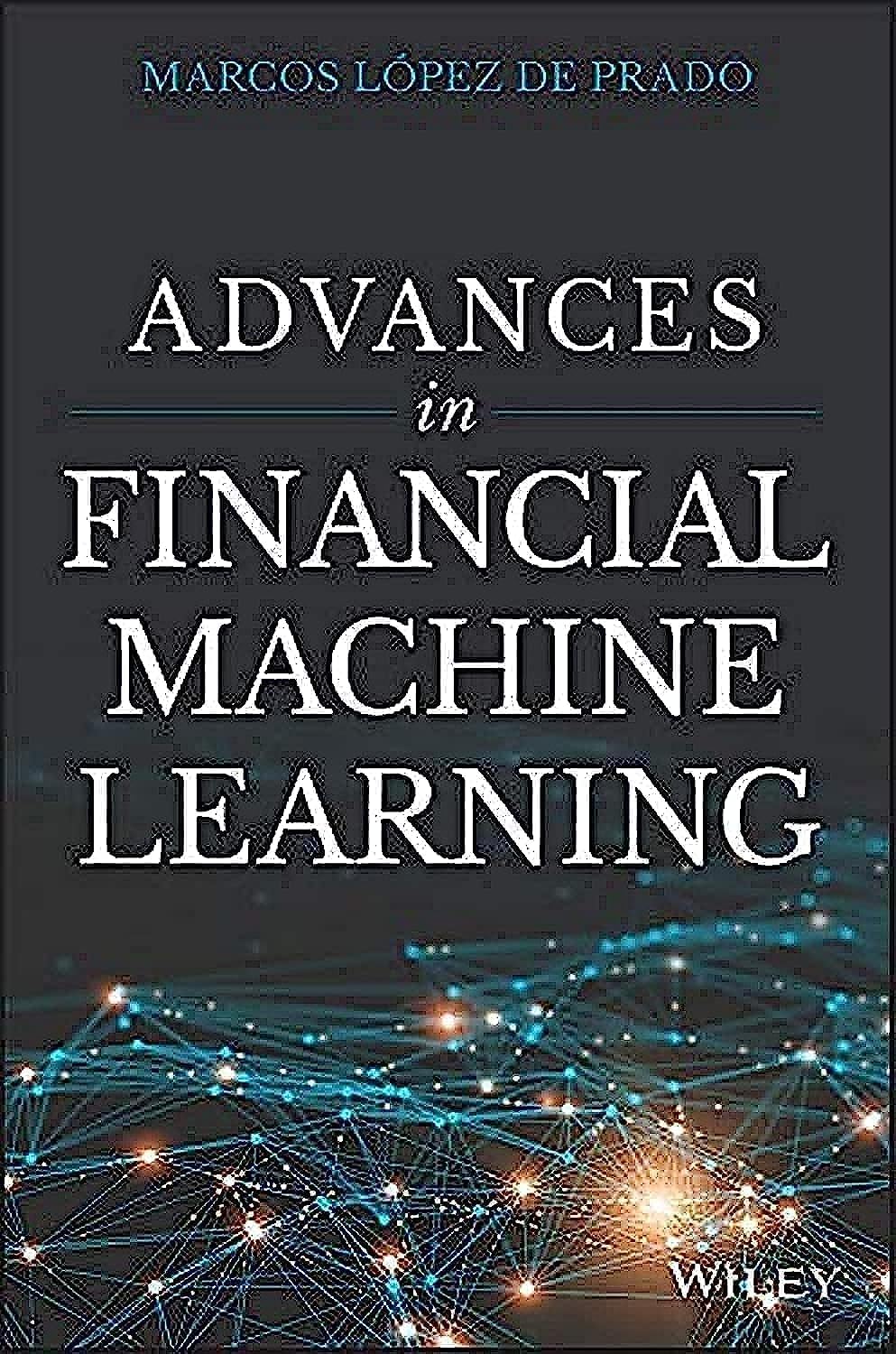
Advances in Financial Machine Learning [Lopez de Prado, Marcos] on desertcart.com. *FREE* shipping on qualifying offers. Advances in Financial Machine Learning Review: Practical, up-to-date, full of nuggets of useful info on building ML trading systems - Well-written, well-researched book that provides new insight in many areas; much better than your run-of-the-mill book that gives a cursory overview of topics like ML and finance. It's obvious from reading this book that the author knows what he's talking about. The book is for people who already know something about both ML and machine trading systems; it's not an introduction. A major theme of the book is the danger of backtest overfitting. Highly recommended! An overview of topics follows, focusing on things I found the most useful. Part 1: Data Analysis (chapters 1-5) Chapter 1 includes a list of reasons that financial ML projects usually fail. It's nice to have the warning at the outset of what traps to avoid. Chapter 2 discusses ways to represent market information; there are surprises here you wouldn't think of on your own, such as "Tick Imbalance Bars", which show up here only because the author has significant experience in HFT (cf. one of his earlier books on market microstructure.) Chapter 3 on Labelling addresses some issues I ran into myself working on dataset preparation. How to do appropriate labelling in computational finance isn't as obvious as in some other ML domains. Chapter 4 continues with appropriate weights for data samples, which help deal with data that violates the IID assumption. I knew the basics of ARIMA processes and the idea of time series stationarity before reading this book, but Chapter 5 introduced me to fractionally differentiated time series, which appears in earlier literature in the 1980s, but which somehow I had missed. This is important in dealing with time series with long memory. Part 2, Modeling (chapters 6-9) Part 2 has a different focus than some readers might expect, talking about modeling in general, but without mentioning specific ML models, such as linear regressions, neural nets, random forests, etc. The book states in its introduction that it is intended to be model-agnostic, and covers issues affecting modeling in general. Chapter 6, for instance, is on ensembles. Chapter 7 deals with cross-validation in financial time series, which is a crucial topic for any model evaluation, and chapter 8 talks about feature importance. Chapter 9 is on hyper-parameter tuning. Part 3: Backtesting (chapters 10-16). Chapter 10 covers bet sizing. Chapter 11-16 discuss backtesting in great detail, including the dangers involved, good statistics to compute, synthetic data use, more on cross-validation, and strategy risk and asset allocation/optimization. Part 4 (chapters 17-19) is called "Useful Financial Features" -- it's about feature engineering, and has a bunch of features that will be new to many readers (there are "entropy features" and "microstructure features", for instance; this isn't just the basic stuff related to returns and volatility. Part 5 (chapters 20-22) seemed the least useful to me, on high-performance computing, since I personally was already aware of this stuff and there is a lot more to say on the topic than these few chapters could cover. Review: Foundational Resource for SWEs, ML Researchers getting into Investing - If you're coming from a computer science and/or machine learning background, you will learn a lot about how to frame your algorithmic thinking in the domain of finance and will leave you hungry for more hardcore graph theory, parallelization, machine learning (beyond simple random forest ensembles and clustering), advanced algorithms, and gutty details of implementation, which are left for you to explore and enjoy. The purpose of this book is not to explain how to apply Deep Learning to make money, but rather to lay a solid foundation of how to invest in a scientifically rigorous fashion given the modern machine learning toolset and access to PBs of data. In many cases, rather than focussing on the specifics of any given model, Dr. Lopez de Prado focuses on generating and selecting useful features. The book, which is a hybrid of a textbook and a manual, explains using both formal mathematics and empirical evidence why many of the assumptions about Machine Learning applied to the financial world are wrong and follows through with rigorous and practical solutions. For example, one of the most common false assumptions addressed in the book is that of IID samples in financial time series data. Dr. Lopez de Prado manages to pull together ideas from a wide spectrum of academic disciplines including mathematics, econometrics, machine learning, computer science, information theory, and physics to build a strong scientific basis upon which to algorithmically invest. Despite the diversity of subject matter, the book progresses well, building on and reusing early themes and then exploring domain specific topics like market microstructure and quantum computing. Source code to implement many of the methods is provided as a practical toolkit to test out the claims presented. The thorough use of references is particularly helpful as it keeps the content fairly short and to the point. Speed reading not recommended. Using a programming analogy, the mathematical notation is more reminiscent of the explicit verbosity of C++ than that of python (which is used in the book and is meant to be concise). It's not much of a problem but be aware the information content is dense. Something that's mentioned but not explored is how to make use of “alternative datasets”. Given many of the advances in the wider realm of ML have been around data you don’t get from exchanges, it would be nice if some helpful pointers or references for dealing with alternative data were included. That said, it's not the end of the world given the wealth of resources online for analyzing text, image, and video data. Buy this book if you're an experienced programmer getting into Finance or a Financial Professional looking to strengthen your algorithmic understanding. It is densely packed with a wealth of practical methods and breaks down and offers alternatives to faulty investing science.


| Best Sellers Rank | #38,534 in Books ( See Top 100 in Books ) #4 in Business Investments #7 in Machine Theory (Books) #210 in Investing (Books) |
| Customer Reviews | 4.4 4.4 out of 5 stars (681) |
| Dimensions | 6.3 x 1.2 x 9.2 inches |
| Edition | 1st |
| ISBN-10 | 1119482089 |
| ISBN-13 | 978-1119482086 |
| Item Weight | 1.46 pounds |
| Language | English |
| Print length | 400 pages |
| Publication date | February 21, 2018 |
| Publisher | Wiley |
E**S
Practical, up-to-date, full of nuggets of useful info on building ML trading systems
Well-written, well-researched book that provides new insight in many areas; much better than your run-of-the-mill book that gives a cursory overview of topics like ML and finance. It's obvious from reading this book that the author knows what he's talking about. The book is for people who already know something about both ML and machine trading systems; it's not an introduction. A major theme of the book is the danger of backtest overfitting. Highly recommended! An overview of topics follows, focusing on things I found the most useful. Part 1: Data Analysis (chapters 1-5) Chapter 1 includes a list of reasons that financial ML projects usually fail. It's nice to have the warning at the outset of what traps to avoid. Chapter 2 discusses ways to represent market information; there are surprises here you wouldn't think of on your own, such as "Tick Imbalance Bars", which show up here only because the author has significant experience in HFT (cf. one of his earlier books on market microstructure.) Chapter 3 on Labelling addresses some issues I ran into myself working on dataset preparation. How to do appropriate labelling in computational finance isn't as obvious as in some other ML domains. Chapter 4 continues with appropriate weights for data samples, which help deal with data that violates the IID assumption. I knew the basics of ARIMA processes and the idea of time series stationarity before reading this book, but Chapter 5 introduced me to fractionally differentiated time series, which appears in earlier literature in the 1980s, but which somehow I had missed. This is important in dealing with time series with long memory. Part 2, Modeling (chapters 6-9) Part 2 has a different focus than some readers might expect, talking about modeling in general, but without mentioning specific ML models, such as linear regressions, neural nets, random forests, etc. The book states in its introduction that it is intended to be model-agnostic, and covers issues affecting modeling in general. Chapter 6, for instance, is on ensembles. Chapter 7 deals with cross-validation in financial time series, which is a crucial topic for any model evaluation, and chapter 8 talks about feature importance. Chapter 9 is on hyper-parameter tuning. Part 3: Backtesting (chapters 10-16). Chapter 10 covers bet sizing. Chapter 11-16 discuss backtesting in great detail, including the dangers involved, good statistics to compute, synthetic data use, more on cross-validation, and strategy risk and asset allocation/optimization. Part 4 (chapters 17-19) is called "Useful Financial Features" -- it's about feature engineering, and has a bunch of features that will be new to many readers (there are "entropy features" and "microstructure features", for instance; this isn't just the basic stuff related to returns and volatility. Part 5 (chapters 20-22) seemed the least useful to me, on high-performance computing, since I personally was already aware of this stuff and there is a lot more to say on the topic than these few chapters could cover.
A**Y
Foundational Resource for SWEs, ML Researchers getting into Investing
If you're coming from a computer science and/or machine learning background, you will learn a lot about how to frame your algorithmic thinking in the domain of finance and will leave you hungry for more hardcore graph theory, parallelization, machine learning (beyond simple random forest ensembles and clustering), advanced algorithms, and gutty details of implementation, which are left for you to explore and enjoy. The purpose of this book is not to explain how to apply Deep Learning to make money, but rather to lay a solid foundation of how to invest in a scientifically rigorous fashion given the modern machine learning toolset and access to PBs of data. In many cases, rather than focussing on the specifics of any given model, Dr. Lopez de Prado focuses on generating and selecting useful features. The book, which is a hybrid of a textbook and a manual, explains using both formal mathematics and empirical evidence why many of the assumptions about Machine Learning applied to the financial world are wrong and follows through with rigorous and practical solutions. For example, one of the most common false assumptions addressed in the book is that of IID samples in financial time series data. Dr. Lopez de Prado manages to pull together ideas from a wide spectrum of academic disciplines including mathematics, econometrics, machine learning, computer science, information theory, and physics to build a strong scientific basis upon which to algorithmically invest. Despite the diversity of subject matter, the book progresses well, building on and reusing early themes and then exploring domain specific topics like market microstructure and quantum computing. Source code to implement many of the methods is provided as a practical toolkit to test out the claims presented. The thorough use of references is particularly helpful as it keeps the content fairly short and to the point. Speed reading not recommended. Using a programming analogy, the mathematical notation is more reminiscent of the explicit verbosity of C++ than that of python (which is used in the book and is meant to be concise). It's not much of a problem but be aware the information content is dense. Something that's mentioned but not explored is how to make use of “alternative datasets”. Given many of the advances in the wider realm of ML have been around data you don’t get from exchanges, it would be nice if some helpful pointers or references for dealing with alternative data were included. That said, it's not the end of the world given the wealth of resources online for analyzing text, image, and video data. Buy this book if you're an experienced programmer getting into Finance or a Financial Professional looking to strengthen your algorithmic understanding. It is densely packed with a wealth of practical methods and breaks down and offers alternatives to faulty investing science.
D**N
Marcos López de Prado’s Advances in Financial Machine Learning is an exceptional guide that bridges the gap between academia and industry. Co-authored with experts like Simon and Alexander Lipton, the book is a testament to López de Prado’s decades of experience in quantitative finance. It offers a unique blend of practicality and structured insights, making it a vital resource for professionals and academics alike. What truly sets this book apart is its meticulous structure and systematic approach. The content is divided into clear sections that build upon one another, starting with foundational concepts of data analysis and advancing to sophisticated modelling, backtesting, and feature extraction. López de Prado avoids unnecessary complexity, focusing instead on presenting a robust framework that readers can adapt to their specific needs. Each chapter is designed to address real-world challenges, creating a seamless learning experience. Chapter 22 is particularly noteworthy, as it introduces the high-performance computational methods pioneered at Berkeley Lab. This chapter not only highlights the importance of advanced hardware and software in modern finance but also showcases the meta-strategy paradigm—a collaborative approach inspired by Berkeley’s structured research model. By emphasizing team-based problem-solving and interdisciplinary strategies, López de Prado reinforces the value of organized frameworks over ad-hoc methodologies. Horst Simon’s and Alexander Lipton’s contributions enrich the book with additional perspectives, ensuring it appeals to a broad audience. Together, the authors provide a roadmap for navigating the complexities of machine learning in finance while remaining grounded in practical, actionable insights. In summary, Advances in Financial Machine Learning is a groundbreaking book that combines a strong theoretical foundation with a pragmatic focus on implementation—an essential read for anyone looking to thrive in the rapidly evolving world of quantitative finance. Whether you’re a seasoned professional or a curious academic, this book is a must-have addition to your library.
A**ー
This book explains about a lot of important tips about how to use machine learning technique in financial data. I tried to use machine learning for my fund managing but I didn't notice about some important tips in this book. Now I'm really excited to use these important technique for analyze the stock data.
C**E
Excelente livro. Aborda de forma profunda o tema. Recomendo a leitura. Realize os exercícios práticos e se aprofunde no assunto. Vale a pena.
J**O
This book opens your eyes over the world of algoritmic trading. I'm giving a course of trading and it gives another point of view. I've found very interesting the approach using machine learning in a different way, threading very carefully to prevent errors that are usual, and others that are not as easy to spot when using statistics for this type of problems. Highly recommended lecture but it's a little dense, so you will be looping over the same chapter and when you break the loop, you can find some insight in after chapters.
"**"
Written for data scientists and financial professionals, not for beginners. Very insightful.
TrustPilot
2 周前
3 周前