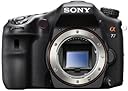
โก Shoot Fast, Focus Faster, Create Forever!
The Sony Alpha SLT-A77 is a powerhouse DSLR featuring a 24.3 MP APS-C sensor, blazing 12 fps continuous shooting, and Sonyโs exclusive 2nd generation Translucent Mirror Technology. It boasts the worldโs first OLED electronic viewfinder for crystal-clear framing and supports Full HD 1080p video recording with advanced manual controls. Rugged yet lightweight with a magnesium alloy body, itโs designed for professionals and enthusiasts who demand speed, precision, and cinematic quality in both stills and video.
| ASIN | B005IHAICK |
| Age Range Description | Adult |
| Aperture modes | F2.8-F22 |
| Are Batteries Included | Yes |
| Auto Focus Technology | Continuous, Face Detection, Live View, Multi-area, Phase Detection, Selective single-point, Single |
| Autofocus | Yes |
| Autofocus Points | 19 |
| Best Sellers Rank | #326,348 in Electronics ( See Top 100 in Electronics ) #514 in DSLR Cameras |
| Bit Depth | 14 Bit |
| Brand | Sony |
| Built-In Media | Battery, HDMI Cable, Instruction Manual, Remote, Tripod |
| Camera Flash | Built-In |
| Camera Lens | A zoom lens compatible with Sony/Minolta Alpha and Sony/Minolta Alpha DT mountings |
| Color | Black |
| Compatible Devices | Sony/Minolta Alpha, Sony/Minolta Alpha DT |
| Compatible Flash Memory Type | SD |
| Compatible Mountings | Sony/Minolta Alpha, Sony/Minolta Alpha DT |
| Connectivity Technology | HDMI, USB |
| Continuous Shooting | 5.5 FPS |
| Crop Mode | 16:9 |
| Customer Reviews | 4.4 out of 5 stars 154 Reviews |
| Digital-Still | Yes |
| Display Fixture Type | Articulating |
| Display Maximum Resolution | 921,000 |
| Display Resolution Maximum | 921,000 |
| Display Type | LCD |
| Dots Per Screen | 837273 |
| Effective Still Resolution | 24.3 MP |
| Expanded ISO Maximum | 16000 |
| Expanded ISO Minimum | 100 |
| Exposure Control | Manual |
| File Format | JPEG |
| Flash Memory Bus Interface Type | UHS-I |
| Flash Memory Supported Size Maximum | 64 GB |
| Flash Memory Type | SD/SDHC/SDXC/Memory Stick Pro Duo/ Pro-HG Duo |
| Flash Modes | [INF] Inferred: Live View Flash, Red Eye Reduction, Fill Flash |
| Flash Sync Speed | 1/250_sec |
| Focal Length Description | 24-75 millimeters |
| Focus Features | TTL 19-point Phase Detection |
| Focus Mode | Automatic AF (AF-A), Continuous-Servo AF (AF-C), Manual Focus (MF), Single-Servo AF (AF-S) |
| Focus Type | Automatic with Manual |
| Form Factor | Mid-size SLR |
| Generation | 2 |
| Global Trade Identification Number | 04905524857863 |
| HDMI Type | Type C Mini HDMI |
| Hardware Interface | USB |
| Has Color Screen | Yes |
| Image Capture Type | Stills & Video |
| Image Stabilization | Sensor-shift |
| Image stabilization | Sensor-shift |
| Item Weight | 1.61 Pounds |
| JPEG Quality Level | Fine |
| Lens Construction | 13 |
| Lens Type | zoom |
| Manufacturer | Sony |
| Manufacturer Part Number | SLTA77V |
| Maximum Aperture | 3.5 Millimeters |
| Maximum Focal Length | 75 Millimeters |
| Maximum Image Size | 24.3 MP |
| Maximum Shutter Speed | 1/8000 Seconds |
| Memory Storage Capacity | 1 GB |
| Metering Methods | Multi, Center-weighted, Spot |
| Minimum Focal Length | 24 Millimeters |
| Minimum Shutter Speed | 30 seconds |
| Model Name | SLT ALPHA A77 |
| Model Number | SLTA77V |
| Model Series | SLT-A77 |
| Movie Mode | Yes |
| Night vision | No |
| Optical Zoom | 3.1 x |
| Photo Sensor Resolution | 24.3 MP |
| Photo Sensor Size | APS-C |
| Photo Sensor Technology | CMOS |
| Remote Included | No |
| Screen Size | 3 Inches |
| Self Timer | 10 Seconds |
| Sensor Type | CMOS |
| Shooting Modes | Automatic, High dynamic rang, Scene |
| Skill Level | Amateur, Professional |
| Special Feature | Live View |
| Supported File Format | JPEG |
| Total Still Resolution | 24.3 MP |
| Total USB 2.0 Ports | 1 |
| Total USB Ports | 1 |
| Total Video Out Ports | 1 |
| UPC | 027242833067 |
| Unit Count | 1.0 Count |
| Video Capture Format | mpeg-4;avchd |
| Video Output | AVCHD |
| Video Resolution | FHD 1080p |
| Viewfinder | Electronic |
| Viewfinder Magnification | 1.1x |
| White Balance Settings | Auto, Flash torch |
| Wireless Technology | EyeFi |
| Write Speed | 12 fps |
| Zoom | Optical |
S**D
excellent for what I use it for
Ok, let's start with the "con": you cannot tether this camera. The a700 could be tethered. The a77 cannot. It's not a huge drawback, but it is a drawback. What do you use tethering for? Controlling the camera from your computer. Transferring the pictures directly and immediately to a computer (for a client or someone else to look at). For easily seeing the pictures on a large screen, rather than the screens on the camera. And...using this in a photobooth! This camera just cannot be used in a photobooth. It's frustrating. Not being able to tether the camera is frustrating, but not a deal-breaker -- not even close. How many times have you needed to tether your camera? But it would be nice. I've been using the a77 for a year and three months. I resisted it and continued using my a700 because I hated the idea of an EVF. However, after about 30 seconds of trying out the a77, I was hooked, and I cannot go back to an OVF. Occasionally I use a Nikon, and it's just awful. An EVF has REAL advantages -- big advantages. I am a professional photographer, and I'm shooting 4-6 days a week, most weeks. About 70% of my assignments are sports, and about 20% are club event photography. The other 10% are group pictures, studio work, on-location "people at work" photos, etc. For sports especially, the EVF is incredibly useful. I shoot in manual mode. With an optical viewfinder, if you change from f/2.8 to f/11, the view doesn't change. If you change from 1/50 to 1/2000, the view doesn't change. The picture will be drastically different, but you won't see it until you actually take a picture. With outdoor sports, the lighting is constantly changing -- sun going behind a cloud, light diminishing during sunset, front-lit, side-lit, or back-lit faces. With an electronic viewfinder, you see exactly how the picture will look. If you change the shutter speed, film speed, or aperture, the image in the viewfinder will change. This is a huge help while shooting. Also, after you take a picture, the picture usually shows up on the back of the camera for a few seconds, right? Well, since the viewfinder is a tiny computer screen, you can have the picture show up there, instead. That is also great. You don't have to take the camera away from you eye and look at the back of the camera -- you can be shooting pictures and reviewing them, all without moving the camera. It's kind of like the difference between using keyboard shortcuts and clicking with the mouse. Yes, you can type, then use the mouse to click on the next field, then type some more, then use the mouse to click on the next field. But it's much faster to just hit "tab" to go to the next field. You never take your hands off the keys,and it just goes faster, your train of thought isn't interrupted, you can just "go" faster. For example, when I take group photos, I need to check to see if anyone was blinking, and take another picture if they were. With an EVF, I take the picture, then the image immediately appears on the screen in the viewfinder, and I can very quickly see whether I need to take another picture or not. I know -- it doesn't sound like a big deal. None of these things would have made much impression on me, before I bought an a77 and got hooked. I would have said they were all small things, and really not very important. Just try it. Borrow or rent one for a week, and then try to go back to an optical viewfinder. You won't be able to do it. One more benefit of an EVF: you know how, when it's sunny outside, it can be hard to see the screen on the back of the camera? Too much glare, too bright outside? Well, the EVF is inside the camera, in a deep dark cave. There are no reflections, no glare to fight. You can see how the picture actually looks. Ok, so obviously I think the EVF is the big selling point with this camera. But there are other good things. The 12 fps is kind of a lie. The real burst rate is 7 fps. 12 fps only works in "P" mode. If you are a serious photographer, you don't use P. But 7 is plenty. If you're the person who has to cull all the photos after an event (and I am), then...7 fps is more than enough to wade through... I do use the 12 fps setting when shooting golf, just because the club and ball move SO FAST. And I also use it in baseball, to get the "ball on the bat" picture. But otherwise, 7 fps is plenty. The camera is rugged. I shoot sports. Most sports don't stop because of rain, sleet, snow, heat, or cold. So I can't, either. I've used this camera in all types of weather, and it survives admirably. It's built tough. People say the Sony alpha cameras have bad high-ISO noise, and I agree. HOWEVER, I work for a large photography company. I am (obviously) the only Sony shooter. Most of the other photogs shoot Nikons, and a few shoot Canon. The head of sports photography sees ALL pictures, from everyone, before the pictures go onto the website. And he raves about my camera's noise performance. He's comparing my a77's noise to pictures from Nikons and Canons, and he thinks the a77 is excellent. He's a die-hard Nikon fan (a member of their professional photographer group), but my pictures have almost won him over to Sony. I honestly don't understand how my pictures are so much better than pictures from Nikon and Canon, but he swears they are. So much so that I have become my company's top photographer for low-light assignments. The GPS feature is GREAT, and I'm very disappointed that they've eliminated it on the a77 mark 2. It's another feature (like EVF) that you don't realize how useful it is until you actually have it. I will be very sad to lose it. Very. The Minolta/Sony hotshoe is a non-issue. Were you planning to use a Canon flash on your a77? No, of course not. So what does it matter? Sony, Sigma, etc make flashes with our mount. It's true, pocketwizard does not. But I use cowboy studio triggers, and guess what? They work equally reliably as pocketwizards, and they cost a small faction of what pocketwizards do. Perhaps a cowboystudio trigger wouldn't work from 100 meters away, and perhaps a pocketwizard would. But I don't work that far from my lights. In normal studio conditions, my cowboystudio triggers work as reliably as my company's pocketwizards. And the cowboystudio triggers allow my camera to fire my Canon 430 EXII flash remotely. (Ok, so I WAS planning on using a canon flash with my a77...) My Sony a77 is rugged, dependable, full-featured, takes great pictures, has good continuous AF, and has an excellent electronic viewfinder. I use the camera 4-6 days a week, and I'm glad I chose Sony, not Canon or Nikon. It's an excellent camera.
J**0
Safe Purchase for Those Looking to Step Up Their Photography From Their Smartphone.
Tldr; You won't find a better overall starter from anyone else, especially Cannon, for the price that you can get the A77 for used. (I paid just $500.00) The A77 brings pro features to an entry level body, but it would be better if it had WiFi or NFC. >9/10 Long form: Every single one of my purchases comes down to one thing, bang for buck. How can maximize my dollar? As someone who spends hundreds of hours researching products before buying them, I can easily say that this camera falls beautifully into the sweat spot of price verses features, and that the purchase was worth the price. This camera was my way to "step-up" my photography from my mediocre smartphone camera. I paid $500.00 flat for a used but "Very-Good" version of this product. The camera arrived in mint condition from Swampscott M.A. of all places. It, however, didn't come in the factory box. Alongside this camera I purchased a 70 - 200mm lens from Sigma for $533.00, also used. This lens I found to highly acclaimed for its diversity and ability to excel in portrait photography. It is important to note that this lens cost over $1,200 new. Being important because what lens you get can make a huge difference and I got what I believe is a pro lens. Overall I paid about half what each item is worth at MSRP and I recommend doing the same only if you are patient enough to wait for the best deal. Remember I spent hundreds of hours on this, so think if its worth spending the time just to save a bit of cash. I want to address something very important. If this is your first DSLR, make sure you are not making any sacrifices in the quality of your lens to be able to afford this body. Glass is far more important than the camera body as it doesn't get outdated as easily as the body will. If anything, you should actually make sacrifices in what body you purchase so that you can buy a better lens. >I could spout specs at you, but you can find better spec comparisons and more complete listings on other sites like DxO. This was my first ever DSLR so I was a bit intimidated at first by the amount of menu options and buttons, but the camera has a handy feature that shows what each menu option means or does when you press a button. This is extremely helpful when I was getting to know the device at first. Full disclosure, I am usually pretty competent at navigating technology and learning new information, so I can't completly say how easy this camera is to learn for everyone. However no matter what camera you buy, you should not be afraid of it. Think of it as a challenge, there is a vast wealth of resources on how this camera works and on the fundamentals of photography for free online, if you don't know what Aperture or ISO means and how they affect your pictures, then I recommend reading up before making a purchase. All that being said the settings menu gives a excellent amount of control over the camera and you image. One of the best aspects of this body is the diversity that it offers in terms of what you can shoot. In the first few months that I had this camera I was able to take sports shots, macro shots, wildlife shots, landscape shots, panoramas, car shots, and most importantly pictures of my cats. The ability to take a picture twelve times every second is incredible. I've been able to make some incredible Volleyball gifs because of it. If you're going to be shooting sports at all definitely look into getting cameras that have a high fps like the A77. It will be the difference of having your subject be a blur or be crisp and in focus. This camera covers all the bases. It preforms commendably in both stills and film, and it brings useful extra features like the panorama mode. The only real downside that I found with this camera was the electronic viewfinder, no headphone jack, and the lack of WiFi or nfc. But with the viewfinder I found that I actually liked what Sony was able create. The viewfinder is an OLED screen that makes by far the best argument for OLED screens that I've ever encountered. This screen puts out inky blacks and crisp accurate colors, plus all at a glorious 1:1 ratio. That ratio is great as it means that 100% of the picture that the camera will take is shown on screen. This is enhanced by the screen showing you how the image is being affected by what settings you are doing in real time. You will be able to judge your exposer and color temperature on the fly. The viewfinder being electronic also gives the ability for it to display everything the normal articulating 3 inch screen can, so you can browse you photo gallery in the viewfinder and adjuste the settings. Continuing with the message of settings, the top mounted screen is really handy. It displays all of your image settings in real time so you can easily see what ISO or shutterspeed your currently using, which is really handy when taking shots really close to the ground. The articulating screen also helps here to. All in all this camera I found to be easy to learn but rich enough in features to provide a wide range of opportunities to explore with the depth to really become proficient. Any drawbacks are quickly and greatly out weighed by the positives. >This I can recommend as a safe purchase for someone who has a basic understand of photography and what's to take their game to the next level. For those who are new to the concept of photography I would still recommend this, but only if you know yourself to be someone who is willing to commit time to learning and developing their skills.< (v.1)
H**R
I love it! I hate it! I love it! I hate it!
I bought this camera as an upgrade for my Sony A700 (badly dated) and this camera is a very good, but too long delayed, replacement for the A700. I do wildlife photography and sports photography as hobbies, so this review will only touch on those uses. I absolutely love the improvement I have gotten in my wildlife pictures. The focusing is faster and sharper, the colors seem more true, and the transition from 12MP to 24MP makes a tremendous difference in my ability to crop images (most animals still refuse to walk up to me) and still have a quality photo. There is a night/day difference between the quality of pictures I take with this camera and pictures I took with the A700. I am disappointed with this camera's usefulness for sports. The quality of pictures I obtain is either excellent or worthless. Some reviewers love the electronic viewfinder and it does give you a better idea of how the camera sensor is "seeing" the scene. However it is slow when following rapid sports action, and the viewfinder stutters (i.e. it shows still shots of previous pictures or just shows a black screen for a fraction of a second) when taking a continuous series of pictures. This is very frustrating when I am trying to follow an athlete who is chasing a ball. It is very difficult to keep a player in focus if I cannot see them and do not know exactly where they are. The manufacturer is justifiably proud of offering a camera that can shoot 12 frames per second (only in aperture priority mode) and I really wanted that level of capture speed to allow me to get better pictures of bats meeting balls etc.. The only time you need 12 fps is when you are photographing a rapidly moving object, which is the time you will not be able to consistently see that object in the viewfinder:( The "Sports Mode" is unusable in my opinion. You cannot employ spot focus in Sports Mode, and consequently the camera tries to average the focus between the athlete you are trying to photograph and all the players, officials, coaches, birds, stands, water coolers, etc., that you do not want to focus on. It is not that difficult to employ manual settings, but why would you make a camera with a Sports Mode that assumes everything you can see is equally interesting to you? I love that I am getting great images and am able to get some shots I could not get before. I hate that I am missing some shots that used to be much easier to obtain. This camera has many great qualities and I will continue to use it, but is does make sports photography more difficult.
D**E
A worthy successor to the A700
The Camera Fairy blessed my porch last Friday and handed me an Amazon box which upon opening, disgorged a familiar black and orange Alpha box with my A77 body inside, safely cushioned in bubble-wrap. In addition to the charger, manuals and ads, software CD, neck strap and USB cable, there was an empty space (sadly) for the kit lens. Since I already own a very nice Minolta 28-75 f/2.8 standard zoom, I passed on ordering the A77 with the new 16-50 f/2.8 SSM "kit" lens. I put quotes around "kit" because the new 16-50 is anything but a standard starter lens. It has a constant f/2.8 maximum aperture, solid build and is weather-sealed to match the A77. Though not designated as a "G" or "CZ" lens, in tests it approaches the performance of Sony's excellent 24-70 f/2.8 Zeiss and is actually designed to fill the same effective focal length range on the APS-C cameras that the 24-70 does on full-frame. I planned on replacing my Minolta lens with the Zeiss next year but this new "kit" entry seems to be a serious alternative and since it is designed for the smaller APS-C sensor, manufacturing cost savings make it a heck of a bargain at half the price. Look and Feel If you have never handled a pro or semi-pro camera body, the tactile difference between a polycarbonate and magnesium alloy shell is immediately noticeable. Even though the body only weighs a little over 1ยฝ lbs (without lens), it feels solid. It has a rubber grip that extends around the back on the right to cover the thumb rest area. The grip itself is deep and fits my medium-wide hands comfortably with a secure feel when holding it one-handed. The body is a little taller than the A700 but more rounded with a matte finish that gives it a no-nonsense appearance. I wouldn't base a camera purchase on how pretty it was, but I appreciate the look of a well-made tool whether it is a Kitchen-Ad mixer, a drill press or a tripod. The A77 is a well-made tool and that makes it pretty to me! It's What's Outside That Counts The control layout is a bit different than the A700 but the main controls are similar enough that I was comfortable with it after only a few minutes of fiddling with them. Sony's Quick-Navi menu system from the A700 is gone but the replacement is not a step backward. All of the main functions except stabilization on/off can be accessed either with a dedicated button or on the LCD with a press of the function button. the The stabilization on/off being relegated to the menu instead of having a dedicated button was surprising at first, but after thinking it over, I decided that I really never switched it off unless it was for one of the rare times I was using a tripod (or by accident) and all too often I forgot to turn It back on. Having it on by default and being able to set the menu to come on in the same position that you left it is a workable alternative to having a dedicated switch. One addition is the movie button. Yes, movie. The A77 is the first DSLR I've owned that can do movies and in addition to a full movie mode on the mode dial, there is a record-it-now movie button that lets you start a recording of that unexpected UFO encounter with your default settings at a moment's notice. Now I just have to remember that my DSLR takes movies! The LCD screen is the same size as the one on the A700 and has the same extremely high resolution but with improved brightness and contrast making it easier to see in bright light. Unlike the A700 the A77's LCD is articulated. Very articulated! The mechanism is very sturdy and can be tilted or swiveled into almost any forward, rearward or sideward position. It even allows you to flip the screen inward in the collapsed position for protection. The top of the body includes the aforementioned dedicated function buttons plus a monochrome LCD with it own dedicated backlight button that displays the basic camera settings at a glance. The selection on the mode dial is a little different from the ones on the A700. The multiple scene modes are replaced with a single scene mode position and the various modes are now chosen on the rear screen using the joystick control. The additional scene modes have been replaced with settings for Movie mode, 12 fps shooting mode, Sweep Panorama and 3D Sweep Panorama. The pop-up flash has a new mechanism that slides the flash forward and up to reduce the chance of the lens/shade blocking it. There is also a button to pop the flash up rather than the manual flip-up on earlier 7-series models. On top of the flash is another new thing for me...there's a microphone on my camera! Maybe I'll have to try this movie thing after all. The autofocus mode switch near the lens hasn't changed but the depth-of-field preview can now be programmed to show either depth of field or a preview of scene settings. Inside counts too The first "inside" part that I checked out was the viewfinder. After reading all of the doomsaying from the fear, uncertainty and doubt threads on the forums followed by nearly unanimous praise from people who had actually used the camera, I had to see for myself. I have had cameras with EVFs that were considered good. My Minolta D7i was hopelessly outclassed by the full VGA EVF on my Minolta A2 (yes, full VGA on a digicam bridge camera back in 2004!) and I was impressed by the A55 that I tried at a local store. About the new OLED viewfinder on the A77, all I can say is....wow! I imagine if you had 20-10 vision and were college-trained to pick flyspecks out of ground pepper, you might be able to see pixels in the image. I certainly can't. It's like looking at a good 17" XVGA monitor from about 2'-3' away. The image is sharp and contrasty with nicely saturated color. The only clear reminder that it is an electronic image is in areas of very bright highlights or deep shadows where the dynamic range of the display cuts off before you eye would through an OVF. If you pan quickly, there is a faint fuzzing of vertical edges, but no serious degradation and no color tearing at all. Following a moving object is no more difficult than it was with my A700. As light gets lower the image grains up and gives you video noise sparkle which worsens as available light decreases. but still lets you see to compose down past where it would be practical or even possible with an OVF. Those are the basics. The initial plusses and minuses, so to speak. Now for the cool stuff! The list of add-ons in the menu includes options for showing all info (OCD mode), no info (just basic shooting info at the top and bottom), graphic mode (like the NEX LCD info display), Histogram overlay and electronic level. On top of any of these you can add a grid with a choice of a 4x6 square grid, rule of thirds or diagonal lines. The real value is something I missed when I went from my Minolta A2 to the 7D DSLR, namely that the viewfinder can be set to display exactly what the sensor is set to capture. This is really helpful when you are working in mixed light or mixed shade where auto white balance will often fail. Too blue? You see it. A little green from fluorescents? You see it. You can tweak settings until it is corrected and check the results in real-time. Another plus is that you can review the image for critical focus or exposure directly in the viewfinder in the brightest light and see it perfectly. Speaking of critical focus... Most of the better DSLRs can magnify the live-view image for critical focus, but in the field it is often difficult to see clearly. Being able to look through the viewfinder and see a magnified image centered on any point in the frame is a real winner. Another great tool is focus peaking. This is a tool used in videography to highlight the parts of the frame that have the highest contrast (sharpest focus) so the cameraman can quickly determine where the focal point is while filming. What it does is create a colored halo (choice of red, yellow or white) on the edges of objects in the in-focus area that is very easy to see even if you are looking at a washed out LCD with the camera at an angle that makes using the viewfinder difficult or impossible. My bottom line? The A77 EVF exceeded my expectations. It offers a razor-sharp image that displays a larger, brighter view than any APS-C camera (the A700 is one of the best) and nearly as good as the full frame cameras. It also has some technological tricks up its sleeve that are more than marketing gimmicks and offer real functional value. Deeper Inside Really deep inside is a somewhat controversial Exmor sensor. It is 24MP which is far and away the highest pixel count of any APS-C camera on the market today. Why controversial? If you have been following the build-up to the release of the A77 and the initial reviews, you have surely seen endless threads on whether Sony should have put so many pixels on an APS-C sensor or spent their efforts on making a lower pixel-count sensor with stellar high-ISO performance. There are also thousands of images with accompanying text declaring its image quality is anywhere from better than medium-format to worse than a cheap compact. In truth, it is neither. Rather it is an advancement in sensor technology that trades some high-ISO performance for some pretty remarkable low-ISO resolution. It also makes a couple of steps ahead in color accuracy and dynamic range. I am not one to snap a photo and peer endlessly at each pixel blown up to 100% on my monitor, searching for something to b1tch about. I prefer to look at the images as I expect to display them and determine if they will look good. So far, the A77 looks good. Real good. Tools to Get Those Images In the past, having "special" modes on a DSLR other than P-A-S-M (Program, Aperture Priority, Shutter Priority and Manual) was pooh-poohed as a sure indicator of an entry-level camera that catered to photographers without a clear understanding of basic settings. Though this sounds a little snotty, it was generally true with helper modes like "Sunsets", "Sports" and "Landscapes" to preset the beginner's camera for best-bet shutter and aperture combinations for those subjects. I always thought that some of the more advanced cameras might benefit from some presets that would quickly get you near the optimal settings or add functionality that would be hard to set up manually. As I mentioned earlier, the A700 had a selection "special" settings on the mode dial for just that purpose and after checking them out when I got it, I never actually used any of them. That may change with the A77. While diving into the scene mode menu on the A77, it earned guaranteed return visits when it revealed a hidden gem in the Hand-Held Twilight mode. This first appeared on the higher end Sony compacts and is quite a useful feature. It fires off a series of shots in rapid succession then matches and stacks them to reduce noise and enhance detail in low-light situations. Image stacking has been available in Photoshop and other dedicated programs for years, but having it done for you in-camera is pretty cool. Some of the other features that have migrated from the compacts to the NEX and now to the DSLRs are Auto HDR and Sweep Panorama. The Auto HDR is similar to the Auto Bracket feature found on many DSLRs to trigger a series of exposures with ascending values to be used to create an HDR (High Dynamic Range) image. Auto HDR goes one step farther by actually combining and processing the images in the camera. Maybe not as "pro" as sitting in front of a computer and processing/tweaking the files in expensive software for an hour to get a natural-looking dynamic range enhancement, but Easy and Good trumps Hard and A Tiny Bit Better any day. If you want to do more than natural and create HDR art, the auto-bracketing covers up to a 6 EV span and there is always manual. The list goes on... Shooting Quite simply...I like it! It is solid, well-balanced, easy to grip and has a control set that grows familiar very quickly. I originally chose the A700 for its control ergonomics and the A77 may end up being a bit better! There's the huge, bright viewfinder and an acrobatic LCD that makes low, high and odd angle shots easier than ever before. The fastest autofocus I have ever had the pleasure to use and it is accurate too. If one of my lenses back- or front-focuses, there is a menu to compensate with micro adjustments that registers and saves the adjustments for up to 30 lenses. Technological assist for critical manual focusing is very useful. Fully metered, focus tracking continuous shooting at up to 8 fps is probably more than I will ever need and if it isn't, the more restricted 12 fps mode should cover it. Image quality is pretty amazing. I haven't tried out the RAW files yet but the JPEGs are quite good. If they improve the JPEG engine with firmware like they did with the A700, I may never use RAW. And then there is the movie mode...up to 28mbs 1080p60 recording with full-time autofocus or manual focus assisted with peaking... The features and combination of features fills a 240 page manual and rather than plod through them here ad nauseum, I'm going to go enjoy the rush of photographic inspiration that always comes with a shiny new tool! Down The Rabbit Hole...? Is the SLT design with a high-quality electronic viewfinder the wave of the future? Maybe, maybe not. There is personal preference and user inertia involved as with any major change. Remember, it wasn't until digital capture surpassed the film in working quality the it was widely accepted by working photographers and it took years after that to pry film out of some of those cold, dead cameras. The usability of the A77 viewfinder certainly has captured my interest and the interest of a lot of people that would have (and did) scoff at the idea. Is 24MP too much for APS-C? Some would say yes and I might have been one of them. Certainly the high-ISO performance would have been improved with fewer and larger pixels but for print sizes up to 12x18, the ISO 6400 images are pretty darn good and that places it at least two stops better than the A700 even with double the pixels. At ISO 100 to 400 in good light (which covers portraits and most landscapes) the level of detail is truly amazing and rivals the current crop of full-frame cameras. If you add the improved dynamic range and better color fidelity I might still say that 24MP is too much, but with a lot less conviction than before. I hope this answered a few questions, I will add more images and perhaps some comments as I get more familiar with my new friend. Happy shooting!
J**D
Surprisingly good
This is my first quality dslr camera. I owned Nikons, from the Nikon F, Photomic T, to the F4HP. The A77 yields very sharp pictures even at 6 mp. I have not taken any pictures at the maximum 24.3 mp yet. I bought it to photograph my Huggmee chair and put it on the side of my van. My little Sony Cybershot with 5 mp was just not enough. With any camera, the quality of the picture is in the lens and the sensor. Everything else is toys. The kit lens is excellent, and the sensor yields pictures indistinguishable from a full screen. The body of the camera is surprisingly light and small, compared to the professional models. Unless you shoot at extreme lighting conditions without a flash, you will get excellent results. Others complain about noise at low light but in the days of film, all high-speen films had grain too. We know how to use flashes! If you do not want to spend $2,000 on the A77, you can get the same lens and CMOS on the A66. Biggest difference between the two is the waterproof and dustproof body of the A77. Taking 12 frames per second was achieved with the translucent mirror whereby we no longer have a mirror flapping up and down. I am glad I spent the time to read up on these cameras and that I bought the A77. I have read some horror stories about bad customer service from all manufacturers but Sony seems to be the best of the lot. I hope this camera lasts me the rest of my life! (I'm 69.) I have taken thousands (over 100,000) with my Nikons and did 40 weddings for friends and employees. I also did my HS yearbook, formal and informal shots in 35mm with a Nikon lens, and retouched negatives and developed prints in my own darkroom. I am colorblind so gave up on photography when color took over. But I know a quality photograph when I see one, and every shot from this camera so far, is a quality picture. The A77 at its price, makes Nikon and Canon look like scam artists. The A77 is state-of-the art in dslr photography and can do some things and has some features that no other dslr has. BTW, I bought this on Amazon and it arrived in less than 24 hours!
D**D
Great Purchase
The SONY SLT-77V arrived in great condition. I fully evaluated the functions of the camera as well as the quality of the images. Although it was used camera body, it appeared to be gently used and properly maintained. This was a great buy and it extended the life of my lenses and external flash.
S**E
Different viewfinder but great camera!
I originally had a Konica Minolta camera that I needed to replace. I did a lot of research, looked at a lot of cameras and finally settled on the Sony Alpha SLT-A77. This camera has a lot of features that some of the more expensive models are missing or charge extra for, and the price was better than comparable Canon and Nikon models. Being that the Alpha line is built on Minolta technology, I had no problems using my existing lenses, which was a big plus for my decision to buy. So far I have been extremely pleased with this camera. It does a lot better than expected in low light situations. The continuous shooting mode is extremely fast, and the auto-focus works really well. The electronic viewfinder took a little bit of getting used to, especially when shooting in low light, but once you do you will wonder how you survived without it! I have not used the video mode all that much, but from what I have tested it works really well. I like the phase detect auto focus in video mode, which keeps you from having to manually focus while shooting video. The one drawback I have noticed, however, is that the lens is somewhat noisy while auto-focusing, which may be picked up on video. The big drawbacks I have noticed is the inability to use some of the extra features while shooting in raw. The in-camera HDR function, some of the screen modes and a lot of the other features can be used in JPG mode only, which is kind of disappointing. However, while these features would be nice, it's works out fine to process these manually when working with RAW files. Overall I am extremely happy with this camera. It has far exceeded my expectations, and I would highly recommend it.
S**U
Sony is really making great strides
Let me preface this by saying that I'm relatively new to the world of DSLR's but have a great fondness for both photography and technology. My first "real" camera was the Sony NEX 3. It allowed me to get my feet wet without breaking the bank. I learned alot about the basics of photography and lighting using it. I quickly upgraded from using the iAuto modes to Manual and eventually purchased an array of Minolta Rokkor lenses to compliment this amazing little device. I love the focus peaking and in most cases, find that manually focusing gave me much better results than autofocus. The only gripe that I had with the NEX was it's inability to use off-camera flash. Although the NEX cameras have amazing low light capabilities, I just love the strobists' style of photography. This is what lead me to purchase the A700 and some flash units. After using it, I began to prefer the handling of a larger DSLR vs the diminutive body of the NEX. It just feels a lot more intuitive for certain types of photography, especially portraiture and sports. Of course, the A700 also came with it's limitations...Live View with histogram to quickly determine the exposure of a scene, focus peaking and magnification for accurate manual focusing, articulating LCD screen which is REALLY useful for low angle shots. The OVF was nice, but it was not something that I was attached to like "old school" photogs. Bottom line, I really missed the conveniences I had with the NEX, but loved the "professional" features of the A700. Along came the A77. It offered everything I loved about the NEX and A700. The price point is a bit high, so I really had to crunch some numbers to justify the cost. I could've either purchased some more lenses and light modifiers or increased my budget to upgrade to the A77. I eventually decided that upgrading was something I'd most likely end up doing anyway. If the A77 didn't work out, I could always sell the body at a minimal loss (actually, between the high demand and limited supply, I could probably sell it at a profit in a month). I've finally received the camera after days of looking for online retailers that had it in stock (yay Amazon!) and after my initial round of testing, I feel that the high ratings from all of it's users are well deserved. I'm sure many of you have read enough about the A77 to know that it's no slouch, so there's really no need for me to reiterate what many have been saying about the technology. My personal opinion? I love being able quickly determinee my exposure in the viewfinder. As I stated previously, my experience with an OVF is very limited, so I don't miss it at all. Focus peaking is great for fine tuning a scene. The body itself is very comfortable to hold, sexy as well as rugged. Very similar to the A700 in some aspects, but slightly improved (not really sure how to describe it). It's a pricey camera, but I see it as an investment. I've been approached by family and friends to shoot portraits and upcoming events next year, but I have no plans to become a professional photographer. Of course, a paid gig here and there doesn't hurt. If you're in a similar situation and are still on the fence about purchasing it, go ahead and take the plunge. You won't be disappointed. For those that prefer OVF's, are not so enthusiastic about the new technology and features, or strictly CaNikon users with a large investment in lenses, you probably will not be as satisified with the camera as I am and most likely won't notice a huge difference switching. PS. I gave the camera a 4-star rating because of the price. It really is a bit expensive. I purchased the body for 1399. Compare it to the D7000 @ 1100.
V**A
It's really a good deal.
It's really a good deal....thanks Amazon Your next day delivery is too good. And a very nice gift raped too.....the camera now i use
P**R
products that work properly
Defective product will not buy again
T**U
Gr8 product
Gr8 product... totally satisfied...
Trustpilot
1 day ago
5 days ago