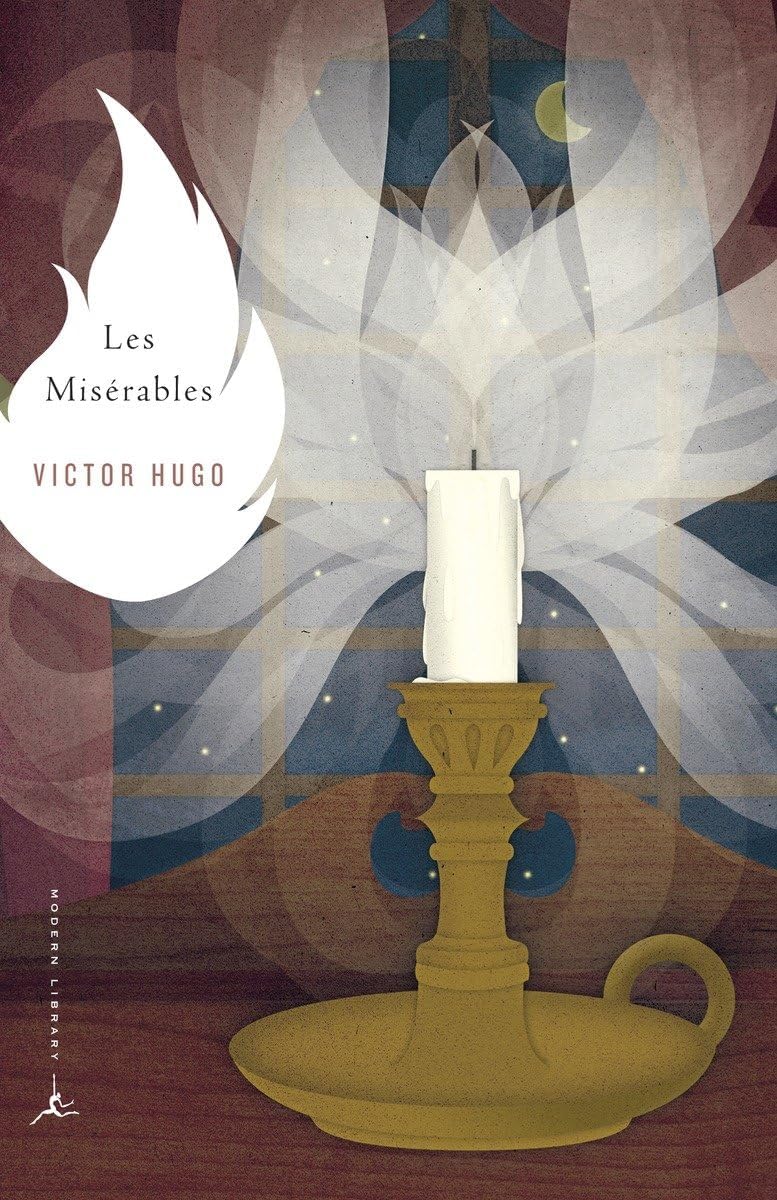
Les Misérables (Modern Library Classics)
Desertcart purchases this item on your behalf and handles shipping, customs, and support to Hong Kong.
Description
Translated by Julie Rose Introduction by Adam Gopnik In this major new rendition by the acclaimed translator Julie Rose, Victor Hugo’s Les Misérables is revealed in its full, unabridged glory. A favorite of readers for nearly 150 years, this stirring tale of crime, punishment, justice, and redemption pulses with life. Featuring such unforgettable characters as the quintessential prisoner of conscience Jean Valjean, the relentless police detective Javert, and the tragic prostitute Fantine and her innocent daughter, Cosette, Hugo’s epic novel sweeps readers from the French provinces to the back alleys of Paris, and from the battlefield of Waterloo to the bloody ramparts of Paris during the uprising of 1832. With an Introduction by Adam Gopnik, this Modern Library edition is an outstanding translation of a masterpiece that continues to astonish and entertain readers around the world.
Specifications
| Asin | 0812974263 |
| Dimensions | 5.2 x 2.28 x 7.99 inches |
| Isbn 10 | 9780812974263 |
| Isbn 13 | 978-0812974263 |
| Item Weight | 2.18 pounds |
| Language | English |
| Print Length | 1376 pages |
| Publication Date | July 14, 2009 |
| Publisher | Modern Library |
Reviews
User
Magnificent Novel; Magnificent Translation
I recently listened to an excellent Radio Theatre production of this incredible story, which inspired me to pick up the book again. I read it during High School, loved it, then saw the musical, and loved it even more. It has been several years now, so I decided that now would be a good time to re-visit this classic story which made such an impression on me when I was fifteen.I went back to my local library and borrowed the same copy I read as a teenager, an antique book originally published in 1915 and translated by Isabel F. Hapgood. One afternoon, I was browsing through Barnes and Nobles when I came upon this copy. I was instantly grabbed by the art on the jacket binding of this beautiful hardcover version, and I grew even more interested when I learned that it was a new translation by a woman named Julie Rose. I compared several sections with the older version, and was struck by how much more I liked the newer one. For instance, here is an excerpt from a conversation between Jean Valjean and the ragamuffin, Gavroche:Hapgood (1915):"The letter is for Madamoiselle Cosette, is it not?"Cosette," muttered Gavroche. "Yes, I believe that is the queer name.""Well," resumed Jean Valjean, "I am to person to whom you are to deliver the letter. Give it here."Gavroche held the paper elevated above his head."Don't go and fancy it's a love letter. It's for a woman, but it's for the people. We men fight and we respect the fair sex. We are not as they are in fine society, where there are lions who send chickens to camels.""Give it to me.""After all," continued Gavroche, "you have the air of an honest man.""Give it to me quick.""Catch hold of it." And he handed the paper to Jean Valjean. "And make haste, Monsieur What's-your-name, for Mamselle Cosette is waiting." Gavroche was satisfied with himself for having produced this remark.Rose (2008):"The letter's for Mademoiselle Cosette, isn't it?""Cosette?" growled Gavroche. "Yes, I think it's some funny name like that.""Well, then," Jean Valjean went on, "I'm the one who's supposed to hand her the letter. Give it to me."Gavroche held the note up above his head. "Don't go getting the idea that it's a love letter. It's for a woman, but it's for the people. We men, we're fighting men, and we respect the sex. We're not like in high society where there are nobs who send sweet nothings to slack cows.""Give it to me.""Actually," Gavroche continued, "you look to me to be a good sort of geezer.""Give it to me quick.""Take it." And he handed Jean Valjean the note. "And get a move on, Monsieur Thingummyjig, because Mamselle Thingummyjig is waiting."Gavroche was very pleased with himself for having come up with this line.Rose's version sounds closer to what a street urchin such as Gavroche would have said. Another example: Instead of Madame Thénardier saying, "How easily children get acquainted at once!" she says, "Kids! See how well they get on already!" Isabel F. Hapgood calls the Thénardiers "unprepossessing figures" and Julie Rose calls them "shady characters." The second word choice paints a much better mind picture for the modern reader.Another advantage for the modern reader: this translation is more understandable. For instance, this is what the doctor says as he considers the possibility of a miraculous recovery for Fantine:Hapgood (1915):"There are crises so astounding; great joy has been known to arrest maladies; I know well that this is an organic disease and in an advanced state, but all those things are such mysteries: we may be able to save her."Rose (2008):"There are some amazing recoveries, great joy has been seen to put an end to disease. I know this one is an organic disease and fairly well advanced, but it's all such a mystery, all that! Perhaps we will save her, after all."Aside from giving the reader an arresting, clearer understanding of the text, Julie Rose also provides more of Hugo's original novel than ever before. In her preface, she explains how often other translators would omit "offensive" content or "useless" details, and that, to her knowledge, she is "one of the few translators to have rendered all of Hugo's magnificent novel without censorship." Because of this, Les Miserables has finally been presented in an English version closer to what Victor Hugo originally intended.So on my second read, I am not only reading more carefully because of my love for the characters, but I am also looking at them as though through a new, clearer, prescription of glasses. For that, I am very grateful to Julie Rose. This is a book I will treasure for years to come.p.s. I would also highly recommend the dramatized audiobook I mentioned at the beginning of my review. Here is the link: http://www.amazon.com/Mis%C3%A9rables-Radio-Theatre-Victor-Hugo/dp/1589973941/ref=sr_1_8?ie=UTF8&s=books&qid=1229374558&sr=1-8. It's a gripping, faithful interpretation of this classic.
User
Amazingly good.
Let me first say, I became interested in reading Les Miserables after watching the 10th Anniversary Concert. I took some time after that to look around the web and try to find out whether there was a consensus "best translation" of the Brick, and Julie Rose's translation was mentioned several times. I chose hers, in particular because I wanted an unabridged version, and I am so very glad that I did (especially after comparison to the public domain version by Hapgood, which I find nearly unreadable in places).After reading through the reviews here, and seeing a lot of criticism of Rose's work, I wanted to say a few words in support of it. And I think that the best possible thing I can say about this translation is how completely engaging it is. Even when I was leafing dejectedly through 42 pages about the Battle of Waterloo, desperately hoping to get back to the characters I was invested in, the prose was still interesting and engaging; I could tell that Hugo felt it was important to include his little digressions from the characters' narrative, and I was compelled to read through faithfully and not skip ahead to the 'story bits'. Now, you could certainly give all the credit for a masterfully-crafted literary work to Hugo himself, but I think it would be unjust not to applaud Rose for being able to convey into English whatever it is about those 'boring' sections that still made me enjoy them. In my preliminary web browsing about the book I had seen people bemoan the sewer passage, for example, and I was dreading it, but when I got to it I actually found it fascinating and a very quick read.I did not study French, and can't attest to how 'faithful' Rose's translation is. But I have done a (very) little translation work in another language, and I am frankly shocked that anyone would thumb their nose at this work. Rose had the task of conveying mid-19th century French prose, with its idioms and colloquialisms, into - and this is the vital part - *comprehensible* 21st century English, and I feel she did so admirably.- Is her English perhaps not 100% American English (a complaint I've seen here)? Perhaps - but why should it be? It is my understanding that Rose is Australian.- Does she add words where Hugo had none? I couldn't tell you, but if it was in the interest of providing more context to the reader, I salute it.- Does she use colloquialisms that aren't 1-to-1 literally what Hugo used? Almost certainly, if her goal was to sound natural to an English-speaker. Slang from even a decade ago can sound ridiculous now, so why should a translator be expected to use contemporaneous phrasing if they want people to understand what they're reading?I will certainly go on now to read the Signet edition also, but I am buying Rose's translation too and couldn't be more delighted about it. Translation is hard work, and if the intensity of my emotional and mental reactions to the story are anything to go on, Rose gave us a very fine product indeed.
User
A Masterpiece of Heart and Struggle: Les Misérables
Les Misérables is a towering epic that weaves thriller, romance, action, redemption, sacrifice, and coming-of-age into a tapestry that grips your soul, much like The Count of Monte Cristo. Its emotional depth and sprawling stakes make it unforgettable, even if it’s a beast to conquer. Jean Valjean’s arc is the heart of the story—a man broken by hardship, transformed by grace, who pours his life into others. As Hugo writes, “Jean Valjean, my brother, you no longer belong to evil but to good. It is your soul that I am buying for you; I am taking it away from black thoughts and from the spirit of perdition, and I am giving it to God.” His journey, giving wealth to the poor and raising Cosette, echoes Edmond Dantès’ redemption, sparked by a pivotal figure who shifts his path. Yet, his past clings like a shadow, proving that good can’t erase bad, though it can save a life.Marius’s story surprised me, a lens to see Jean’s goodness through another flawed, noble soul. His arc, finding love and purpose, expands the narrative’s heart, reminding us, “The ultimate happiness in life is the conviction that one is loved; loved for oneself—better still, loved in spite of oneself.” Cosette, a survivor, carries a lovable warmth, though her early fragility makes her growth into strength by the end all the more rewarding. Hugo’s words capture her essence: “To love another person is to see the face of God,” tying her to the story’s core of love’s transformative power.But Hugo’s tangents—endless dives into French revolutions, sewers, and slang—drag the pace. I craved more of Jean’s soul, not Paris’s history lessons. For history buffs, it’s a feast, but it clogs the story’s flow, making the prose feel clunky at times. As Hugo notes, “Yes, the bishop said, ‘you have come from a place of sadness… If you come out full of goodwill, gentleness, and peace, you are worth more than any of us.’” This speaks to the book’s redemptive hope, but the long-winded detours test patience.Despite this, Les Misérables is a masterpiece. It’s a rollercoaster—thrilling, wrenching, reflective—that leaves you awed by its humanity. The emotional payoff, from sacrifice to love, rivals East of Eden’s family sagas. It’s not perfect; the history weighs it down, reducing readable joy. But its grandeur, driven by characters who breathe and ideals that soar, makes it worth the wrestle. Hugo’s vision—love and redemption triumphing in a messy world—sticks with you, a testament to why this epic endures.
User
it's one of the greatest stories ever told
I really don't have much to say about the content of the book besides that in my opinion, it's one of the greatest stories ever told, and that the many many adaptations of this story might all be fantastic, none is quite as emotional and thought provoking as the original story told by Victor Hugo.Being on this page, though you probably already know that and are looking for a good version to buy. I don't know four words of French, I had to look up the pronunciation for half of the words said in this book (Which is especially difficult when you have to read names like "Chanvrerie" or "Montreuil-Sur-Mer" 50 times in a chapter), so I can't tell you how true it is to Hugo's original work. All I can say is that comparing some of the text with excerpts I've seen, it's pretty much the same wording and feel, only a little more palatable.As far as readability goes, I read this in about 3 weeks, several hours a night without getting too bored or frustrated (Although I was incredibly bored at some points when Hugo was going off on some tangent dealing with morality or lengthy encyclopedic descriptions of fairly minor points). It's written in a way that's easy to read, yet isn't watered down. This book was written for college level reading, but it's not like reading Immanuel Kant. If the size of this book worries you (1200 pages), I would still recommend an unabridged version. If you have no interest in Waterloo, Convents, or slang, it's very easy to skip those chapters as Hugo tells you when the story stops and when it picks back up. I've heard of many abridged versions that skip entire sequences like when Valjean goes to retrieve Cosette (one of the most exciting parts, in my opinion)I guess it really depends on what you want to get out of this book. Are you looking for insight into Hugo's mind? The gist of what he's saying is in this book. Is it EXACTLY what he was trying to say? I couldn't tell you. I would suggest learning French if that's what you're after. If you just want to read the story, and not have to constantly reread lines, or worry if you somehow missed part of the story, I'd recommend the Julie Rose translation.
User
The Definitive Translation of a Powerful Novel
I advise those perusing these reviews to take with a measure of salt the dogmatic pronunciations on the quality of Rose's translation. Provenance is important, and one should always "consider the source." (Yes, even with me.)A number of interviews with Rose are available online, in which she discusses her work, and her work on this novel. The novel has a lengthy and detailed Translator's Preface, in which she discusses the novel, the translation process, and her approach to it. You also can find online some independent articles about this translation.The great translator of Spanish language literature, Edith Grossman, said:"I can't say what makes a book translatable, but I do think that all texts can be translated. The question of whether or not a work is "translatable" stems from a mistaken and widely held notion that a translation is really a one-for-one set of equivalences with the original--a straightforward lexical problem--when in fact it is a rewriting of the first text. Some, of course, are immensely difficult (they're usually just as difficult in the original) and challenge the translator's sensitivity to nuance, levels of meaning, and artistic impact in both languages. I see my work as translating meaning, not words."Rose has spoken similarly about her work."I think the essential difference is that...and I'm not saying that translators always have to do this, there are reasons for departing a little bit further from a writer's text where it just won't work in English. I found on the contrary what really worked better in English was to follow Hugo much more closely than anyone else seems to have done. So I've actually followed his syntax as closely as possible, I've followed the rhythm of his sentences and I've actually broken it up the way he has and stuck more closely to what he says." -- Julie Rose, interview, 2009She's translated more than thirty French works into English -- plays, poetry, novels, genre fiction. She worked on Les Miserables for three years. She has been awarded three international prizes for her translations. I'm willing to take the leap of faith -- she is "fluent in French." I recommend others accept the facts in plain sight, and do likewise.I stopped reading works in translation in the early 1980s, and didn't start up again until around 2005. The reason I stopped was that I concluded that I could not hear the author's voice in the translated work. The reason I started again was that Rose, Grossman, and some others showed that they understood this challenge, accepted it, and that it is possible to capture the author's voice in a translation, by actually listening to the author's intent.According to one account, the Rose translation is almost 100,000 words longer than the 1976 Denny "translation" -- that's how much material he excised from the novel to "improve it." Denny, in fact, is on record as saying that Victor Hugo was a terrible writer, and needed some "tidying up." If you're just looking to pad your reading CV with another of the "great books," then it doesn't matter which one you read. Might as well go with a shorter one. If you're looking to read the translation of Les Mis, that will make you feel like you are reading the original, hearing Victor Hugo's voice, then pick up Rose's translation.
User
superlative translation
While translations are much a matter of taste, the Julie Rose translation in my opinion comes the closest of all the 3 major translations in capturing the "spirit" of Victor Hugo in a contemporary English style, his robust love of life, his bawdiness, his sense of humor and his monumental appetite for experience, his "exuberance and gusto," as Ms. Rose explains. French critics have long long ago taken the very stilted and outdated Charles Wilbur translation of 1876 to task for being more awkward and pretentious in English than the original is to French readers, and that is a very important point. If you wish a 19th century American or British experience reading Les Miserables, then by all means go for the Charles Wilbur - or the updated but still very formally British Norman Denny translation (1976). Both of these translations are guilty of substituting Anglo Saxon propriety for Hugo's vast appetite for lustful experiences of all kinds and the result is eminently, respectfully dull. But it is not the French experience of reading Hugo in the original. Hugo is anything but pretentious in the original, but the Wilbur and Denny translations are, sadly, just that, Denny less so. Furthermore, both earlier translators assumed there were things in Hugo you should not be allowed to read, both for propriety's sake and because of - in their judgement - Hugo's "excess." Do you really wish to read a censored version of Les Miserables. If not, go for the Julie Rose, painstakingly translated from the original French with all the odd and bawdy bits left in. Yes Ms. Rose may err occasionally on the side of too much easy familiarity and casual speech (referring to a restaurant as a 'greasy spoon'), but she was trying in a way Wilbur and Denny did not attempt, to capture the "spirit" of Victor Hugo, the sense of the man, the humor, the pathos, the bawdiness, as well as the compassion and the outrage that come across in the original French. For all of her irreverent phrases and expressions, Ms. Rose has finally given us a translation that pulsates with the vibrancy and irrepressible energy of the original.
User
A Masterpiece
This is an extraordinary novel. Its themes are as broad as those explored by Tolstoy in "War and Peace" -- the nature of love and redemption, Napoleon's downfall, and the misery created by an unjust social system. The lead character, Jean Valjean, who after spending 20 years in jail for stealing a loaf of bread is redeemed by an act of kindness from a local bishop and who then lives a model Christian life, is one of the most charismatic characters in all of literature.The book was a popular success for its time. And there are points in the book -- Jean Valjean's various escapes, his flight through the Paris sewers, the trial, the various confrontations with Thernadier -- that are absolutely riveting. But the book is not always well suited for the modern reader. Hugo makes many lengthy digressions and is an intrusive author. As a consequence, I put the book down several times, and it took me about a year to read. Still, it is worth the effort.The translation is striking for its familiar and often colloquial language. Some of the reviewers have criticized this for straying too far from Hugo's literal text. Fair enough, but the book is hard enough to slog through for the modern reader, and Ms. Rose's translation does make the book far more accessible.A masterpiece.
User
Summer reading
Every summer since I was about 15, I have chosen a BIG book to read over the summer. The reason for this is I want one book that will last the entire summer and one that has depth so that I sort of live with the characters. Summer is usually less stressed as well, so reading a long book that is a classic feels easier to do and is fun in the sun! This summer I chose Les Miserables by Victor Hugo and the version that was availabale online at Amazon.com is perfect in every way. I am one of those readers who want their book to "feel" a certain way--the pages, typeface, and actual size of the book matter. Even the cover art is important to me. Now, unless you are one of "those readers" too, you won't understand this criteria, but if you are, you will understand immediately what I'm talking about and this version is just right! It has a chronology in the front to help the reader sort through what is happening, and it has notes in the end to help the reader understand the action. The introduction by Adam Gopnik and the translators preface made me want to dive right into the book! Officially I wait until the Summer Solstice to begin my summer reading--it is a whole ritual with me. Since I haven't read it yet, I can't comment on the content of the novel, but as a well known clasic, I also don't feel I need to here. This review is more about the physical book itself. As usual the shipping from Amazon was quick and well packed. Thank you Amazon for being my alternate bookstore. Happy Summer reading!
User
Amazing novel
I bought this book only because it is a classic, so that I could say I've read it. I was unfamiliar with the story and had never seen a stage production of Les Mis in musical theatre. I am only 200 pages into the novel and I am completely captivated. Victor Hugo was a master at character development, providing an insight of a character that delves deep into their mind and soul. When reading of the character Fantine, and her descent into a hellish existence of poverty and despair, it was difficult trying to keep it together emotionally. The imagery that Hugo's words provoke is extremely vivid.
User
You saw the film... you should have read the book instead
I went to see the film not knowing it was a musical (er, yes) and when R. Crowe opened his mouth and out came a computer assisted voice my heart sank, but I endured the following two hours of torture only by holding on to the idea that when I got out of the cinema I would buy the best available translation and read it in its entirety. Julie Rose's translation is the best available translation, and it is marvellous. I cannot praise it too highly. I'm a translator (not of French, but Persian) and I think I know a good translation when I see one. It should say 'This Will Change Your Life' on the cover but anyway, I'm sure you'll be re-reading it when Mr Crowe and company are long faded from the memory.
User
LES Miserables
Libro in lingua inglese
User
Wrinkled front cover and dirty book edges with grease
I bought this title when there were two in stock. Lo. The book is not in good condition. However the book content is not affected.
User
Super
Alles bestens.
Common Questions
Trustpilot