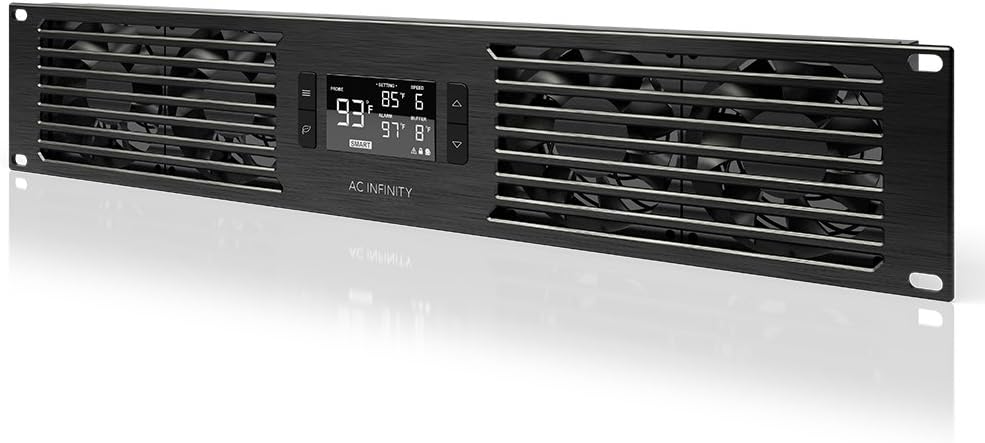
❄️ Stay cool, stay ahead — the silent guardian your rack deserves!
The CLOUDPLATE T7-N is a 2U rack mount fan panel engineered for efficient intake airflow (50-220 CFM) with ultra-quiet operation (10-36 dBA). Featuring a programmable thermostat controller with automated speed control and alarm warnings, it safeguards AV, home theater, and network equipment from overheating. Crafted from premium anodized aluminum with CNC detailing, it combines durability with a sleek professional look, fitting standard 19” racks seamlessly.


S**L
Great quality, many operating modes, runs quiet!
Used in an Omnimount av rack to keep the AVR cool. Easy to setup (set the temperature buffer and max fan speed) and the smart mode is perfect. Runs fans in low/quiet to maintain and responds to temperature increases as needed by turning up the fans. We had previously been using a WILLHI WH1436A Temperature Controller to operate the pre-installed fans in the Omnimount rack - but they only run at 1 speed and are seriously loud. The AC Infinity Cloudplate keeps the AVR cool, runs itself and is quiet. For AV racks, these fans are sensational.
A**N
High quality thermal solution
High quality thermal cooling in our new Home network rack system. Fans are well designed, offer good airflow, and added to the look and serviceability of our rack. Fans are well finished, heavy gauge and very presentable. Almost a shame to lock them behind a wire front cabinet in a server room. Sound levels are well within norms for this application. Displays are easy to read and very intuitive. Highly recommend for use.
A**R
High Quality product with excellent value. Highly Recommended for your rack cooling needs!
This unit is extremely well built and looks and functions great! This is a great value at it's price point, and the different modes allow me to customize the sound levels and air flow for the needed situation. Great if i'm recording in the studio, or performing live on stage. Highly recommend this product!
J**N
The best game in town needs some work.
Largely, liking this depends on your threshold for acceptable noise which is different for everyone and every situation. Fortunately, there’s a couple of things that can be done about that as this seems to be the most capable controller in town at the moment. I like good product design and packaging but I don't think it makes up for product limitations of which there are a few with this ecosystem. But, the lack of competitive products doing the same thing on the market gives AC Infinity the advantage of being more or less the only game in town with its feature set. That being said there's a lot of upsides to their product, it's simple, modular, affordable, and very straightforward for the average consumer to get some results. If you aren't the average consumer you might be disappointed. (A person with a rack in their house should probably not consider themselves the average consumer anyhow). For me, I wasn't willing to accept the noise of their fans both internal and external variants, even on the absolute lowest fan setting. So, this product left me saying, well, how can I take this attractive, simple fan controller and make something that better suits my needs (lower noise, better performance, greater range of speed control). Unfortunately, AC Infinity Product reps answering questions on amazon have been pretty obviously cagey about the compatibility of their controllers with aftermarket fans, seemingly with the goal of keeping people purchasing only from within the AC Infinity ecosystem. After all, really all of these products are built around one piece of technology and reutilized in different form factors: their fan controller module / fan units. I think it a bit silly given this fact that they haven't spent more effort on their fan design. If they wanted to be more accommodating, they could have easily provided standard headers in the rear of the unit. Anyhow, let me provide some clarification for anyone curious (and please, follow this advice at your own risk and understanding it's likely voiding of your warrantee): Note: On my to-do list is determining what exactly are the voltages provided at the six speed settings for both 5V and 12V fans (the range doesn’t seem impressive). I’ll update this review when I have time to address that. The fans: There is nothing proprietary about their fans. There's no locked rotor or other feature that would prevent let's say a Noctua from being used. However, they've gone to great lengths to discourage this and encourage using their own product line. This would be fine, however their fans are quite noisy and in my homelab environment they just aren't cutting it. Intake vs Exhaust: there’s nothing in the controller that defines intake or exhaust, just the direction the fans are facing. You are able to swap from intake to exhaust simple by changing the direction the fans are facing. Plugs and Voltage: The DC jack connected fans operate at 12V, the USB connected fans operate at 5V. Noctua makes a great 5V variant of their flagship fan that includes a USB adapter. Speed Control Mechanism: None of the fans utilize a PWM signal, only voltage control. External fans utilize only +/- 12V, while internal fans connect the Tach signal. I'm not sure how the signal is used by the microprocessor but likely as a fan fail alert. That would indicate to me that fan fail alerts are not possible utilizing external fans. This also means it's totally possible to use the resistor method / Noctua Low Noise Adapters for even lesser noise on external fans, or even internal if you can fit it, should you choose. It will not trigger a failure mode. Connectors: Models with internal fans use mini-JST type connectors. Adapters are plentiful on Amazon as it is frequently used as a standalone GPU fan header. Or, you can make your own and swap them out. Their pin out is standard. When replacing internal fans, be mindful to remove the display assembly carefully. Keep it held together, and pay attention to its position. Work on an uncluttered surface to keep track of parts and screws. Things are a little cramped in there and this is delicate. For the internal fans it’s possible to completely remove the female JST header (carefully!) with a pair of electrical pliers and the pins will remain intact. Then, you can plug a 3 pin or a 2 pin fan directly into those pins without resorting to adapters or making custom cables. It worked like a charm for me. However, a 4 pin fan will not fit as there are nearby caps and components. For the external DC Plug you want a 5.5 x 2.1mm barrel power jack adapter, in which there are two screw down terminals for the +12V and -12V that will accommodate virtually any fan in production. For 3 or 4 pin fans, simply omit connecting those pins. For multiple fans on one port, know the difference between connecting them in series or parallel. For the USB external connector all you need is a 4-pin (will also work fine for 3 and 2 pin male fan plugs) PWM to USB fan adapter and if using multiple fans. For multiple fans on the same USB port you’ll also need a fan splitter or usb splitter depending on how you want to address it. Again, familiarize yourself with what it means to connect these in series or in parallel. Hope that helped sort out a lot of the confusion that seems systemic with this product.
J**Y
Beware: Made in CHINA
The product seems to be very sturdy and well-built. However, AC Infinity omits the fact that it is made in China while, at the same time, touting on their website that they are an American technology company based in the City of Industry, California, leading me to believe that the product was made here as well. While I like the features and performance of this rack fan, I was very disappointed to see "Made in China" written on the label on the box. I was led to believe that this is an American product; sadly, it is NOT. I am still undecided as to whether or not I'm keeping it, but one thing I know for sure is that I will NOT be buying anything else from AC Infinity again. Minus 1 star because it's made in communist China. In the "City of Industry," are they unable (or unwilling) to find a machine shop to make the rack plates? Is there not a company that makes 80mm computer fans? We need to break our "dependence" on foreign countries, especially China. There is no reason that this could not have been manufactured here in the US. Also, the item description states the noise level is 10-36 decibels. At the lowest speed, I think this is higher than 10db. In a radio studio (where this is being used), noise is a big issue. EDIT - 4 Years after purchase: This has held-up pretty well. I just fully dismantled it and vacuumed-out a bunch of dust that gathered in it over the years...wow. Makes me wish they had integrated some removable, washable dust filters for the front of this thing. 4 years and it's still going strong despite all that, though. All the fans still work, work smoothly, and don't make any odd noises. One qualm I have with the internals is that they hot-glued all the connectors onto the circuit board, making removal difficult. These are standard 3-pin 12-volt DC 80mm fans, but they do not utilize the standard 3-pin case fan connector. Instead, they use a different 3-pin wafer connector. Seems like a pretty standard connector for PCB's but not for fans. So if you plan on replacing the fans, be prepared to identify and source the connector, or to do some splicing. Also, one of the screws holding one of the PCB's down had a stripped head, and I never opened this up before so it surely wasn't me. I also noticed that a good number of the fan screws holding the fans on in the back had been over-torqued, so a lot of them would not fully tighten and kept spinning. POOR quality control in manufacturing!!! Makes sense since it was made in CHINA. Another thing is I paid $109 for this on May 8th, 2020, and now it is May 9th, 2024 and costs $129 for the same product. Unless manufacturing processes have moved to the US and/or improved, the price increase is not justified in my opinion. Call it dumb luck that I serviced this 4 years almost to the day from buying it, and decided to re-visit my review.
Z**F
Very good cooling setup for networking cabinets
I added this to my networking cabinet to cool my Ubiquiti gear. Works great, and looks wonderful doing it. I love the smart settings with a set buffer. Depending on the heat inside the cabinet it can self adjust the fan speed, and it works great. So far the cabinet has been to 72F under load and about 67F idle with these fans and AC Infinity quiet muffin fans in the top of the cabinet exhausting air. Very Very Very nice fan plate, feels and looks like it costs 3x more.
W**A
Perfect, bought 4 of them
Needed to really move some air in a new rack of video components in our Mobile Broadcast Trailer. Even with great AC it still gets hot in the production trailer in the middle of the summer in South Georgia during the day. Bought 3 of these and one a bit larger. Some blew in some blew out. Work great and they are really quite. Daisy chain power supply is very handy and like the sensors that you can locate about anywhere in cabinet to monitor temp. Will be buying more for my other racks real soon to replace noisy privative fans without the monitoring these have.
R**N
Great product
I bought this for my 15 yr old Mid-Atlantic rack with two of their cooling fan systems that remain on continuously. Once installed the AC Infinity was quieter, and Cools rack in 5 min and then turned off on the Auto setting. It’s well made and efficient. I have it installed in one rack and it Cooled both of my racks ( connected racks). Right now using Mid.Atlantic fans for exhaust but i may switch to AC Infinity exhaust fans as they can be set on auto as well. Highly recommend this product.
Trustpilot
2 months ago
1 month ago