We remain fully operational. Our teams are working around the clock to ensure your deliveries continue safely.

DOWNLOAD THE APP


Customer Services
Copyright © 2025 Desertcart Holdings Limited
DOWNLOAD THE APP


Buy anything from 5,000+ international stores. One checkout price. No surprise fees. Join 2M+ shoppers on Desertcart.
Desertcart purchases this item on your behalf and handles shipping, customs, and support to Hong Kong.
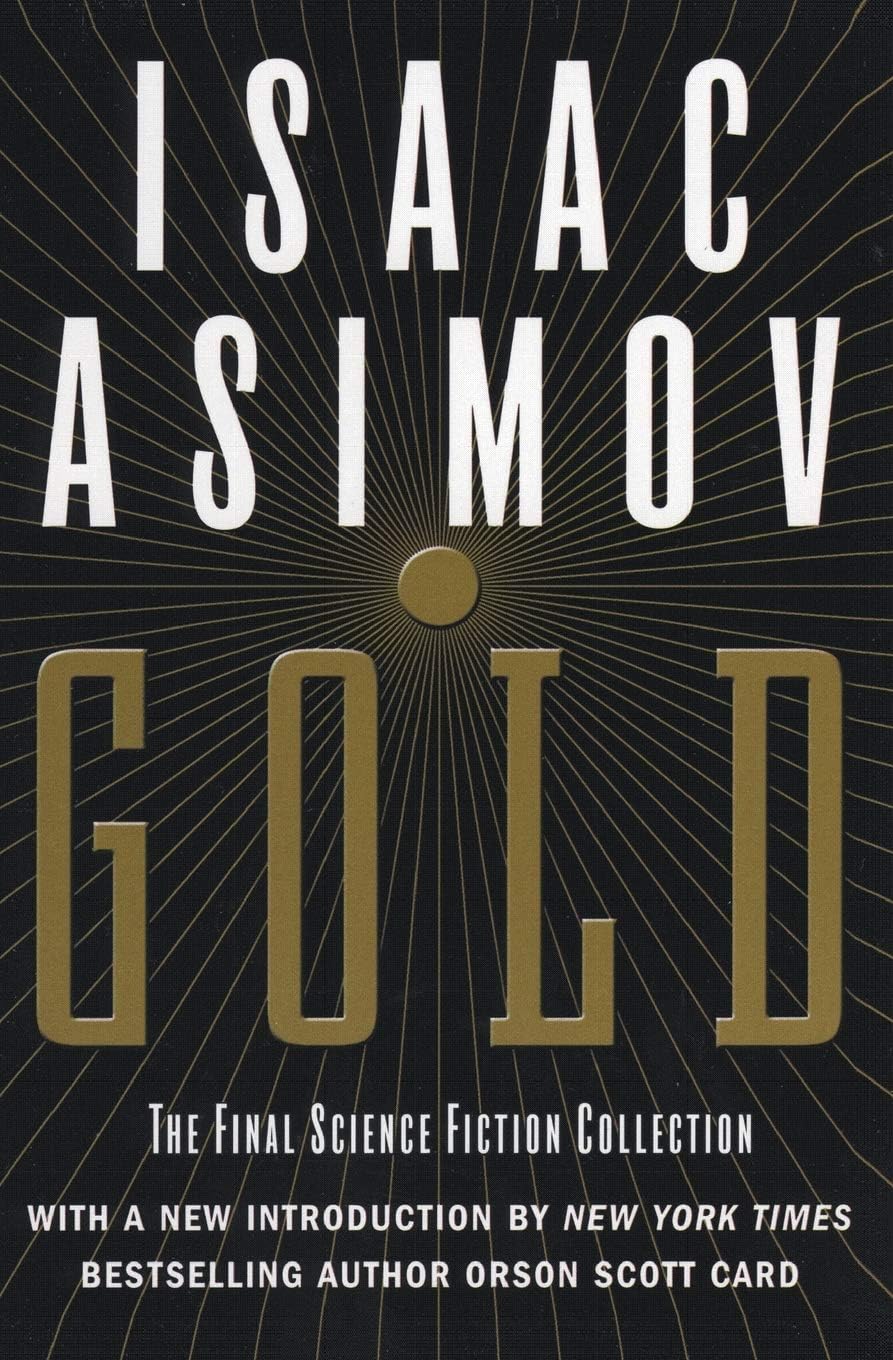
desertcart.com: Gold: The Science Fiction Genius's Final Collection – Profound Stories and Reflections on Immortality (The Final Sci Fi Coll.): 9780060556525: Asimov, Isaac: Books Review: Get into Asimov's head - I enjoyed this very much For the last half of the book is a series of essays on Asimov's mind and how he thought and wrote. It explained how he wrote and why. I felt that I got to know him as a person and I would have liked him as a friend. Review: Fiction so so, nonfiction good to great - I've read lots of Asimov's fiction and always very much enjoyed it. Unfortunately most of the fiction in this book did not measure up. Yet, I very much enjoyed most of his nonfiction musings in this book. Overall worth it. I did enjoy Cal, the first short story.


| Best Sellers Rank | #1,122,850 in Books ( See Top 100 in Books ) #712 in Short Stories (Books) #712 in Science Fiction Short Stories #878 in Science Fiction Anthologies (Books) |
| Customer Reviews | 4.3 4.3 out of 5 stars (354) |
| Dimensions | 5.31 x 0.94 x 8 inches |
| Edition | Reprint |
| ISBN-10 | 0060556528 |
| ISBN-13 | 978-0060556525 |
| Item Weight | 10.4 ounces |
| Language | English |
| Part of series | The Final Sci Fi |
| Print length | 416 pages |
| Publication date | October 21, 2003 |
| Publisher | Harper Voyager |
L**G
Get into Asimov's head
I enjoyed this very much For the last half of the book is a series of essays on Asimov's mind and how he thought and wrote. It explained how he wrote and why. I felt that I got to know him as a person and I would have liked him as a friend.
K**0
Fiction so so, nonfiction good to great
I've read lots of Asimov's fiction and always very much enjoyed it. Unfortunately most of the fiction in this book did not measure up. Yet, I very much enjoyed most of his nonfiction musings in this book. Overall worth it. I did enjoy Cal, the first short story.
J**.
not what I expected at all
Asimov, among my favorite writers. Science Fiction, among my favorite genres. And there was NO SCIENCE FICTION in this book! But it was spectacular!
A**N
2 Star for the Fiction. 5 Star for the Essays. A Master at the End of His Career. 63% Positive.
GOLD: THE FINAL SCIENCE FICTION COLLECTION RATED 63% POSITIVE. STORY SCORE 3.33 OF 5 15 STORIES : 1 GREAT / 6 GOOD / 5 AVERAGE / 3 POOR / 0 DNF and 37 ESSAYS ON HIS FICTION AND WRITING At the risk of this blog getting morbid, here is another posthumous collection by one of the masters of the science fiction genre. This time it is one of “The Big Three,” Isaac Asimov. Gold is exact what it says on the cover: Asimov’s Final Science Fiction Collection. But it is more than that. Every truly great author gets to a point where editors will publish anything they write. That was certainly true for Asimov. . Nearly every man who is lucky enough to get to old age, sees a decline in the quality of work during the last years. This was also true of Asimov. Many of these stories shouldn’t have been published and wouldn’t have been with a different byline. Even the good stories aren’t innovative in the way his previous thousands of stories had been. Even when he has a cool new idea - and its rare - he doesn’t seem to be able to work it through to the proper conclusion. It gives me no pleasure to write this, Isaac Asimov continues to be one of my favorite writers. Yet, I recommend reading this book. Very little of it is actually made up of the short stories. There are 37 brief editorials by Asimov which include essays and thoughts on the craft of science fiction writing. They are crucial to understanding Asimov’s legacy beyond his fiction. His insights into writing are filled with practical advice, historical context, and reflections on the genre's evolution. These sections are especially significant because they capture Asimov’s voice as a mentor and intellectual figurehead within the science fiction community. It is so rare that science fiction editorials are represented, this is a gem that deserves to stay in print for future generations of sci-fi lovers. There is also a beautifu defense of Isaac Asimov’s writing style by legendary author Orson Scott Card. Card describes Asmiov’s style as the “American Plain Style.” I quote that introduction at length below for those who think of Asimov as a ‘bad writer’ when compared to today’s MFA influenced fiction style. "The American Plain Style is devilishly hard to bring off well. Because there is great art in seeming artless; one must grind the lens very smooth indeed to make it perfectly clear. What the American Plain Style celebrates is the democratic ideal. The writer declares, by making his language as clear and accessible as possible, that he values all readers and wishes to invite them to participate in his conversation. The Plain Style closes no doors, draws no veils across the meaning. Let’s all sit down together and tell our tales, says the Plain Style writer. Let’s put on no airs, nobody’s impressed by that sort of thing. There’s none of us better than any other; only the story itself matters, only the ideas. When American Plain Style is done well, readers never notice the writer or the writing at all. They are completely immersed in the story or essay, receiving it as if it were unfiltered by any other mind. Of course it is filtered; it was completely created by another mind. But because the reader is never reminded of it, the ideas and events recounted in that style are likelier to be received without doubt. … But the purest, clearest, most fluid, most effective writer of the American Plain Style, ever, was the man whose stories and essays you now hold in your hand: Isaac Asimov. — Orson Scott Card" Only One Story In This Collection Makes The All-Time Great List: Gold • (1991) • novelette by Isaac Asimov Great. A famous artist is asked to adapt a science fiction story into a multimedia computer-generated play. The story is quite obviously “The Gods Themselves” by Asimov. This artistic transition leads him into a profound exploration of art, technology, and the essence of storytelling. New dimensions of both his work and the future of art are revealed. Another very interesting story in light of 2024’s conversations about A.I. art. *** GOLD: THE FINAL SCIENCE FICTION COLLECTION 15 STORIES : 1 GREAT / 6 GOOD / 5 AVERAGE / 3 POOR / 0 DNF and 37 ESSAYS ON HIS FICTION AND WRITING Cal • [The Positronic Robot Stories] • (1990) • novelette by Isaac Asimov Average. What happened in the middle of this story? It starts as a superb story as a robot who works for an author gets inspired to write fiction. He keeps failing hilariously because of the “Three Laws of Robotics.” Then the robot ends up writing an entire Azazel story, which is pretty lame because Asimov thinks these are funny and they really aren’t. Went from a superb robot story with implications for our A.I. Writing world to a gooey bit of nothing. Sad. Left to Right • [Probability Zero] • (1987) • short story by Isaac Asimov Average. Silly short-short that is basically a pun on a fellow sci-fi writer’s name. Frustration • (1991) • short story by Isaac Asimov Good. Kinda preachy story about why a computer will never come up with a reason to goto war. Hallucination • (1985) • novelette by Isaac Asimov Good. Sam Chase arrives on Energy Planet for a specialized education in gravitational engineering. He is intrigued by rumors of hallucinations experienced by other members of the crew. Sam explores outside the dome that protects the settlers and, in the process, discovers secrets of the planet and the hallucinations. The Instability • (1989) • short story by Isaac Asimov Average. Short-short about time travel and unfortunate cosmic side effects. Alexander the God • (1995) • short story by Isaac Asimov Good. A brilliant young man named Alexander wants to conquer the world. He creates a computer that gives him every he ever wanted. In the Canyon • (1990) • short story by Isaac Asimov Good. Short-short epistolary story about the optimism over starting a hard life on a new world that only future generations will really enjoy. Good-Bye to Earth • (1989) • short story by Isaac Asimov Average. Self sustaining habitats above the Earth face challenges that may lead to Earth becoming isolated. Battle-Hymn • (1995) • short story by Isaac Asimov Poor. One of Asimov’s silly pun-stories about trying to get consent to use Martian territory through wordplay. Feghoot and the Courts • (1986) • short story by Isaac Asimov Poor. An even worse, even shorter, pun story. Wombat-shaped aliens are studied. Fault-Intolerant • (1990) • short story by Isaac Asimov Good. A very thinly veiled Isaac Asimov gets a computer that takes over more and more of the writing. Interesting in light of current controversy on a.i. writing. Kid Brother • (1990) • short story by Isaac Asimov Good. A family gets a robot as a brother for a very nasty kid. The Nations in Space • (1995) • short story by Isaac Asimov Average. A preachy short story with the written moral about two societies learning to live together. The Smile of the Chipper • (1988) • short story by Isaac Asimov Poor. Two brilliant men compete over a woman and the future of a corporation, just not the way you think. This didn’t age well. Gold • (1991) • novelette by Isaac Asimov Great. A famous artist is asked to adapt a science fiction story into a multimedia computer-generated play. The story is quite obviously “The Gods Themselves” by Asimov. This artistic transition leads him into a profound exploration of art, technology, and the essence of storytelling. New dimensions of both his work and the future of art are revealed. Another very interesting story in light of 2024’s conversations about A.I. art. There are also many essays by Isaac Asimov about his fictional worlds and his writing…. They are absolutely worth reading, but beyond the scope of this review The Longest Voyage • (1983) • essay by Isaac Asimov Inventing a Universe • (1990) • essay by Isaac Asimov Flying Saucers and Science Fiction • (1982) • essay by Isaac Asimov Invasion • [Asimov's Essays: Other's Work] • (1995) • essay by Isaac Asimov (variant of Introduction (Invasions) 1990) The Science Fiction Blowgun • (1978) • essay by Isaac Asimov The Robot Chronicles • [Asimov's Essays: Own Work] • (1990) • essay by Isaac Asimov (variant of Introduction: The Robot Chronicles) Golden Age Ahead • [Asimov's Editorials] • (1979) • essay by Isaac Asimov The All-Human Galaxy • [Asimov's Editorials] • (1983) • essay by Isaac Asimov Psychohistory • [Asimov's Editorials] • (1988) • essay by Isaac Asimov Science Fiction Series • [Asimov's Editorials] • (1986) • essay by Isaac Asimov Survivors • [Asimov's Editorials] • (1987) • essay by Isaac Asimov Nowhere! • [Asimov's Editorials] • (1983) • essay by Isaac Asimov Outsiders, Insiders • [Asimov's Editorials] • (1986) • essay by Isaac Asimov Science Fiction Anthologies • [Asimov's Editorials] • (1981) • essay by Isaac Asimov The Influence of Science Fiction • [Asimov's Editorials] • (1981) • essay by Isaac Asimov Women and Science Fiction • [Asimov's Editorials] • (1983) • essay by Isaac Asimov Religion and Science Fiction • [Asimov's Editorials] • (1984) • essay by Isaac Asimov Time-Travel • [Asimov's Editorials] • (1984) • essay by Isaac Asimov Plotting • [Asimov's Editorials] • (1989) • essay by Isaac Asimov Metaphor • [Asimov's Editorials] • (1989) • essay by Isaac Asimov Ideas • [Asimov's Editorials] • (1990) • essay by Isaac Asimov Serials • [Asimov's Editorials] • (1980) • essay by Isaac Asimov The Name of Our Field • [Asimov's Editorials] • (1978) • essay by Isaac Asimov Hints • [Asimov's Editorials] • (1979) • essay by Isaac Asimov Writing for Young People • [Asimov's Editorials] • (1986) • essay by Isaac Asimov Names • [Asimov's Editorials] • (1984) • essay by Isaac Asimov Originality • [Asimov's Editorials] • (1986) • essay by Isaac Asimov Book Reviews • [Asimov's Editorials] • (1981) • essay by Isaac Asimov What Writers Go Through • [Asimov's Editorials] • (1981) • essay by Isaac Asimov Revisions • [Asimov's Editorials] • (1982) • essay by Isaac Asimov Irony • [Asimov's Editorials] • (1984) • essay by Isaac Asimov Plagiarism • [Asimov's Editorials] • (1985) • essay by Isaac Asimov Symbolism • [Asimov's Editorials] • (1985) • essay by Isaac Asimov Prediction • [Asimov's Editorials] • (1989) • essay by Isaac Asimov Best-Seller • [Asimov's Editorials] • (1983) • essay by Isaac Asimov Pseudonyms • [Asimov's Editorials] • (1984) • essay by Isaac Asimov Dialog • [Asimov's Editorials] • (1985) • essay by Isaac Asimov
K**G
Great for science fiction fans
Many short stories for science fiction fans; I purchased as a gift for my husband who’s a big fan of this author.
C**R
Asimov at his best
A wonderful collection of works by a true master of the English language. And unlike Orson Scott Card (see Introduction) I even enjoyed the nonfiction pieces. Yet, like Card, I wish there were more works of fiction. I can't say I have read all 500 books Asimov wrote but I am an Asimov junkie and have read almost all of his novels and have consumed a lot of his short fiction (robot stories and mysteries). This book isn't perfect but it is a wonderful addition to my collection.
A**R
Perfect title!
Pure Asimov, Pure Gold! This book while containing autobiographical material isn't an autobiography. (He wrote at least 3 of those.) It is more akin to Stephen King's "On Writing." Made up of editorials and treatises on how he wrote, what he thought was good writing technique the book is a direct look into Asimov's thinking and feelings about his own writing and sci-fi as a whole. Again Pure Gold!
A**R
Received in excellent condition
Received book in timely manner and in excellent condition.
K**Y
This author knows how to write and he even has a section ‘on writing’ in this book!
C**E
Ho letto Asimov fin da ragazzo. Oggi, sessantenne, leggendo Gold, mi è sembrato di passare qualche ora in compagnia di un vecchio amico. Rimarrà un classico della letteratura anche fra mille anni.
"**"
A good deal of the book consists of forewords and similar material without much context. The stories that are included show the beloved Asimov well past his prime - I am big fan of his work and it was rather sad reading this volume.
R**Y
An amazing insight to an honest and balanced mind. Worth the time to tread each essay in full. Get it and enjoy Asimov the man.
T**Y
Great book. Reading his stuff for decades.
Trustpilot
1 week ago
1 month ago