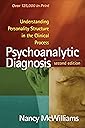


Psychoanalytic Diagnosis: Understanding Personality Structure in the Clinical Process: 9781462543694: Medicine & Health Science Books @ desertcart.com Review: The Best Book for Learning How Diagnosis can Help You Treat Better - I know some people will reject this book because "Psychoanalytic" is in the title. Others will reject this book because "Diagnosis" is in the title. However, this essential text is highly useful to all practitioners of any theoretical orientation if they can get past the negative stereotyping. The term "Diagnosis" as used in this book is in line with the original definition of the word that is derived from Greek- meaning a distinguishing, to perceive, to know thoroughly. The second part of the book title explains that the point of diagnosing is to know how to help. McWilliams clarifies that, "The main object of this book is to enhance practice..." and that is what this book does extremely well. Nancy McWilliams never looses the person to the diagnosis. "Once I have a good feel for the person, the work is going well, I stop thinking diagnostically and simply immerse myself in the unique relationship that unfolds between me and the client...one can throw away the book and savor individual uniqueness." Her writing style is much like she describes her therapy sessions. She points out the necessity at times, to judiciously self-disclose. Her personal sharing gives the text a soul and you feel you are with a warm and wise teacher. For example when discussing the value of psychoanalysis, McWilliams discloses, "I share this opinion, having benefited all my adult life from a good early classical analysis." Let me share with you an example of her eloquent style that pervades this text: "When any label obscures more than illuminates, practitioners are better off discarding it and relying on common sense and human decency, like the lost sailor who throws away the useless navigational chart and prefers to orient by a few familiar stars." It is writing such as this, which makes this text enjoyable, as it is enlightening. McWilliams' taxonomy is fundamentally based on just two Axes. The first dimension conceptualizes a person's degree of developmental grow or personality organization (neurotic-normal level, borderline level and psychotic level). McWilliams assesses the neurotic, borderline, and psychotic levels of personality structure in terms of favorite defenses, level of identity integration, adequacy of reality testing, the capacity to observe one's pathology, nature or one's primary conflict, and transference and countertransference. She explains that "borderline" is not a distinct personality disorder as introduced by DSM III, but an over-all level of severity. It is a stable instability between the border of neurotic and psychotic ranges, characterized by a lack of identity integration and reliance on primitive defenses without the overall loss of reality testing that is seen with people at the psychotic level. The second axis identifies the type of character or personality patterns (psychopathic, narcissistic, paranoid, depressive, schizoid, etc.). She explains that though this two-axis model is oversimplified, it is useful in synthesizing and streamlining diagnostics for newcomers. McWilliams first looks at how the levels of personality organization are important in the therapeutic process. She states the neurotically organized person is like the boiling pot with the lid on too tight making it the therapist's job to let some steam escape (uncovering-expressive work). However, the psychotically vulnerable individual's pot is boiling over, and it is the therapist's job to turn down the heat and get the lid back on (supportive work). I strongly recommend this recent edition of Psychoanalytic Diagnosis: Understanding Personality Structure in the Clinical Process as a required text for doctoral and post-doctoral students to help them understand and treat patients. Review: Psychoanalystic Diagnosis by Dr. McWilliams - I am thoroughly enjoying this book that I am studying for a doctoral course in clinical psychology. Dr. McWilliams begins by explaining why analysts or clinicians diagnosis and then proceeds to developmental levels of personality organization. She writes descriptively and with clarity, which makes it easy to understand. She explains the fundamental Freudian principles well. She provides an understandable and clinical review of Object Relations and Ego Psychology, which is very helpful, then provides a comprehensive description of defenses, which I found fascinating. I am studying the last half of this book on the types of character organization and I know that I will be grateful for the knowledge she imparts to me as I have been from the beginning of the book.
| Best Sellers Rank | #20,402 in Books ( See Top 100 in Books ) #9 in Medical Psychoanalysis #13 in Medical Clinical Psychology #21 in Popular Psychology Psychoanalysis |
| Customer Reviews | 4.8 4.8 out of 5 stars (607) |
| Dimensions | 6 x 1.06 x 9 inches |
| Edition | Second |
| ISBN-10 | 1462543693 |
| ISBN-13 | 978-1462543694 |
| Item Weight | 1.3 pounds |
| Language | English |
| Print length | 426 pages |
| Publication date | February 6, 2020 |
| Publisher | The Guilford Press |
R**.
The Best Book for Learning How Diagnosis can Help You Treat Better
I know some people will reject this book because "Psychoanalytic" is in the title. Others will reject this book because "Diagnosis" is in the title. However, this essential text is highly useful to all practitioners of any theoretical orientation if they can get past the negative stereotyping. The term "Diagnosis" as used in this book is in line with the original definition of the word that is derived from Greek- meaning a distinguishing, to perceive, to know thoroughly. The second part of the book title explains that the point of diagnosing is to know how to help. McWilliams clarifies that, "The main object of this book is to enhance practice..." and that is what this book does extremely well. Nancy McWilliams never looses the person to the diagnosis. "Once I have a good feel for the person, the work is going well, I stop thinking diagnostically and simply immerse myself in the unique relationship that unfolds between me and the client...one can throw away the book and savor individual uniqueness." Her writing style is much like she describes her therapy sessions. She points out the necessity at times, to judiciously self-disclose. Her personal sharing gives the text a soul and you feel you are with a warm and wise teacher. For example when discussing the value of psychoanalysis, McWilliams discloses, "I share this opinion, having benefited all my adult life from a good early classical analysis." Let me share with you an example of her eloquent style that pervades this text: "When any label obscures more than illuminates, practitioners are better off discarding it and relying on common sense and human decency, like the lost sailor who throws away the useless navigational chart and prefers to orient by a few familiar stars." It is writing such as this, which makes this text enjoyable, as it is enlightening. McWilliams' taxonomy is fundamentally based on just two Axes. The first dimension conceptualizes a person's degree of developmental grow or personality organization (neurotic-normal level, borderline level and psychotic level). McWilliams assesses the neurotic, borderline, and psychotic levels of personality structure in terms of favorite defenses, level of identity integration, adequacy of reality testing, the capacity to observe one's pathology, nature or one's primary conflict, and transference and countertransference. She explains that "borderline" is not a distinct personality disorder as introduced by DSM III, but an over-all level of severity. It is a stable instability between the border of neurotic and psychotic ranges, characterized by a lack of identity integration and reliance on primitive defenses without the overall loss of reality testing that is seen with people at the psychotic level. The second axis identifies the type of character or personality patterns (psychopathic, narcissistic, paranoid, depressive, schizoid, etc.). She explains that though this two-axis model is oversimplified, it is useful in synthesizing and streamlining diagnostics for newcomers. McWilliams first looks at how the levels of personality organization are important in the therapeutic process. She states the neurotically organized person is like the boiling pot with the lid on too tight making it the therapist's job to let some steam escape (uncovering-expressive work). However, the psychotically vulnerable individual's pot is boiling over, and it is the therapist's job to turn down the heat and get the lid back on (supportive work). I strongly recommend this recent edition of Psychoanalytic Diagnosis: Understanding Personality Structure in the Clinical Process as a required text for doctoral and post-doctoral students to help them understand and treat patients.
W**F
Psychoanalystic Diagnosis by Dr. McWilliams
I am thoroughly enjoying this book that I am studying for a doctoral course in clinical psychology. Dr. McWilliams begins by explaining why analysts or clinicians diagnosis and then proceeds to developmental levels of personality organization. She writes descriptively and with clarity, which makes it easy to understand. She explains the fundamental Freudian principles well. She provides an understandable and clinical review of Object Relations and Ego Psychology, which is very helpful, then provides a comprehensive description of defenses, which I found fascinating. I am studying the last half of this book on the types of character organization and I know that I will be grateful for the knowledge she imparts to me as I have been from the beginning of the book.
M**H
So helpful!
Am a therapist and been enjoying this read!
V**A
Extremely informative
Excellent overview of personality types, mostly focused on the pathologies associated with them. The introduction is an invaluable guide to key strains of psychoanalytic thought. The book is a bit academic, yes, but this is to some extent necessary to explain the subject matter in precise terms. It's written for therapists, but I'd recommend it to anyone who has done read some pop psychology and wants to go deeper.
C**E
Lots of value in this
I'm fairly new to the field and have been reading books like crazy. This book is fantastic with helping to understand and zero in on the details of psychotherapy. It's fairly easy to read and understand and really helped me to learn more about myself as well as others. This book is chalk full of great information for anyone working in the mental health field.
A**P
Brilliant & Humane
This is an excellent resource because Dr. McWilliams knows how to place diagnostics within a socio-cultural framework and can therefore provide a more thorough and insightful analysis of personality disorders, those who diagnose them and those who suffer from them. She is not one of those clinicians who attempts to detach in a pseudo-scientific manner, but rather constantly reminds the reader of the DYNAMICS between therapist and patient. I have read various books on these issues, and some authors known as experts in the field (Kernberg, Millon) are tedious to read because of their jargon. They have much in common with the DSM which takes a "cold," clinical approach by listing symptoms. McWilliams provides a great deal of insight by contextualizing these issues; J. Reid Meloy is also excellent. Highly recommended: one of the most accessible, comprehensive and scholarly books I have read on the challenging and fascinating subject of personality disorders.
R**A
Insightful book on a scholars level
A hard read at first although Very informative.
T**M
Best general discussion of personality disorders
Nancy McWilliams writes as a thoughtful, experienced, and well-read psychoanalytic theorist. Whether or not you are interested in psychoanalytic thought, this text is a highly readable, practical and well-considered overview of personality disorders in clinical practice, as well as underlying theoretical ideas. The writing is enjoyable, with warmth and compassion consistently evident
J**E
Beeinflusst und strukturiert mein gesamtes Denken und therapeutisches Handeln seitdem ich es gelesen habe.
I**)
Although the nomenclature is at an intermediate - advanced level, the information is laid out quite well and can be understood with relative ease. Ms. McWilliams Psychoanalitcal Diagnosis takes a most direct, yet humanistic approach to psychoanalysis and the pursuit of psychiatry at large. A must read for any practitioners, but as well a good source for a cultivating a more in-depth knowledge base! Portable size (not full textbook size), well bound, removable jacket/sleeve.
K**.
Kitap hasarlı bir şekilde geldi. Kargolanma sürecine hiç özenilmemiş. Benim için hayal kırıklığı oldu.
P**A
Ótimo livro e leitura fácil!!!É muito claro e objetivo! Excelente para psiquiatras em formação e psiquiatras que desejam um livro de consulta rápida!
C**Q
Uno dei libri fondamentali di psicoanalisi. Nancy McWilliams mette a disposizione dei lettori tutta la sua esperienza, fornendo linee guida di intervento e di diagnosi che raramente altri autori sono riusciti a delineare così chiaramente. Un libro importante, consigliato non solo agli studenti, ma anche ai professionisti già esperti
Trustpilot
2 days ago
3 days ago