

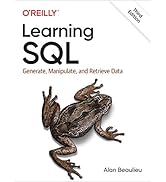
Learning SQL: Generate, Manipulate, and Retrieve Data
Product ID: 207819248
Buy anything from 5,000+ international stores. One checkout price. No surprise fees. Join 2M+ shoppers on Desertcart.
Desertcart purchases this item on your behalf and handles shipping, customs, and support to Hong Kong.
Learning SQL: Generate, Manipulate, and Retrieve Data [Beaulieu, Alan] on desertcart.com. *FREE* shipping on qualifying offers. Learning SQL: Generate, Manipulate, and Retrieve Data Review: Learn to be a SQL Expert! - Comprehensive and readable. Best audience is anyone who has been in tech for a couple of years but wants to learn SQL in depth or switch careers to DB admin. Review: Excellent Book as a SQL noob; might struggle if complete SW noob - I'm really enjoying this book. I have zero SQL experience, and have read up to chapter 9 in the book. If I browse StackOverflow for SQL related tags, I can understand a good number of the questions and have even been able to answer a couple (a lot of the questions are people trying to figure out how to write a query to get a specific result). I think the book is very well written, and there are plenty of examples in each chapter. The book uses MySQL and I elected to use Postgres (you can find a sakila port on github) to intentionally run into errors and struggle. Outside of some MySQL and Oracle specific stuff, you either directly use the code in Postgres or look at the Postgres documentation and figure out the syntax differences. That being said, my biggest issue with the book is that there are not a lot of exercises. Each chapter only has 3. Also, because I have SW development experience I know how to use the cli. Someone without SW experience will install MySQL, try to follow the cli commands in MySQL shell and get frustrated by it not working. If that is you, you'll have to find the installation location of MySQL (or Postgres), go to the bin folder, which should have multiple exes, and add that location to your PATH environment variable. Then you should be able to run commands like mysql or psql from your command line terminal. I only mention this because I remember seeing a review where someone rated this book as 1 star and said the information was out of date.







| Best Sellers Rank | #85,349 in Books ( See Top 100 in Books ) #5 in Data Warehousing (Books) #6 in SQL #22 in Data Mining (Books) |
| Customer Reviews | 4.6 out of 5 stars 583 Reviews |
M**O
Learn to be a SQL Expert!
Comprehensive and readable. Best audience is anyone who has been in tech for a couple of years but wants to learn SQL in depth or switch careers to DB admin.
P**E
Excellent Book as a SQL noob; might struggle if complete SW noob
I'm really enjoying this book. I have zero SQL experience, and have read up to chapter 9 in the book. If I browse StackOverflow for SQL related tags, I can understand a good number of the questions and have even been able to answer a couple (a lot of the questions are people trying to figure out how to write a query to get a specific result). I think the book is very well written, and there are plenty of examples in each chapter. The book uses MySQL and I elected to use Postgres (you can find a sakila port on github) to intentionally run into errors and struggle. Outside of some MySQL and Oracle specific stuff, you either directly use the code in Postgres or look at the Postgres documentation and figure out the syntax differences. That being said, my biggest issue with the book is that there are not a lot of exercises. Each chapter only has 3. Also, because I have SW development experience I know how to use the cli. Someone without SW experience will install MySQL, try to follow the cli commands in MySQL shell and get frustrated by it not working. If that is you, you'll have to find the installation location of MySQL (or Postgres), go to the bin folder, which should have multiple exes, and add that location to your PATH environment variable. Then you should be able to run commands like mysql or psql from your command line terminal. I only mention this because I remember seeing a review where someone rated this book as 1 star and said the information was out of date.
G**K
So good that I wore out the print version
Oreilly has always been great quality when it comes to technical topics but this book goes above and beyond. It is loaded to the gills with SQL info - everything from design, queries, DB admin, and more. This is the book you want on your bookshelf when dealing with MySQL/MariaDB databases. I find myself referencing this book daily in my job. It is THAT good. Here is the Table of Contents: Creating and Populating a Database Query Primer Filtering Querying Multiple Tables Working with Sets Data Generation, Manipulation, and Conversion Grouping and Aggregates Subqueries Joins Revisited Conditional Logic Transactions Indexes and Constraints Views Metadata Analytic Functions Working with Large Databases SQL and Big Data For a book that is only 376 pages, it covers a TON of stuff. I highly recommend for anybody who touches MySQL or MariaDB databases.
C**R
Exactly what you woud expect.
Like most O'Reilly products, clear concise and accurate.
K**R
Very good for an introduction
It is a really nice book for anyone who wants to begin in the SQL world and its nuances. Totally recommend!
A**Z
Excellent
Very useful for beginners.
G**I
Great
Great but it needs more basics
P**E
Abstract and Concrete Enough
Used for work to expand my SQL knowledge. The book uses MySQL as its practice, but provides concepts of what can be done in MS or Oracle as well. It sticks with concepts and includes practice. Learners like myself need both.
Trustpilot
1 month ago
2 weeks ago