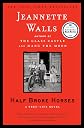
Half Broke Horses: A True-Life Novel
Product ID: 2084662
Desertcart purchases this item on your behalf and handles shipping, customs, and support to Hong Kong.
"Those old cows knew trouble was coming before we did." So begins the story of Lily Casey Smith, Jeannette Walls’s no-nonsense, resourceful, and spectacularly compelling grandmother. By age six, Lily was helping her father break horses. At fifteen, she left home to teach in a frontier town—riding five hundred miles on her pony, alone, to get to her job. She learned to drive a car and fly a plane. And, with her husband, Jim, she ran a vast ranch in Arizona. She raised two children, one of whom is Jeannette’s memorable mother, Rosemary Smith Walls, unforgettably portrayed in The Glass Castle . Lily survived tornadoes, droughts, floods, the Great Depression, and the most heartbreaking personal tragedy. She bristled at prejudice of all kinds—against women, Native Americans, and anyone else who didn’t fit the mold. Rosemary Smith Walls always told Jeannette that she was like her grandmother, and in this true-life novel, Jeannette Walls channels that kindred spirit. Half Broke Horses is Laura Ingalls Wilder for adults, as riveting and dramatic as Isak Dinesen’s Out of Africa or Beryl Markham’s West with the Night. Destined to become a classic, it will transfix readers everywhere. Review: MEMORABLE CHARACTERS & BEAUTIFUL PROSE - "Those old cows knew trouble was coming before we did." So begins the story of Lily Casey Smith, in Jeannette Walls's magnificent, true-life novel based on her no-nonsense, resourceful, hard working, and spectacularly compelling grandmother. By age six, Lily was helping her father break horses. At fifteen, she left home to teach in a frontier town -- riding five hundred miles on her pony, all alone, to get to her job. She learned to drive a car ("I loved cars even more than I loved horses. They didn't need to be fed if they weren't working, and they didn't leave big piles of manure all over the place") and fly a plane, and, with her husband, ran a vast ranch in Arizona. She raised two children, one of whom is Jeannette's memorable mother, Rosemary Smith Walls, unforgettably portrayed in Glass Castle . From the very first page of Half Broke Horses , I was hooked. Lily Casey's first person narrative brought me right into the midst of her world: a world that started in West Texas, but would lead her to numerous places, from Arizona to Chicago and back to Arizona, with a few jogs along the way. Through her eyes I saw the gorgeous, yet sometimes brutal Southwest, from a new perspective. I could admire her energy as she trained those "half broke horses" that occasionally came along. And her determination to earn her education in spite of the odds against her. Some might describe her as stubborn, while others can see that she had the stamina necessary for the life she had chosen. A life thrust upon her by birth and family, but one to which she returned after deciding that "city life" was not for her. Her persistence in showing her children the life lessons she wanted them to learn had the opposite effect on her daughter Rosemary (the author's mother). Rosemary preferred living life for the moment, since the future was not something one could count on. I liked this excerpt that shows us the companionship between Lily and her husband Jim, and their philosophy, too, as they watch their daughter after her wedding to Rex Walls: "Jim put his arm around me and we watched them take off up the street, heading out into open country like a couple of half-broke horses." The author describes that she gleaned the facts of the story from those she interviewed, but that she recalls her grandmother's distinctive voice: a wonderful detail she has brought to the reader as she tells the story. A story that I won't forget...and to which I offer five stars. Review: Not The Glass Castle But A Great Book That Hearkens Back To A Simpler Harder Time In A Beautiful Way - This book reminded me of the stories that my grandmother and her sisters told of growing up in Texas and Oklahoma during the depression. Told in the first person, this book may be hard for some tor read as it reads as a story being recounted by the person being written about. I think the book does a great job of capturing (if not romanticizing) the enduring spirit of women and men who settled this country and built it in the early 1900's. The story does a wonderful job of recounting stories that were handed down through generations about the matriarchal figure of the writer's family. It also chronicles to some extent the life of her mother, one of the big figures in The Glass Castle. I liked this book a lot because it really did deliver on the promise of describing a woman who is bigger than life and who overcomes unthinkable adversity with grace and determination. The story ultimately reminded me of many similar stories that the older women in my own family recounted and the values they developed as a result of living them. An interesting thing that the story does if provide hope in a time currently where many people are facing one of the toughest times of their lives. It provides hope and a lesson for how to live when times are difficult. And, I think that it is also a history lesson in ways for younger generations who are out of touch with the experiences of people who lived through those times. I believe that many women will find Lily Casey Smith, the central figure of the book inspirational and in interesting ways a model for life that they themselves might adopt in times of stress or difficulty. I think Janette Walls has done another phenomenal job, I can't wait for her next book. Her books are a joy to read.

| Best Sellers Rank | #27,341 in Books ( See Top 100 in Books ) #71 in Biographical Historical Fiction #88 in Biographical & Autofiction #490 in Coming of Age Fiction (Books) |
| Customer Reviews | 4.5 out of 5 stars 9,737 Reviews |
L**W
MEMORABLE CHARACTERS & BEAUTIFUL PROSE
"Those old cows knew trouble was coming before we did." So begins the story of Lily Casey Smith, in Jeannette Walls's magnificent, true-life novel based on her no-nonsense, resourceful, hard working, and spectacularly compelling grandmother. By age six, Lily was helping her father break horses. At fifteen, she left home to teach in a frontier town -- riding five hundred miles on her pony, all alone, to get to her job. She learned to drive a car ("I loved cars even more than I loved horses. They didn't need to be fed if they weren't working, and they didn't leave big piles of manure all over the place") and fly a plane, and, with her husband, ran a vast ranch in Arizona. She raised two children, one of whom is Jeannette's memorable mother, Rosemary Smith Walls, unforgettably portrayed in Glass Castle . From the very first page of Half Broke Horses , I was hooked. Lily Casey's first person narrative brought me right into the midst of her world: a world that started in West Texas, but would lead her to numerous places, from Arizona to Chicago and back to Arizona, with a few jogs along the way. Through her eyes I saw the gorgeous, yet sometimes brutal Southwest, from a new perspective. I could admire her energy as she trained those "half broke horses" that occasionally came along. And her determination to earn her education in spite of the odds against her. Some might describe her as stubborn, while others can see that she had the stamina necessary for the life she had chosen. A life thrust upon her by birth and family, but one to which she returned after deciding that "city life" was not for her. Her persistence in showing her children the life lessons she wanted them to learn had the opposite effect on her daughter Rosemary (the author's mother). Rosemary preferred living life for the moment, since the future was not something one could count on. I liked this excerpt that shows us the companionship between Lily and her husband Jim, and their philosophy, too, as they watch their daughter after her wedding to Rex Walls: "Jim put his arm around me and we watched them take off up the street, heading out into open country like a couple of half-broke horses." The author describes that she gleaned the facts of the story from those she interviewed, but that she recalls her grandmother's distinctive voice: a wonderful detail she has brought to the reader as she tells the story. A story that I won't forget...and to which I offer five stars.
D**I
Not The Glass Castle But A Great Book That Hearkens Back To A Simpler Harder Time In A Beautiful Way
This book reminded me of the stories that my grandmother and her sisters told of growing up in Texas and Oklahoma during the depression. Told in the first person, this book may be hard for some tor read as it reads as a story being recounted by the person being written about. I think the book does a great job of capturing (if not romanticizing) the enduring spirit of women and men who settled this country and built it in the early 1900's. The story does a wonderful job of recounting stories that were handed down through generations about the matriarchal figure of the writer's family. It also chronicles to some extent the life of her mother, one of the big figures in The Glass Castle. I liked this book a lot because it really did deliver on the promise of describing a woman who is bigger than life and who overcomes unthinkable adversity with grace and determination. The story ultimately reminded me of many similar stories that the older women in my own family recounted and the values they developed as a result of living them. An interesting thing that the story does if provide hope in a time currently where many people are facing one of the toughest times of their lives. It provides hope and a lesson for how to live when times are difficult. And, I think that it is also a history lesson in ways for younger generations who are out of touch with the experiences of people who lived through those times. I believe that many women will find Lily Casey Smith, the central figure of the book inspirational and in interesting ways a model for life that they themselves might adopt in times of stress or difficulty. I think Janette Walls has done another phenomenal job, I can't wait for her next book. Her books are a joy to read.
M**H
The story of one incredible, resourceful woman
I loved this book. The style of writing was engaging, the story incredibly interesting. Lily Casey Smith, was one pretty brave, resourceful, curious, creative, cunning, strong woman. I don't think they make many like her any more! The bulk of the story is set in Arizona, and what a sense of hardship it must have been living in that time, in that manner. But, for Lily, I don't think she saw it that way. Lily rose to every challenge and made the best of her situation in life. The people she met, whose names are on buildings or etched in Arizona history color this book. In fact, Lily's name should be etched into the fabric of Arizona history. I liked her resourcefulness in that when she was looking for a bus, for a small frontier school where she taught, she that it an excellent deal to purchase a used hearse! Writing school bus on it, didn't really change the fact, but it did the job. I got a sense that she felt happier, more alive and free in the country than when she lived in Phoenix. And, the pictures of the countryside, painted through the story where really sharp, desolate, yet gave such an incredible sense of freedom. This is one very enjoyable book. I urge you to read it.
R**J
Fresh, Gritty and Down To Earth
I mean those three words literally! The author pulls no punches as she describes her grandmother's life beginning with her sod dugout of a home in West Texas where periodic floods had Lily Casey Smith and her siblings hanging on to tree limbs for hours for sheer survival - to patching up an old wooden shack and transforming it into their first real home. Lily and her brother and younger sister were isolated from other children and were lucky to have a father who could teach them basic reading and history at a time (early 20th century) when many of their peers were unschooled. At age 13, she was sent off to a convent school for a year but had to drop out after her father spent her tuition buying four carriage horses to train. "Well, I needed you to train the horses", he told an angry Lily. But successfully train them she did, marking the beginning of her life's occupation as a rancher. But she was also a good teacher, spending year after year teaching at one-room schools despite the fact that she hadn't gone to college. She would later finish college. The combination of ranching and teaching while raising her two rambunctious children with her ex-Mormon husband is told from an earthy point of view, uniquely Western in nature, a no-nonsense, "knock the lace from your panties" perspective - a phrase Lily Smith likes to use when "escorting" Easterners around the ranch. Readers of Jeannette Walls' first book: "The Glass Castle" will enjoy returning to her straightforward, yet poignant storytelling style. New readers are in for a "real" treat!
B**R
Stunning Tough Lives --to become half-broken
"Half-Broke Horses" is a gripping book about the grandmother of Jeannette Walls (who is also the author of the Glass Castle, a 5 star). It's a fascinating story in its own right about a Walls' incredibly tough grandmother Lily, who also forged her own way from a very difficult beginning. Lily had a weak mother and sister, and a hard-working father whose head was 'stove in' early, such that his speech was difficult for most people to understand--and more other difficulties beyond the need to tell here. At the book's opening Lily climbs partway up a cottonwood, pulling up her two younger siblings, to escape a flashflood near their dugout house in West Texas, and helping them stay awake all night till the floodwaters recede. A few years later at age 15, she rides 28 days across Texas, New Mexico and Arizona desert country on her own to get to her first teaching job. The book works on many levels if you have also read The Glass Castle, as the picture builds for how the Lily mothers her daughter who will become so fully broken before becoming Jeannette Walls' mother in The Glass Castle. It is hard to comprehend how Jeannette Walls managed to survive and succeed despite her catastrophic upbringing by her two fully broken parents, and retain the strengths of her 'half-broke' grandmother and forge a family out of all of it-- (at the last book review I read, she was still caring for her mother in a cottage Jeanette built for her on her own land, despite that her mother still thinks so little of her). And she writes about all of it with simplicity, clarity, love, humanity, even humor and beauty. The two books together are a wonder. Think "28 up" over 3 generations.
A**E
She Can Explode a Detail into a Thunderbolt
Walls writes chapters which are distinctively short. Most seem little more than sketches, and are just as easy to read. But the seemingly straight-forward detail with which she packs them is loaded with hidden charges that go off in chapter-ending surprise. At the same time (and this is where her story-telling skill goes to work) these chapters somehow retain the effortless charm of unpremeditated vignettes. Somehow, the chapter-ending surprises don't come off as the predictable cliff-hangers we expect to see engineered into plots, leading us (nudge, nudge) to anticipate certain resolution. This true life novel has the irresolute pace of true life...even as seemingly small details quietly accumulate with freighted force. Caveat Quibbler (which most of us, to some extent, are): As a reporter, I often hear creative non-fiction knocked as inherently flawed -- in a publishing world plagued with fake quotes and larger fraud, the last thing we need is getting 'creative' with reality. Social scientists and historians are especially prone to this critique -- and thus they write accounts which are often, and exceptionally, flat. For me, the answer is non-fiction novels which never invent a thing, but use many techniques of fiction -- especially closely observed detail and character development from which plot may emerge. Rwanda Means the Universe: A Native's Memoir of Blood and Bloodlines Except in close and constant partnership with a 'true life' narrator, I would never do what Walls does, narrating this book in the voice of somebody she isn't. But that may be largely to satisfy the quibblers. Walls never tries to disguise the liberties she takes, and I had no problem with them, especially given her intimate, closely researched connection to the book's homely subject. In fact I loved it; the impact was much larger than homely.
L**L
Good story, good writing, lacking emotion.
Half Broke Horses takes us through a time in our history of which we only guess about. For that I give the book high praise. However, although this book was interesting, and definitely worth reading, it left me wanting something more. I read, The Glass Castle, first, and if I tore off the covers, I would not be able to tell one book from the other. The back cover mentions, `Jeannette Walls channels that kindred spirit', meaning her grandmother. I didn't read it that way. I was still very curious as to how Lily Casey Smith felt about all those true life adventures she experienced. What about love? Love of her friends, husband, even her own children? What blast of emotions did she feel when her friend died! What about her sister? The book was very detailed about the descriptions and adventures, but dry with the human interactions. It also dribbled to a close after her daughter, Rosemary got married. Since this was a true life novel, I would have liked it to have completed her and her husband's lives. It didn't even let us know how they died, or who died first. If her husband died first, how did she manage? The book was finished, just not enough. It left me feeling a little irritated because the book was very good. It had so much potential.
A**R
Don't pass this one up!
What a beautiful story Jeannette Walls created describing the life of her grandmother, Lily Casey Smith. Through a first person narrative, we are given a glimpse into the hard life this woman led, and I can tell you, she was one tough cookie. We follow Lily's life from when she was a young girl living on her parent's ranch in Texas, to her following her dreams. When she first decides she has had enough life on the ranch, she heads for a new life in Chicago. Life in the big city turns out to be more than she bargained for when she meets up with a man who turns out to be probably the biggest sleazeball she ever met, and then losing the first true friend of her life. She finds herself heading back to her family in Texas, to find her mind opened up to the dream of becoming a teacher. Knowing that she needs to make a life of her own, she heads out on her horse for a one-month journey to her first teaching destination. This is the first of many teaching jobs for young Lily, as she doesn't conform easily to other's directions and ideas. She is a woman who stands up for her convictions and will not ever be easily swayed. We follow Lily throughout her adult life as she finds love and deals with personal tragedies. She moves across the Western United States, not afraid of what she will find when she gets there, but enjoying the journey along the way. I developed a respect for Lily throughout this book, just knowing what she endured throughout her life. She gave every task her all, and was never afraid to try something new. How her daughter Rosemary turned out to be a woman without ambitions I guess I will never understand. This was an awesome story that was enjoyed by all of the ladies in my book group. Overall, our group enjoyed this one more than The Glass Castle. I enjoyed both of them about the same, but I think there were many more points in this book that just made me laugh out loud. I mean, if you have read this book, can you tell me that the Mormon's "Wonder Underwear" did not make you laugh? With themes of love, family, struggles, perseverance, and home, this book made for a wonderful book club selection. Don't be afraid to read it for your own entertainment though. I highly recommend this true-life novel.
L**L
Very good read
A true story of the American west, the hardships and work ethic so dear to many Americans yet without much of the clichés.
S**9
Schullektüre
Für die Schule und dennoch interessant und spannend.
S**A
Merece la pena
Al igual que los otros dos libros de la autora, este tampoco me ha defraudado. Merece la pena, lectura fácil
H**O
The Glass Castleの著者のお婆さん(祖母)のストーリー
Jeannette Wallsの自叙伝であるベストセラーになった"The Glass Castle"に登場する母 "Rosemary" のお母さん,つまりJeannetteのお婆さんにまつわるお話です。読み始めるとあれっと思われるかもしれませんが,この話を語っているのは著者の言葉でなくお婆さんのLilyが一人称で語る形式になっています。時代は古き良き時代のアメリカを背景にLilyは1901年に (日本は明治34年)牧場を営む父母の間に生まれます。 物語は,lily 10歳,弟のBuster9歳・妹のCasey7歳 (表紙の3人です。)が牧草地で大きな鉄砲水が押し寄せてくる場面から始まります。大洪水の中,なんとかポプラの樹にしがみつき3人は一夜を過ごす。出鼻からドキドキ,ハラハラさせられる展開になりますが,実はこのドキドキ場面は最初から最後まで続きます。 友人の死,妹の問題,失業,離婚の経験(相手は2重結婚をしていた。さらに後に,生活費の為に売ろうとしたダイヤのエンゲージリンクはフェイク物)など次々に襲いかかる逆境にもめげず,Lilyは自分の信じた道を突き進みます。 我が道を突き進むところはどうやら少女時代からのようで,15歳になった彼女は教師になる夢を求めて愛馬のPatches(パッチ)とともに約500mile西の地Red Lake (Arizona)へ向かいます。 804kmもの距離を馬で単身で15歳の少女が旅をする所は結構感動ものです。 彼女はその後Jimとの間に2児をもうけます。(長女のRosemaryとlittle Jim。) 長女のRosemaryが著者であるJannetteを生むところあたりでお話は終わります。大胆不敵なLily, そしてそれに負けない程頑なRosemary。の性格は著者へもどうやら受け継がれているとか。。。 読んでいて少しメモをしたくなる様な名言???もちらほらと。 少し気に入った一部を紹介します。 First thing a horse needs to learn is to be a horse," he liked to say. "Life's too short, honey," I said, "to worry what other people think of you." "Everything in life has a purpose and unless it achieves its purpose, it's just taking up space on the planet and wasting everybody's time." この物語はほぼ事実に忠実なのですが,多少手を加えているとのことで,正確には"True-Life Novel"とういう肩書きになっているようです。
A**R
A very good read
A very interesting story of a very interesting and at times, harsh life. Well written and easy to read. It is mainly the story of the struggle of one woman to overcome adversity. I thoroughly enjoyed it.
Trustpilot
3 weeks ago
3 weeks ago