🎸 Cut the cords, not the vibe—wireless freedom for the modern musician!
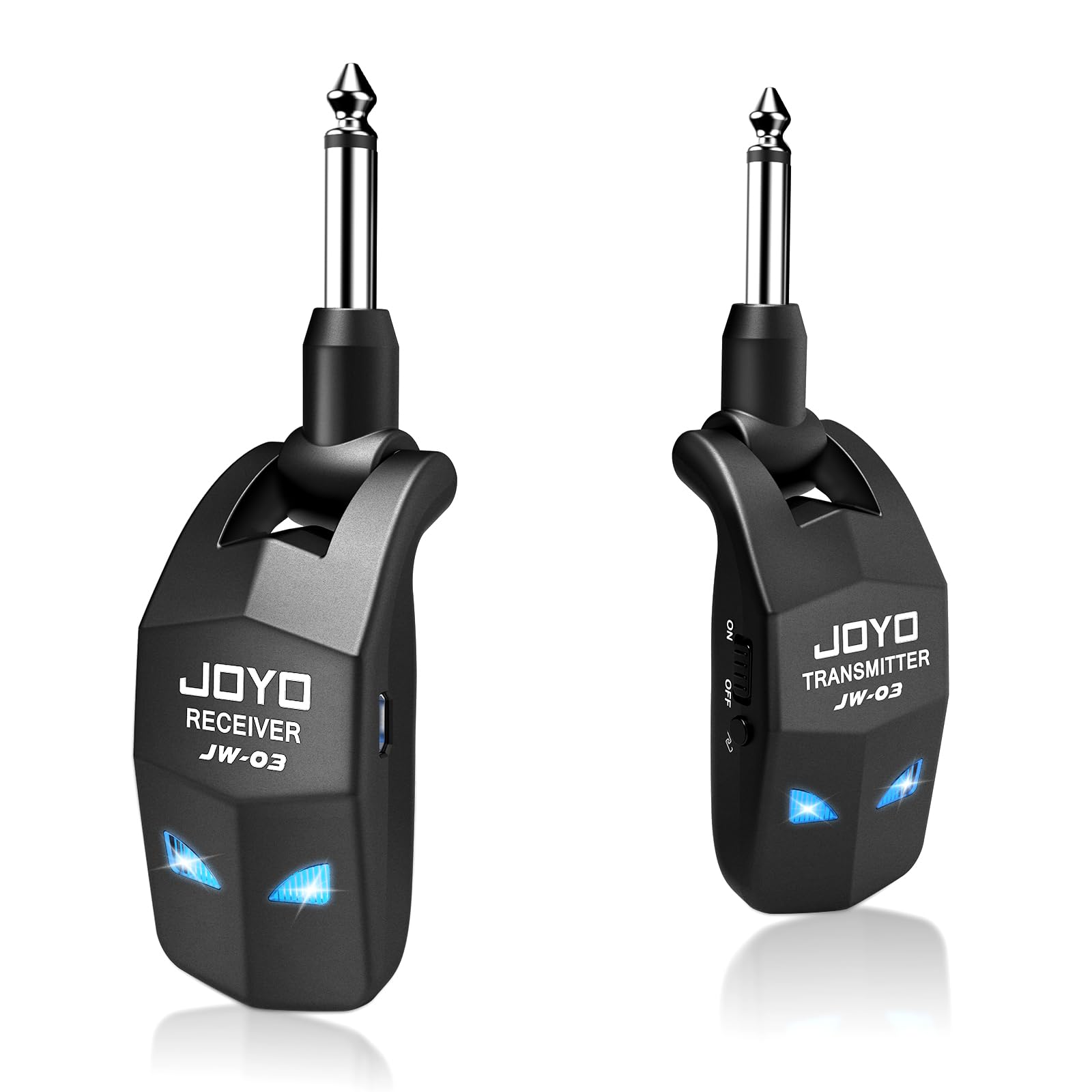
The JOYO JW-03 Wireless Guitar System delivers professional-grade 2.4GHz wireless audio transmission with ultra-low latency and over 20 meters range. Featuring 4 interference-free channels, 220° rotatable plugs for universal instrument compatibility, and a rechargeable battery lasting 8+ hours, it’s designed for seamless, cable-free performance. Ideal for guitarists and bassists seeking reliable, high-quality sound with effortless pairing and charging convenience.


| Best Sellers Rank | #222 in Musical Instruments ( See Top 100 in Musical Instruments ) #1 in Electric Guitar Electronics |
| Customer Reviews | 4.3 out of 5 stars 2,829 Reviews |
A**R
Good Reliable Sound and Easy to Use
Bought this to use with my bass for playing at church. This works very well, good sound level, just slight less than with a cord. I hav had no connection issues. I especially love the recharging base: just push the receiver and transmiter into the base and the recharging starts without having to mess with charging cords. The recharging base keeps a charge and the level indicator lights showd when it is charging the transmitter/ receivers and when it needs to be recharged.
C**R
Awesome Value!
Absolutely love it. Once charged it connected immediately, I could not detect any sound degradation and a single USB charging cable has two USB-C connectors to charge both transmitter & receiver. Works flawlessly for me. Caveat: I am not a gigging/pro so only used in my study where the receiver connects to my pedal board only a few feet away and I generally sit to practice. I cannot vouch for long term reliability and my ears are not the best but I did not notice any difference in sound quality. May not be pro level gear but at the price may be a good backup option even for a professional guitarist.
P**K
works great and easy to use
works well so far. good battery life for a couple of hours, 2 or 3 practices and performances. is clear with no hum or feedback. seems to not be too loud so have to make adjustments to the soundboard to get a signal but is clean and clear sound. easy to pair, just turn both on at or near the same time. no distortion of sound. great to have no cords to keep me tied down so I can hear myself though the mains and walk around the stage. no interference with other wireless mics and equipment
B**S
Doesn't play well with active electronics...
I bought this to do a quick reunion show, so wasn't looking for a high-end device. It charged and paired up as expected, but I could not get any audio out of it. I was trying to use it on an Ibanez SG bass, which has active electronics. I thought I had seen that it would work with active electronics, but apparently it doesn't, in my case anyway. Tried it with a passive guitar and it worked fine. I remembered that I had another unit (different brand) that someone had given me because it had the same exact issue. So, to get it to work, you have to "trick" it into thinking it's in a passive guitar. Use a 1/4" to 1/4" TRS (stereo) coupler from the transmitter, to a 1/4" patch cable to the jack, and it worked. Not sure exactly why, but it has worked on both devices. I guess it's something to do with it shorting to ground on the TRS. Sounds really good and is a nice package. And cheap. I like the charging base, and it's sleek, compact design and it seems pretty solid. But, there's got to be a better way. Maybe an ON/OFF switch... Hmm... As an addendum, I tried it on my Ovation active, and it did work IF you power cycled the transmitter while it was plugged in... Addendum: So, I've really gotten to like this thing. Having that charging base is brilliant. Works well on my passive guitars. Haven't tried them again on the active electronic. The coverage is OK. Not great. The shape is not great on guitars with bottom-mounted jacks. I'm always hitting with my leg, making it cut out. But, I'm going to give it an extra star. It's not bad....
D**R
Work and sound great for home practice!
Just bought the JW-06 last week. These are great. I have a little practice area in my living room all running cable. But I also want to be able to bring my guitar over the couch or another close by area but didn't want to deal with cable. So I decided to give these wireless units a try. I use them strictly for home practice (I don't gig). I use it on a Silver Sky SE, Fender tele and a Michael Kelly LP. No problem plugging them in. I don't really hear anything different nor volume differences between cable and the wireless. I primarily play clean or slight/bluesy breaking sound. Not sure how it would work with heavy distortion. The distance from the amp was only about 10-15 feet. As I said previously, I use it at home for practice. I can't comment on its use for gigging. But nonetheless it works really well. I have my fireTV and router in the same room and haven't noticed any dropouts nor interference. And the plug-in units themselves are nice and small. The charging block actually has it's own battery....Its not just a charging stand. The box has a USB-c "in" and "out". The "in" is for charging USB connected to an electrical outlet. The "out" allows you to provide power/charge to anything using a USB connector....your phone, rechargeable tuner, little bluetooth wireless connector for my amp, etc......really nice little feature. I will add for the JW-06, that if you long press the button on the transmitter and the receiver, they will turn off. So if you are taking a break between sets or taking a break during practice, you can always just turn them off to preserve battery power in the units during breaks. So, if you don't want to unplug them from guitar and amp and put them into the battery charging device every time you take a break, you can always just quickly turn them off for a break The one thing to consider is that if something were to happen to the charging box ei: an amp falls on it and crushes it...lol, you won't have a way to charge the two wireless units. You can't charge the individual units. There is no place to plug in a USB line for charging on the individual units. Overall, I would highly recommend these for practicing at home if you want to go cable free
L**L
Excellent wireless guitar!🎸
I’m not gonna lie I’m skeptical at first how good this unit would work based on how the price was but it totally outperformed a more expensive system that died in less than a year. Totally happy with this wireless guitar unit. It’s a great value for the price and works as advertised, works very well. Absolutely zero problems with any kind of battery life tone or distortion, sound qualities great, and the range is pretty good too. I can walk all around my house jamming out.
W**R
There is no reason not to give these a try, even if you think you're not interested in wireless
This system has been a game changer for me. I am an intermediate player who jams with a group. Our group probably has 8 live shows a year. Our lead singer uses a wireless mic and asked my the rest of us don't try wireless. I figured I'd give it a shot. There are other systems from better known brands with more features, but at this price it was worth a try. Boy am I glad I chose to go wireless. I started using these about 3 gigs ago and LOVE THEM. No more looping my cable through my strap so I don't accidentally jerk the cable out. No more tripping on my cable. If I need to say something to another musician, I just walk over there. I've had no problem with the range. So far, I haven't noticed any latency (perhaps a more advanced player might). The internal battery (no, you cannot replace it) lasts more than 6 hours on a single charge. A couple more comments: 1. It is definitely worth it to spend a little extra money to buy the version of this with the charger. 2. I have used this with a pedal board and can hear no difference between a wired connection and wireless.
N**S
The Good, The Annoying, and The Avoidable.
Device (JOYO JW-02S), designed and manufactured by a fully owned subsidiary of Amazon Corp. (since 2004) - pledging to "always accepting new challenges in constant pursuit of new technologies and services", providing "continuous innovation in a new era", and "the best products and services", where "our customers' satisfaction is our honor." Excellent. I do hope that they mean those words. . Latency: Regarding the oft-popular subject of "latency" in these (and other) wireless system reviews. Latencies" only matter in cases where the same signal has multiple individual signal paths (where even short delays affect the net sum channel response). In the more common case of using one single wireless system signal path, even though signal envelope "rise-times" of more than a few milliSeconds can (sometimes) be perceived, time delays (of composite signal envelope) are not perceived. At speed of sound, signal arrival time delays propagating through air are equal to ~10 mSec per 9 Feet of distance. The Good: Use of the 5.8 GHz band. A worthy idea - seemingly imperative in this day and age of such dense channel-overlapping 2.4 GHz band "clutter", though spectrally perhaps not "more in the clear" forever. Battery capacity. Following initial charge-discharge cycle, full charging (from prior partially discharged state) took 200 Minutes for the Receiver and 240 Minutes (4 Hours) for the Transmitter. (At least early on in the battery life), the Transmitter begins to flash "1-bar" indication on battery-level display at around 6 hours time (the sum of several successive individual use sessions). Good show on that score. System range (from one simple test in apartment building hallway early on) appears to be pretty good. (Perhaps) something like around 50 Feet total distance (including one non-line-of-sight 90 deg. turn). System (receiver, output-referred) noise is rather workable. Specified by JOYO as being a Receiver output-referred Signal/Noise Ratio (SNR) of 105 dB. My post-signal-processing-chain is relatively demanding - as it applied amplifies low-level noise by 36 dB (a multiplicative factor equal to ~63) after the JOYO JW-02S Receiver output. From very careful listening, I do not think that (Receiver output) uses noise-gating (except, perhaps at extremely low signal levels that do not in my experience resulting in perceptible "signal-gating"). Some more pricey systems advertise SNR specifications on the order of 110 db. One competing system claims an (SNR-related) Dynamic Range (DR) of 140 dB - electrically impossible to achieve without using some sort of (always dubious to employ) noise-gating circuitry. System frequency response appears to be (roughly) as claimed, very steeply dropping-off in magnitude by 22 KHz (indicating probable digital-filtering, which may results in large changes in signal phase). No idea why JOYO in marketing the JW-02S product as specifically intended for electric bass apps. Like many similar systems, it has/should have low frequency (~40 Hz) response to work fine with bass. If JOYO really wants to tailor the product specifically for bass guitar applications, they should increase the allowable input signal level before non-linear clipping takes place (as is discussed below). The Annoying: 4-channels used in the 5.8 GHz band appear to be all-too-easily interfered with by the presence of one single fixed Channel 157 use of (nearby, in small apartment) 5.8 GHz Wi-Fi by Amazon FireTV device receiving 5.8 GHz Wi-Fi signal from a gateway. I had to go through the (thanks to Cramcost, ever more elusive for average users to easily execute) process of disabling 5.8 GHz Wi-Fi channel on gateway, and use (only) 2.4 GHz Wi-Fi to link it to smart-TV in order to mitigate these problems. Hard to understand how with 4 separate individual channels (possibly 5.8 GHz band channels 149, 153, 157, 161), Receiver was not able to offer meaningfully useful signal path "selectivity" in the presence of only one single (channel 157, 5.785 GHz) signal being transmitted from gateway to nearby smart-TV. The peak output voltage levels of (energetically plucked/strummed) passive-electronics single-coil guitar pickups are around -6.0 dBv (0.707 Vpeak), and a (series-connected) "humbucking" pickup are around 0.0 dBv (1.414 Vpeak). Nevertheless, the electronic designers of the JOYO JW-02S (and/or the chip-sets designers utilize for processing conversions, transmissions, modulations, demodulations, etc) unfortunately chose a lower maximum peak input voltage than the magnitude of intended input signals from electric guitar pickups - measured as being equal to ~660 mVpeak (-3.61 dBv) on the JW-02S). Receiver/Transmitter output/input signal gain (amplification factor) is around unity (a factor of 1.0). JW-02S hard-clipping at the input peak voltage limit (of ~660 mVpeak) is (thankfully) not the most extreme case of guitar-pickup signal hard-clipping. I see (costlier) similar systems specified as having lower peak input signal voltage maximums of 450 mVpeak (-6.94 dBv) as well as a lower 314 mVpeak (-10 dBv). Most guitarists will (probably, in most cases) not notice such "hard-clipping" very much. It is most likely to potentially degrade overall system sound quality if and when the user is energetically strumming multiple guitar strings (more so than "plucking" individual, or a small number of, guitar strings). However, all users who (like many folks) intend to follow the JW-02S system with "high gain" processing devices (including compressors, limiters, additional "distortion generation”, etc) should be aware of the JW-02S hard-clipping non-linearities that will be irreversibly imposed upon the source signal when using this system (when placed in a commonly connected "front-end" position, connected to the source, existing before other subsequently connected signal processing devices in signal-chain). The 220 kOhm input impedance of the Transmitter unit is too low in resistance value - as this serves to limit signal levels from (passive) electric guitar pickups and their associated volume and tone control circuitry. Perhaps this arbitrary choice represents an attempt to counter perceptions surrounding the (relative) loss of low frequency content, by artificially limiting high frequency content. Not a wise choice, as on-board volume controls (already, as is) load the pickup(s) with between 250-500 kOhms. The Avoidable: DEAD-BRICK FAIL. Happened only once (so far). This single occurrence qualifies the JW-02S received as DEFECTIVE. Transmitter and Receiver were nearly fully charged (both battery level indicators displayed at least 3 of 4 total "bars"). They faithfully tracked each other, easily hopping and locking-in at all 4 of the individually selectable "channels". ZERO signal came out of Receiver output - so little that one (might) guess that some kind of in-circuit noise-gating had surely been activated - or the circuitry was completely "dead". Then, a few hours later (with no cause), system began to work again. PROBLEMATICALLY UNSTABLE output amplifier drive circuitry exists within the Receiver unit. Resistive/capacitive current-draws (associated with oscilloscope-probe) was absolutely minimal (1 megOhm; a few picoFarads), yet the output amplifier (quite readily) "flew" [broke into oscillation(s)] at some unidentified rather high frequenc(ies). The Receiver output system itself can be easily seen to "ring" (overshoot) maximally at around 8 KHz. If the Transmitter to Receiver signal is a "square" (or other steeply rising/falling type) "wave" (particularly around 8 KHz), immediately upon reaching ~660 mVpeak input voltage, Receiver output stage launches into high amplitude/frequency oscillation(s). Present electronic design of the Receiver output amplifier stage is patently inadequate - in that JOYO electronic designers have failed to ensure what is known in design as "conditional circuit stability"in Receiver output amplifier stage - (even) with very small resistive and capacitive load currents flowing. . I am open to the JOYO company making an effort to fulfill their own published "mission statements" by replacing my JOYO JW-02 with a system that will not spontaneously "brick itself" (even once), and in addition has a Receiver output amplifier stage that does not represent an embarrassment to the analog design profession (by being so unstable and likely to oscillate, even with the very lightest loads).
Trustpilot
1 week ago
1 month ago