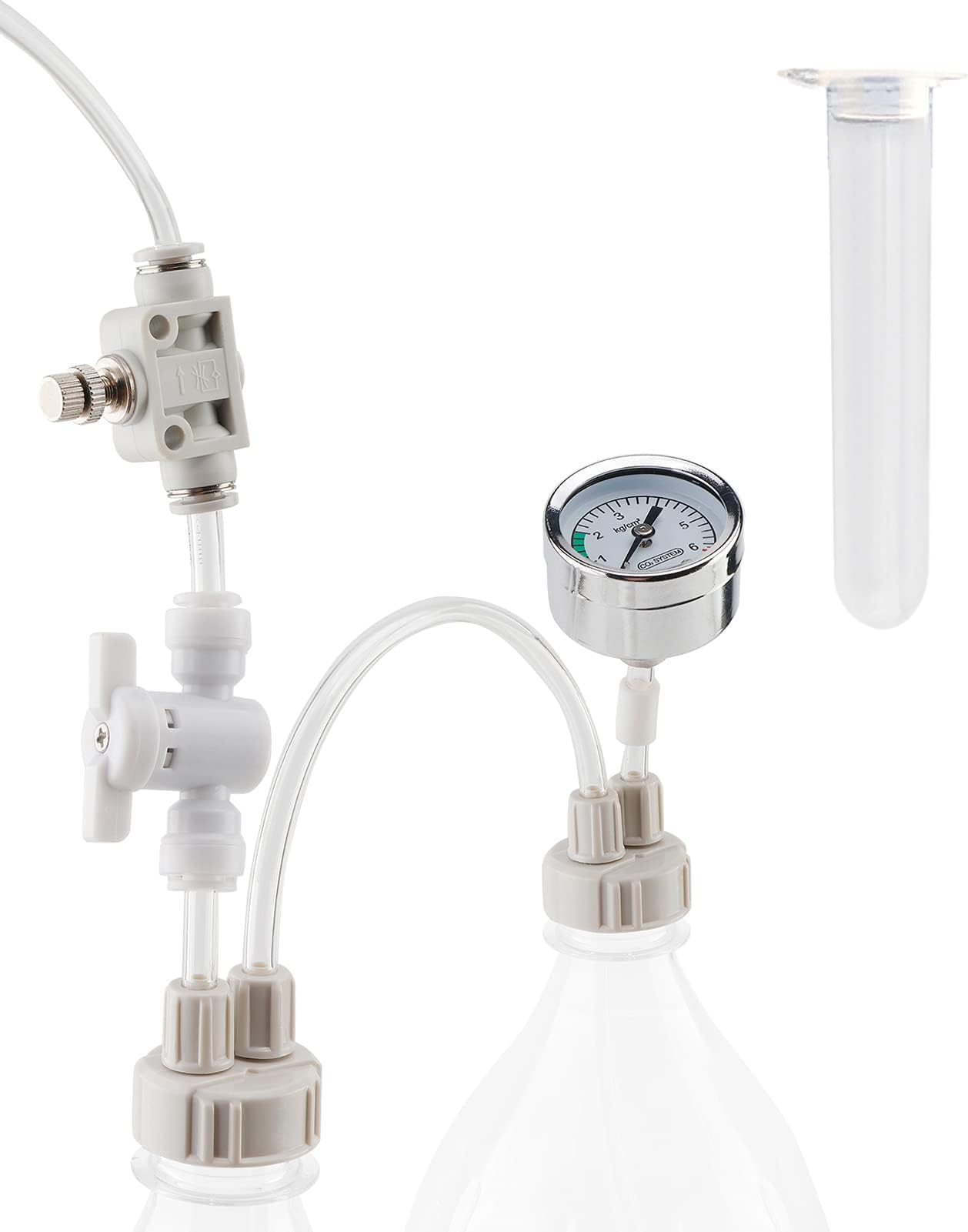
CO2 DIY Generator Kit
Product ID: 336201725
Details
- BrandClscea
- Item FormPowder
- Item Weight200 g
- Liquid Volume2 liters 200
- Unit Count1 Count
⏱️Fast reaction test tube
⚗️Citric acid + baking soda reaction
🛡️Pressure & acid-resistant tubing
Desertcart purchases this item on your behalf and handles shipping, customs, and support to Hong Kong.
🌿 Elevate your aquarium’s green game with DIY precision CO2 magic!
The Clscea Aquarium DIY CO2 Generator System Kit, G200, offers a budget-friendly, easy-to-use solution for injecting CO2 into planted aquariums. Utilizing a citric acid and baking soda reaction, it features durable, acid-resistant tubing and ABS plastic caps for safety and longevity. The kit includes a fast reaction test tube, pressure gauge with relief valve, and user-friendly valves for precise CO2 control, helping aquatic plants thrive with professional-grade efficiency.


| ASIN | B08XZ4T67L |
| Best Sellers Rank | #53,730 in Pet Supplies ( See Top 100 in Pet Supplies ) #99 in Aquarium Test Kits |
| Brand | Clscea |
| Brand Name | Clscea |
| Customer Reviews | 4.2 out of 5 stars 170 Reviews |
| Item Form | Powder |
| Item Weight | 200 g |
| Liquid Volume | 2 liters, 200 ml |
| Manufacturer | Clscea |
| Pet Type | Fish |
| Target Species | Aquatic Plants |
| Unit Count | 1 Count |
D**B
Great for yeast
Ok, this CO2 Generator System kit is intended for a citric acid setup. Guess what? It works for yeast too. One caveat with yeast vs. citric acid... If you let the pressure build up on yeast, the mixture's CO2 content will increase and the pH will drop. You can potentially shut down the fermentation through pH drop and CO2 toxicity, although the yeast will likely just go dormant vs. dying. What this means is that shutting off the white on/off valve to build up pressure is unlikely to produce enough pressure that your gauge will show anything at all. Even with this, you can build up enough pressure inside the generator bottle that you can use the regulator. I use a Paffrath bell to regulate the amount of CO2 in surface contact with my aquarium's water. This is probably a better idea than using a CO2 fine-mist diffuser for yeast, since you have less control over production volume and it's better to waste a little bit of CO2 than to overdose your tank. What I like: - Tight seals on both bottle caps and hose fittings. - I like the high-quality appearance. - No messing with silicone and adaptor fittings, this thing just goes together. - Use whatever size bottles make sense as long as they fit standard-sized caps. I use a 2 liter for the yeast generator and a 1 liter for the bubble counter. - No durability issues so far with any hose or fitting failures. - I can position the whole assembly behind my micro-tank without worrying about appearance.
M**A
Really good on a budget
The kit works great only bad thing is the valve that comes with the system, if you let your pressures get above 1.5~ adjusting bubble rate becomes a real challenge. I have come home to dangerously high co2 levels 2 times because of the valve although I shouldn't have left the system generating co2 while I was gone so you could attribute that to user error. Great bang for your buck and my plants are thriving thanks to this kit.
A**Y
Works well for the price.
This has been working like a charm for me, I went about a month on the first mixture for my 20 gal. However the needle valve has stopped working I'm not sure if it's dirty or something else, I'm assuming it's a known problem and that's why the new version has a metal one. But either way mine has a problem and that's why I only give it 4 stars. Otherwise all of the other parts seem to be good quality and haven't given me any problem.
D**L
Has feliz a tus peces.
Definitivamente útil y muy práctico.
T**E
Maintenance and Stability Concerns for the Kit
This kit requires nearly daily maintenance. Initially, I expected to refill the baking soda and citric acid only every other week. However, regular water replacement is also necessary. The water is transferred from one bottle to another via a slow but steady siphon process. With a 1L bottle (4 qt) filled halfway, one bottle empties after a day while the other fills up. Exercise caution when replacing the water. The bottles are highly pressurized, and there is no release valve. To safely open the bottles, you need to remove the diffuser and release the CO2 before unscrewing the caps. I once made the mistake of loosening the cap slightly to release the pressure, which caused the cap to pop off and water to splash out. The water, after reacting, becomes sticky like syrup, resulting in a considerable mess. Although the chemical product is low in acidity and food-safe, it still makes me anxious each time. Additionally, since the two bottles are attached, the entire setup is physically unstable. If the bottles fall, liquid can enter the gas outlet pipe, flow directly to the diffuser, and potentially reach the pressure gauge as well. This risk is particularly high when changing the water or refilling the reactants. The kit includes a magnet to stop the reaction by moving the pipe away from the reactants. However, this needs to be done twice a day, which can be inconvenient. Overall, the solution is not sustainable in the long term.
J**N
Best option for DIY
I tried making my own setup and it wouldn’t hold pressure so I picked this up. I wish I knew about this product in the beginning because it works so awesome! I use it with yeast and sugar and get great results
J**N
Ehhh, not what I anticipated, NOT WORTH the hassle or expense
This CO2 generator kit may seem like an affordable option for those who are new to the aquarium hobby, but it ultimately falls short in both convenience and effectiveness. Firstly, the kit requires citric acid, baking soda, and water to work, but the citric acid is not included in the package. While baking soda and water are easy to obtain, sourcing citric acid can be a challenge for many, and it would have been helpful if the manufacturer had included a small packet of it. Secondly, even after sourcing the citric acid, getting the kit to work was a challenge. The instructions were not very clear, and it took several attempts to get the generator to produce any CO2. Many other Amazon reviewers have also noted similar issues with getting the kit to function properly. Finally, even when the kit was working, it did not produce enough CO2 to have a significant impact on plant growth in the aquarium. For those serious about growing aquatic plants, investing in a proper CO2 system would be a much more effective and worthwhile option. Overall, I would not recommend this CO2 generator kit from Clscea. The hassle of sourcing citric acid and the difficulty of getting the kit to work, combined with its limited effectiveness, make it not worth the expense or effort.
C**N
Good product with good customer service
This is an update to my previous review. I recieved this product with a defect (drop of glue on the diffuser) and the seller contacted me promptly to send me a replacement. I receieved a replacement without having to go through the hassle of having to return the previous product. The replacement is great and I am happy with my purchase and the customer service I received from the representative I worked with.
I**D
Works with sodastream!
Can be modified to work well with sodastream using this valve: " https://www.amazon.ca/dp/B0912817DY?ref=ppx_pop_mob_ap_share " Just set bubble flow to ~one bubble per second and let stabilize.
M**A
El sistema es bueno se puede cerrar por las noches
Es muy bueno y muy eficiente tengo 2 montados, uno en un 200l y otro en un 130l la carga dura aprox 20-23 días con 2 burbujas por segundo, para obtener unas burbujas finas la presión debe alcanzar como minimo 2kg/cm2 de lo contrario serán gotas muy grandes, se puede cerrar de noche sin ningún riesgo mientras la botella B no tenga movimiento, es para mí el mejor sistema de co2 tipo casero que uno puede comprar
B**N
Vinyl tubing cracked and leaking after 2 yrs
Overall a very good solution. After 2 years, the vinyl tubing cracked and started leaking. Went to HD and bought a 1/4" od, 0.17" id vinyl tubing. Replacing is quite easy.
C**S
Works good so far
Working good so far, easy to set up after watching the Clscea video tutorial as well.
Trustpilot
3 weeks ago
2 months ago