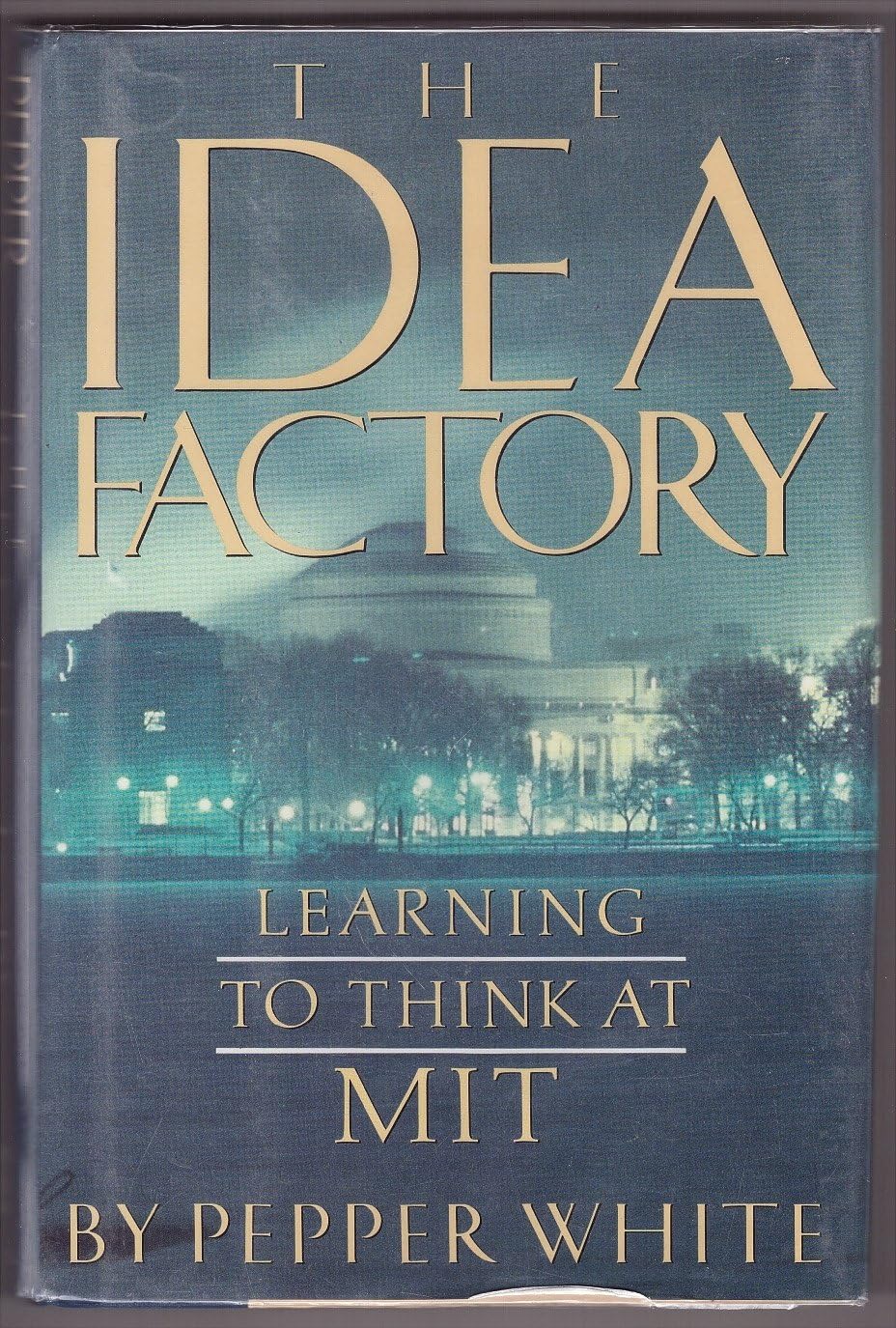
White Pepper : Idea Factory (Hbk)
Product ID: 506371465
Desertcart purchases this item on your behalf and handles shipping, customs, and support to Hong Kong.
A former student remembers MIT's rigorous, challenging, and intense program, an academic system that molds America's finest scientists Review: What has tea leaves at the end of the cup got to do with fluid dynamics and MIT? - Do you really think you are smart and it is all there is to get everything in this world? Read this book and reconsider. (And no, I won't talk about tea leaves. Pepper did a better job of doing that.) MIT or not, if you have ever spent a couple of years banging your head with some intensive mechanical and civil engineering courses, had to struggle under the pressure of inhumane deadlines to stand up to the standards of your university, or had to bear the harshness of your professors (the kings of the mountain) then you really know what Mr. Pepper is talking about. Being an engineer is not easy and trying to have your master's degree in engineering (mechanical, civil, computer, electrical, etc.) from one of the best technology universities in the world, MIT, probably is tough experience, if not tougher and harsher than the description of the author who had been there and done that. I read the book more like a thriller than a diary. Mr. Pepper proved to be not only a good engineer but also a very engaging writer. Well, I guess if you have at least a bit of that geek, nerd or engineering streak than this book will be definite page-turner for you. It has its technical points, psychological analyses, personal dramas, behind-the-scenes expositions, hard-to-bear suspenseful moments. What else could a reader like me ask for? This book is the saga of young man who goes to a temple in order to get the degree he wishes for but what he really gained was the ability to think in a very rigorous manner when faced with challenging and original problems. One of the most important aspects of the book is that you can see how the author spends very intensive time to solve a problem and how his experience with seemingly an artificial problem helps him to solve many different 'real-life' problems. And the final take home message of the book should be considered this: No matter what your ambitions are, no matter how pressured you are, do not forget your humanity. You may think you'll compensate for the broken hearts in the future and then it may be too late. Think like a human, act like a human. Well done, Mr. Pepper. And thanks for the recommendation of the bicycle museum at Dinant, Belgium. I'll be listening to some tunes played by the instrument invented by Mr. Sax as I wonder at the adventures of human creativity and problem solving. PS: Don't forget the references to Lisp and Scheme programming, managing complexity and answers to fluid dynamics questions :) Review: Good read if you're not going to MIT - If you're going to MIT, I bet there are loads of websites and info-dumps out there for you. This is the book for the rest of us, those that that wonder what it would have been like. How is it different? How is grad school in the sciences different from taking undergrad classes? Easy, well-paced read that is a good balance of social and academic and everything else. Worthwhile read. Just not the peak best-of-the-best. If it wasn't for the MIT info it would go (for me) from 4 to 3 stars. One L (Scott Turow's first year law at Harvard) would be 5 stars on this ranking. I enjoyed Pepper's ride, and it's a good thing that I wanted more, that I finished the book in a few happy days, but when you finish the book and feel like it could have been more it is a little frustrating. Great for anyone making the transition from undergrad to grad in the sciences. Good for anyone who has thought about MIT.
| Best Sellers Rank | 1,362 in Engineer Biographies 3,703 in Engineering Teaching Aids 4,877 in Higher Education of Engineering |
| Customer Reviews | 4.1 out of 5 stars 41 Reviews |
E**Ç
What has tea leaves at the end of the cup got to do with fluid dynamics and MIT?
Do you really think you are smart and it is all there is to get everything in this world? Read this book and reconsider. (And no, I won't talk about tea leaves. Pepper did a better job of doing that.) MIT or not, if you have ever spent a couple of years banging your head with some intensive mechanical and civil engineering courses, had to struggle under the pressure of inhumane deadlines to stand up to the standards of your university, or had to bear the harshness of your professors (the kings of the mountain) then you really know what Mr. Pepper is talking about. Being an engineer is not easy and trying to have your master's degree in engineering (mechanical, civil, computer, electrical, etc.) from one of the best technology universities in the world, MIT, probably is tough experience, if not tougher and harsher than the description of the author who had been there and done that. I read the book more like a thriller than a diary. Mr. Pepper proved to be not only a good engineer but also a very engaging writer. Well, I guess if you have at least a bit of that geek, nerd or engineering streak than this book will be definite page-turner for you. It has its technical points, psychological analyses, personal dramas, behind-the-scenes expositions, hard-to-bear suspenseful moments. What else could a reader like me ask for? This book is the saga of young man who goes to a temple in order to get the degree he wishes for but what he really gained was the ability to think in a very rigorous manner when faced with challenging and original problems. One of the most important aspects of the book is that you can see how the author spends very intensive time to solve a problem and how his experience with seemingly an artificial problem helps him to solve many different 'real-life' problems. And the final take home message of the book should be considered this: No matter what your ambitions are, no matter how pressured you are, do not forget your humanity. You may think you'll compensate for the broken hearts in the future and then it may be too late. Think like a human, act like a human. Well done, Mr. Pepper. And thanks for the recommendation of the bicycle museum at Dinant, Belgium. I'll be listening to some tunes played by the instrument invented by Mr. Sax as I wonder at the adventures of human creativity and problem solving. PS: Don't forget the references to Lisp and Scheme programming, managing complexity and answers to fluid dynamics questions :)
D**H
Good read if you're not going to MIT
If you're going to MIT, I bet there are loads of websites and info-dumps out there for you. This is the book for the rest of us, those that that wonder what it would have been like. How is it different? How is grad school in the sciences different from taking undergrad classes? Easy, well-paced read that is a good balance of social and academic and everything else. Worthwhile read. Just not the peak best-of-the-best. If it wasn't for the MIT info it would go (for me) from 4 to 3 stars. One L (Scott Turow's first year law at Harvard) would be 5 stars on this ranking. I enjoyed Pepper's ride, and it's a good thing that I wanted more, that I finished the book in a few happy days, but when you finish the book and feel like it could have been more it is a little frustrating. Great for anyone making the transition from undergrad to grad in the sciences. Good for anyone who has thought about MIT.
A**R
Is MIT too dysfunctional to be the world's premier technical university?
Like a professor administering tough love to a gifted but under-performing student, the author gives MIT bad grades in hopes of spurring improvement. In this book, MIT gets A in technical rigor and a C in leadership training, for a B overall. Since MIT graduates have a big impact on US universities, companies and government agencies, the reader is left to wonder what effect the dysfunctions documented here have on the whole United States. The author asks who has the responsibility for providing MIT's gifted student body with the resources they need to become leaders in academia, government and industry. Apparently it's not the professors, who often moonlight as busy CEOs of their own companies. Apparently it's not the bright students themselves, who are too overloaded to help each other. It is those at the bottom of the academic hierarchy who suffer most in this me-first environment, the author argues. That point really sinks in when a fellow MIT student and friend of the author commits suicide just before finals. According to the book this friend was a capable engineer who helped other students learn, the sort of person who should have flourished at a top university. As a fact-check I confirmed via an internet search that a person matching the description in the book committed suicide as described in the book. I found this person's mentoring of peers at MIT acknowledged in an unrelated document. Could a better school impart excellent technical knowledge without creating in its students a core of self-loathing that diminishes the students' leadership potential? Judging by the number of graduates in top government positions, it would seem that Tsinghua does better at preparing future leaders than does MIT. The dysfunction at the USA's flagship technical school may be one reason why China's top leaders are science-savvy while US leaders are notably weak in science.
N**E
Very interesting perspective of grad school
The book is MIT as seen by the author during the process of getting his masters. One can see opinions and biases sometimes, but I have to give credit to the author for stating his opinions straight regardless of whether they sound nice or not. I am sure the experiences may not sound familiar to everyone who went through grad school, but there are lot of instances that remind me of situations very common in grad school - social situations and personal issues especially. One major point I saw is that the author enters MIT with huge reverence for MIT and low self esteem. May be MIT ambience forces it. Some of the mechnical engineering stuff felt like too much detail for me. Author does have strong opinions about his school and other schools, but he is entitled to his ideas. If one can put up with that, this book is a very interesting read. Only thing I kept thinking is that if the author managed to go into the PhD program, the book could have had a very different tone. Who knows? Given the constant drive of the author in the book (big bucks and cushy job - usual stuff), I think he did well in the end.
P**R
Amazing memoir
This memoir is a one-of-a-kind, chronicling Pepper White's time at MIT. It's at once inspiring and cautionary, about the trials and triumphs of working on an advanced degree in engineering. As an outsider to MIT, I couldn't have imagined what the experience was like.
Trustpilot
5 days ago
3 days ago