Buy anything from 5,000+ international stores. One checkout price. No surprise fees. Join 2M+ shoppers on Desertcart.
Desertcart purchases this item on your behalf and handles shipping, customs, and support to Hong Kong.
🔌 Protect your power, prolong your freedom.
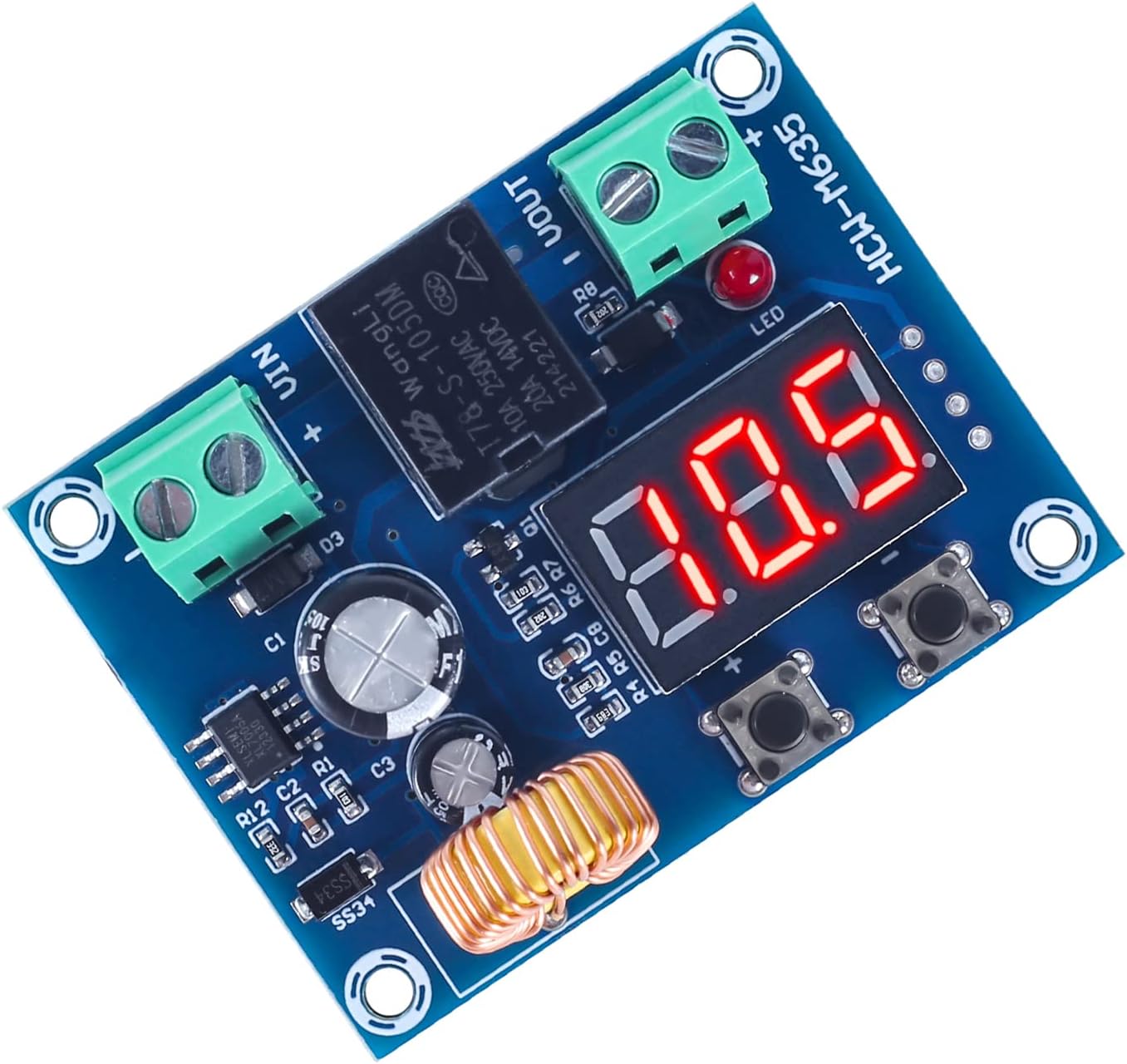
The ICSTATION Digital Low Voltage Protector is a compact, panel-mount battery protection module designed for 12-36V DC systems. It prevents over-discharge by cutting off loads at user-set voltages with 0.1V accuracy and supports up to 20A current. Featuring a delay turn-on timer (0-999s), memory retention of settings, and a clear LED voltage display, it’s ideal for solar, lead acid, and lithium battery setups seeking reliable, customizable power management.


| ASIN | B07929Y5SZ |
| Actuator Type | Push Button |
| Best Sellers Rank | #38,069 in Patio, Lawn & Garden ( See Top 100 in Patio, Lawn & Garden ) #20 in Renewable Energy Controllers |
| Brand | IS |
| Brand Name | IS |
| Circuit Type | 1-way |
| Compatible Devices | Lead Acid Batteries, Lithium Ion Batteries, Solar Panel Batteries |
| Connectivity Protocol | X-10 |
| Connector Type | Plug In |
| Contact Material | Stainless Steel |
| Contact Type | Normally Closed |
| Control Method | Touch |
| Control Type | manual |
| Controller Type | Push Button |
| Current Rating | 20 Amps |
| Customer Reviews | 4.3 out of 5 stars 1,014 Reviews |
| International Protection Rating | IP65 |
| Item Dimensions | 2.24 x 1.65 x 0.75 inches |
| Manufacturer | icstation |
| Material Type | Plastic |
| Model | Digital Battery Low Voltage Protection |
| Mounting Type | Panel Mount |
| Number of Positions | 2 |
| Operating Voltage | 36 Volts |
| Operation Mode | Manually, Off, Push Button |
| Part Number | 13098 |
| Switch Type | Push Button |
| Terminal | Screw |
| Unit Count | 1.0 Count |
| Wattage | 1.5 watts |
F**N
It just works! Very simple, and very capable.
This device is intended to prevent over-discharge of the battery (or batteries) in a system like a solar panel-charged battery bank. Rechargeable batteries of any type can be damaged by being overly discharged in use. There are such things as "deep cycle" batteries, which are more resistant to these problems, but they still have a minimum voltage to which they can repeatedly be discharged without causing permanent damage. This module is a very simple, but very capable, device which basically allows the user to set a minimum voltage, and when the battery voltage drops below that value, it cuts off the output of the battery, shutting down the powered system. I set it up in a test circuit with a variable voltage power supply, to see how well it worked, before using it in my actual circuitry, and was able to verify that this module did exactly what it's intended to do. Then I set it up in a battery capacity testing system, to be used to verify the condition of an aircraft battery. I was interested in applying a moderately heavy load to a fully-charged battery. I wanted to discharge the battery to a reasonable point, but then shut off the load so as not to damage the battery. I was interested in monitoring the capacity of the battery to power that load, while not hurting it. I set the module to allow the battery to discharge to 10 volts. The fully charged battery had an open-circuit voltage of 12.6 volts. I then applied a 100W resistive load (just under 8 amps at the beginning). I monitored the time it took to drop from 12.6 to 10 volts, and then looked at the time it took to do that, using another electrical timer. This allowed me to leave the testing setup alone, without worrying that I would over-discharge the battery. It worked exactly as it was supposed to. As the voltage fell about .1 volts below 10 volts, the relay on the unit opened, and shut off the load. The other setting, the "difference value" keeps the circuit from cycling quickly after the load is removed. As the battery hits 10 volts, it shuts off. That immediately allows the voltage on the battery to increase, due to the loss of the load. If it did not have this "difference setting", that alone might allow it to reset and turn the circuit back on again. This would cause it to cycle off-on-off-on for a while, until the battery didn't recover to above the 10 volt setting. This behaved exactly as I needed for my intended use. If one was using this as it's intended for, in a solar system, for example, without the "difference setting", as soon as the battery output was shut off, when solar charging started again, it would immediately turn on the load again, and the battery wouldn't charge. One would use this device to ensure that the battery (or bank of batteries) is charged above the desired voltage before the load was again enabled. For example, as the system was used to power, say a small lighting system, or a waterfall pump, when the battery falls to below the set minimum safe level you choose, say 9 volts for a deep-cycle battery, it would disconnect the load. You could set the "difference value" to 4 volts. The next day, when the sun came out, the battery would charge, without powering the load, until it reached a level of 13 volts. The load would then be enabled, and if needed power would flow again to the load. Then, when the sun goes down, it would continue to power the load, until the battery reached 9 volts again, when the load would again be disconnected, and the cycle would repeat. This device seems to be very stable. It has a voltage display (red LED digits) to show the battery voltage. I found this to be very accurate, at least within .1 volt DC. And the battery/load cutoff is also very accurate, again within no more than .1 volt DC. The same display is used with the two switches to select and set the minimum voltage and the "difference value". You select "min voltage" by holding the left switch until the display flashes, and then use the two switches to set the value, up or down. When you leave it alone for a few seconds, it reverts back to the normal monitoring mode, and indicates the battery voltage again. You do the same thing with the right switch, to set the "difference value". It's pretty easy to set up once you figure this little finger dance out. It's not that tough, and you will likely only need to do it once. There is a small red LED that lights whenever the relay is energized (ON) and the load enabled. When it trips and turns off the relay/load, the LED is off. So you can tell at a glance what the status of the load is, and at the same time, what the battery voltage is at any given moment. Basically, the thing just works. The setting is persistent, in that it stays after power is disconnected until you manually change it. If you have a need for such a module, you can't beat this to control a moderate load. The relay is marked as being rated for a 20A load. It can handle a battery voltage up to 36 volts.
T**N
Simple and straightforward protection
I purchased this disconnect to help prevent the battery in my kids’ toy car from being discharged too much from either use, or from the little toy radio not being turned off. The item itself is self explanatory in its installation, but instructions are provided nonetheless. The instructions warn that the device itself consumes power and will over time discharge the battery it is connected to. This should be expected, and doesn’t present a problem as it’s designed to prevent over-discharge - in my two weeks of testing this module, I have found it to work flawlessly. As mentioned, it’s easy to install - I used a 3D printer to make a little mount, but a few standoffs would work equally well. After setting the device up by patching it into the circuit and setting the threshold, it’s ready to go. The LED display is crisp and easy to read and shows currently voltage passing through the device. It has worked great for the post two weeks in my application. When the device shuts off the toy car, I disconnect the battery and recharge it so it’ll be ready to go the next day. I was pleasantly surprised by how straightforward the device is. The price is very reasonable and I’m considering buying more for other projects in the future.
W**E
Very Novel Product, and Extremely Useful, but Overpriced in My Opinion
Another seller has two of the similar/same product for TWO pieces, at only $9.99, so I took a star off for that. The relay is rated 20A at 14V DC, but the trace width is about 1/8 inch (125mil, 125 thousands of an inch), and that should only be rated for 5.5 Amps. I would not run this over 5.5A at 14V or lower, and if you run this at 20A and 36V DC, you may have issues, or it may not last long. I will be soldering 18 AWG silicon coated wire with 3 runs on the back of the PCB and that will easily extend the amperage to 15A, and may run at 20A at 14V DC or lower. This is a very novel idea to not allow your battery to over discharge, which will ruin your batteries. As stated on the product page, this DOES draw some current from your battery to run the electronics even if the load is disconnected. A possible work around is to add a trickle charger to your battery that is being discharged, and this will automatically reconnect the load after the voltage rises to the difference value (programmable) plus the input voltage. So if the disconnect voltage (also programmable) is set to 10.5V, and the difference voltage is set to 2V, then the load will disconnect if the input voltage (i.e. a battery) is 10.5V or less, then reconnect when the input voltage reached 12.5V or higher. This does not have over current or over voltage protection, so I would run this at a max of 5.5A and a max of 14V (or 14.6V should be ok for a fully charged 12V LiFePO4 battery). Directions are NOT included, so take a screen shot of the directions on the product page and save it as a PDF or just print it. It is very easy to use in my opinion. I took another star off for not including directions, and in my opinion the voltage and current ratings of 20A and 36V are much too high, I plan to take 5 minutes and add 3 jumper wires for the input+, the Output+, and between the input and output ground. This product is highly recommended and costs much less than other sellers, and an excellent value for the money! Also that 8 pin chip is a buck converter running at about 150 MHz and has excellent filtering based on the size of the inductor and capacitors, but that is only for the onboard logic. The micro-controller or ASIC is likely under the display:) I also LOVE that the input and output do not have to be soldered and have very nice connections! The directions show that the reconnect delay may be programmed in minutes from 0 to 10, but the listing states that it is programmed from 0 to 999 seconds, so there is a conflict on that, but no big deal, as 10 minutes is fine in my opinion. I also changed my rating to 5 stars due to the seller having such a high level of integrity, and that is so rare today, and I wish to support those sellers if possible with a solid 10 out of 10 on customer service. I give the seller the highest rating I can, and did not change anything in the review, but only added a few sentences and a higher rating. I wish more sellers were like this seller.
S**T
No output/broke
Worked well for a week or two with a 20v battery but after that, there was no output. Edit: company offered a full refund
J**E
Versatile protection against excessive, destructive discharge.
This is a very flexible tool for protecting against excessive discharge of batteries, though it can also be used any time you want to disconnect a circuit from a source of power when the power source drops below the setpoint. The reconnect setpoint is adjustable as well, and the user can also set a delay (up to 10 minutes, in one minute intervals) after power source voltage rises to the reconnect setpoint. Basic time setting accuracy is pretty good - on my unit it was within 2% of the set time. Voltage setpoint were accurate to within +/- 0.1V (but ONLY after you calibrate the voltage accuracy, which I found to be critical). Over all, the circuit functions well, especially given its sales price. However, it's important to note that the circuit derives its operating power from the input power source, and because of this, it will continue to discharge batteries used as a power source. If the battery cannot be recharged immediately after the lower voltage limit is reached it is probably a good idea to set the discharge voltage limit 0.1 - 0.2V higher.
R**M
Works ok!
Compact and appears good quality build. Great instructions provided and easy to program. Bench testing showed accurate and consistent operation. Power consumption with relay off is 150 mA, consumption with relay engaged was 770 mA. In my case the load I wanted to disconnect was lower than 770 mA so this will not work for me.
S**R
Doesn't work
Lots of reviews on here. Mine doesn't work. I looked at the negative reviews and found one that exactly matched what mine was doing. So I just copied it here: I don't know what it is doing, but it isn't what it was sold as. Long-press + button: A random number starts flashing. I can increase or decrease that number. When I stop and wait for it to stop flashing, that number stays on the screen. NOT the input voltage. Long-press - button: A different number with the decimal all the way to the right starts flashing. I can increment or decrement this number. I stop and wait, and after a while it stops flashing and returns to the random number that was displayed earlier. Short-press the + button: 12.0 is displayed. Doesn't matter what I did after the long-press of the + button. The short-press of the + button will always display 12.0. Short-press the - button: 2.0 is displayed. Doesn't matter what I did after the long-press of the - button. The short-press of the - button. The first photo attached is an example. Power supply is set to 15V, and I've verified it with a DMM. This PS is connected as the input to the device. It says 24.3. What is 24.3 supposed to mean? The second two photos show that the disconnect voltage is still 12.0V, and the difference voltage is still set to 2.0V, no matter what I have done to change them. Silly little device might entertain a child, but doesn't do anything it is supposed to do.
J**3
Good for conditioning LiIon batteries for long term storage
I purchased this to condition my snowblower's LiIon batteries for long term storage over the summer months. The price was a little higher than from other sellers but with Amazon Prime I had the circuit board in two days.
J**B
does the job — it's handy!
I hooked up this handy little gadget to the battery backup system we use to power my camper when we don't have grid power. The little relay on this circuit board can't handle the current that my inverter draws; so i simply connected this cut-off device to a hefty 250A relay which switches my inverter on or off. Now, when my battery drains below a pre-determined voltage, this little device turns off my big relay which, in turn, cuts off power to my inverter. (So, i no longer have to worry about draining my battery below a certain depth of discharge.) The other nice feature about this thing is the "differential" setting. I've now set the device to shut off at 11.4v and not kick back on until the battery reaches 12.6v. ONE LITTLE NUANCE: According to my multimeter, this thing reads about 0.2 or 0.25 volts less than the actual measured voltage of the battery. So i had to accommodate for this error factor when i set it up. I want it to cut off at 11.4 volts, so i set the cut-off voltage to 11.2. I want it to kick back on after the battery has reached 12.6 volts; but, because this thing is apparently off by 0.2, i therefore want it to kick back on at 12.4. The "difference" between 12.4 and 11.2 is 1.2. So that’s where I set the “differential” setting.
J**T
Fonctione très bien
Still going strong afters many years of service. It protected my battery from over drainage. So far i am pulling 7 amp from the battery.
J**E
Toute va bien ..
Mes la Led rouge marche pas...mes je respire avec ca
G**O
Works well
Used to prevent overdraining Milwaukee battery which is powering a light.
V**G
It works but it doesn’t
I bought this device thinking everything work as advertised. It turned out not everything works as advertised… Works: cutoff future Doesn’t work: memory Every time I turn off/disconnect battery from device I have to readjust the cutoff voltage because it resets to default. Annoying Also, manual is useless just go and watch “battery low voltage disconnect module by mpjaonline”
Trustpilot
2 weeks ago
3 days ago