
DOWNLOAD THE APP


Customer Services
Copyright © 2025 Desertcart Holdings Limited
DOWNLOAD THE APP
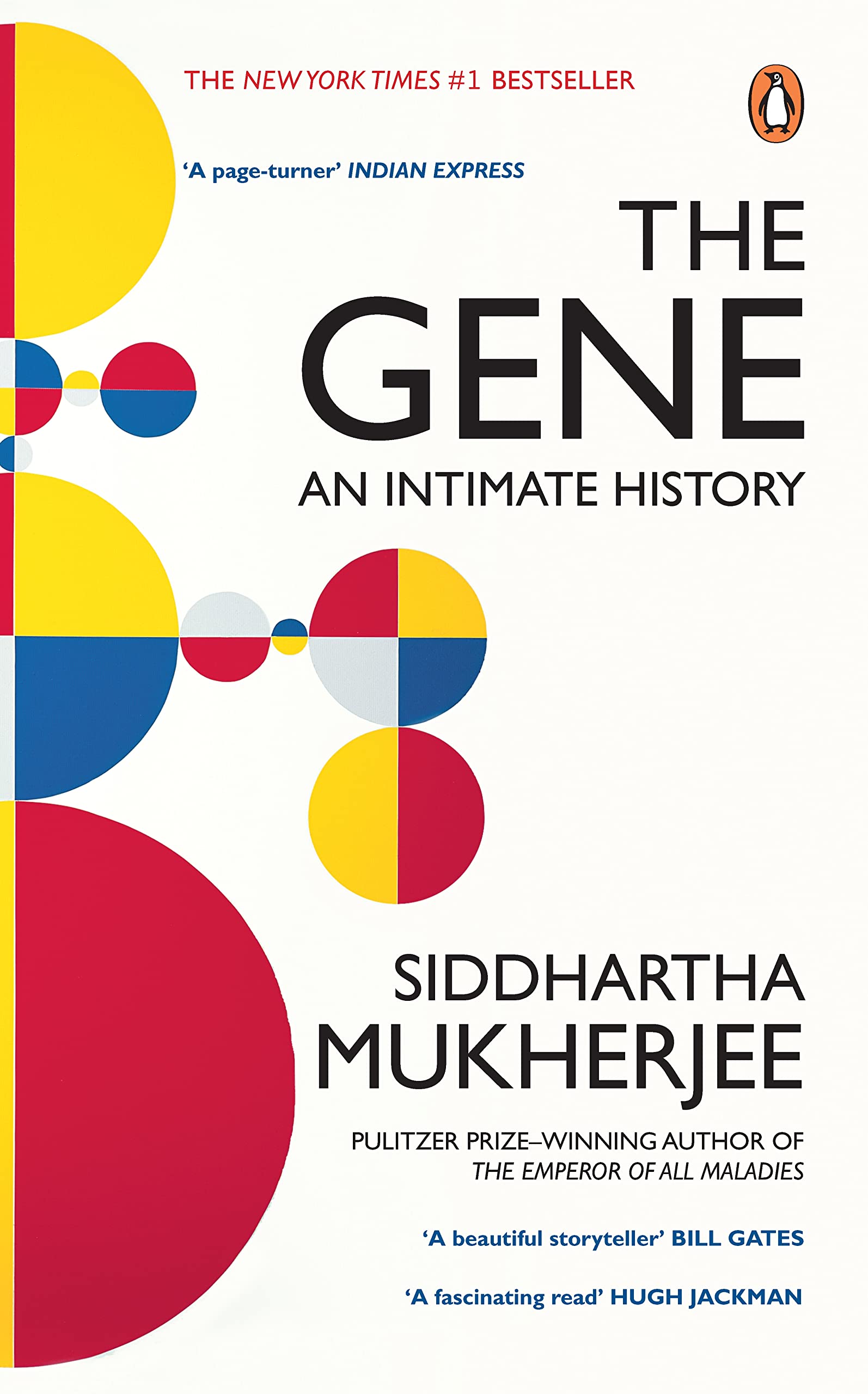
Gene, The: An Intimate History : SIDDHARTHA MUKHERJEE: desertcart.in: Books Review: An exquisite read! - I finished reading ‘The Gene’ by Siddhartha Mukherjee last month. It has been a fascinating voyage in the world of biology- genetics to be precise. As I wrote before too, it has been written with great erudition and is richly laced with metaphor and similes to make it comprehensible even for a non-biologist. It staggers my mind to think how must an ocean of research material have been mined for it, grasped, and then put to masterly use by the doctor-writer. Only a man of SM’s calibre who gave us a wonderful book on cancer ‘The emperor of all maladies’ before, could have done it. The gene book tells us in gripping detail the whole story of the gene right from early meanderings before the Christian era by the Greek Philosophers like Pythagoras (530 BC), Anaxagoras (400 BC), Aristotle (350 BC) and many others to unravel the mystery of inheritance. (Incidentally, Anaxagoras thought that the essence of heredity was carried by the male sperm, while the female only “shaped’ male semen in the womb to produce the foetus! And Aristotle argued that hereditary information is transmitted in the form of messages.) Nothing is in fact left out by the author in this long journey of man’s search for answers to the intriguing gene puzzle: Mendel’s experiments on pea to unravel the mystery of inheritance of characters, Darwin’s great voyage, how Watson and Crick cracked the DNA code, the human genome, how the new findings have helped mankind in understanding and curing genetic disorders by gene therapy, gene edting and gene surgery and the future scenario in regard to genomics and humankind. A lot has been done but a lot more still needs to be discovered. So many tricky genetic ailments such as Haemophilia, sickle cell anaemia etc which have afflicted mankind causing huge suffering, are now being cured thanks to new insights into the subtle working of the gene. Many more are on the threshold of being tamed and treated through gene therapy. The quest is on. Needless to say, the coming decades will see man (or a geneticist) playing God with gene editing and cloning technologies in his kitty. It will be for the humankind though to see and decide where to draw the line. What makes the book so outstanding is the interesting manner and the arresting narrative with which the whole story of the gene is laid bare before the mesmerized reader with fascinating details about the personal lives of Mendel, Darwin and all other luminaries who have been involved in their scientific endeavours in unravelling the mystery of the gene right from the beginning till date, their obsessions, devotion, dedication, foibles, failures, jealousies, the politics and so on. Having been a zoologist myself – though not a great one! – I could strike an instant chord with the book and had it fill many gaping voids in my understanding of the gene. Subhash Sharma, Palampur, Kangra HP Review: A book that broadens your vision... - I liked the book-The Gene: An Intimate History by Siddhartha Mukherjee. Being a former teacher of Human Anatomy including Genetics, I am aware of the vastness of the subject and its branches but this book covers all the important aspects in less than 600 pages. The book has been divided into Parts and in each Part, there are several chapters; this makes convenient reading. All the parts and chapters have been thought provokingly titled. The author has meticulously avoided technical terms as the book is intended to be for the lay readers. If you are interested in the development and evolution of the subject, this is a book for you; it makes interesting reading. The author’s background has lent authenticity to the contents. He has tried to give justice to every character who contributed significantly: Aristotle, Darwin, Mendel, Morgan, Bateson, Johannsen, Galton, Garrod, Beadle and Tatum, Jacob and Monod, Watson and Crick, Khorana, McKusick, Sanger, Berg, Venter, Gurdon and Yamanaka; it is actually ‘Who is who’ of Genetics. Some new terms like previvors have been introduced and Human Genome project has been discussed in details. The narrative is so detailed and vivid that we feel that the author was personally present when and where the history (and the future) happened! I enjoyed reading accounts pertaining to Eugenics, BRCA1, Indian counter part of Nazism, sexual identity, Gay gene etc. I tend to agree with the author’s prediction- “The discontinuity of genes-the discreteness and autonomy of each individual unit of heredity-will turn out to be an illusion: genes may yet be more interconnected than we think.” That would be the end of the prevalent reductionist view of the word-Gene. A clinician is mainly concerned with what can be applied on patients in the clinic. In spite of the tremendous strides that Genetics has taken in recent years, there is not much that can be offered to the needy patients as far as the curative treatment is concerned; this is particularly true for the mental ailments (the author with several members of his family suffering from such disorders knows about this more intimately than anyone else) and the cancers. Some of the advancements are rightly facing political, social and ethical hurdles. If researches on the stem cell and gene therapy are approved wholeheartedly in due course of time, we may see more practically beneficial genetics which not only satisfy curiosity but also cures. Human Genome project has been rightly proved to be just the beginning in this direction; we are now eagerly awaiting the outcomes of Human Epigenome project and Encode. This is a book that broadens your vision whatever your background may be.
| ASIN | 0143422162 |
| Best Sellers Rank | #3,858 in Books ( See Top 100 in Books ) #15 in Biology Books #599 in Reference (Books) #1,110 in Biographies & Autobiographies (Books) |
| Country of Origin | USA |
| Customer Reviews | 4.6 4.6 out of 5 stars (7,426) |
| Dimensions | 20 x 14 x 4 cm |
| Generic Name | Book |
| ISBN-10 | 9780143422167 |
| ISBN-13 | 978-0143422167 |
| Importer | Penguin Random House India Pvt Ltd |
| Item Weight | 480 g |
| Language | English |
| Net Quantity | 750.00 Grams |
| Packer | Penguin Random House India Pvt Ltd |
| Paperback | 608 pages |
| Publisher | Penguin Random House India (1 October 2017) |
A**R
An exquisite read!
I finished reading ‘The Gene’ by Siddhartha Mukherjee last month. It has been a fascinating voyage in the world of biology- genetics to be precise. As I wrote before too, it has been written with great erudition and is richly laced with metaphor and similes to make it comprehensible even for a non-biologist. It staggers my mind to think how must an ocean of research material have been mined for it, grasped, and then put to masterly use by the doctor-writer. Only a man of SM’s calibre who gave us a wonderful book on cancer ‘The emperor of all maladies’ before, could have done it. The gene book tells us in gripping detail the whole story of the gene right from early meanderings before the Christian era by the Greek Philosophers like Pythagoras (530 BC), Anaxagoras (400 BC), Aristotle (350 BC) and many others to unravel the mystery of inheritance. (Incidentally, Anaxagoras thought that the essence of heredity was carried by the male sperm, while the female only “shaped’ male semen in the womb to produce the foetus! And Aristotle argued that hereditary information is transmitted in the form of messages.) Nothing is in fact left out by the author in this long journey of man’s search for answers to the intriguing gene puzzle: Mendel’s experiments on pea to unravel the mystery of inheritance of characters, Darwin’s great voyage, how Watson and Crick cracked the DNA code, the human genome, how the new findings have helped mankind in understanding and curing genetic disorders by gene therapy, gene edting and gene surgery and the future scenario in regard to genomics and humankind. A lot has been done but a lot more still needs to be discovered. So many tricky genetic ailments such as Haemophilia, sickle cell anaemia etc which have afflicted mankind causing huge suffering, are now being cured thanks to new insights into the subtle working of the gene. Many more are on the threshold of being tamed and treated through gene therapy. The quest is on. Needless to say, the coming decades will see man (or a geneticist) playing God with gene editing and cloning technologies in his kitty. It will be for the humankind though to see and decide where to draw the line. What makes the book so outstanding is the interesting manner and the arresting narrative with which the whole story of the gene is laid bare before the mesmerized reader with fascinating details about the personal lives of Mendel, Darwin and all other luminaries who have been involved in their scientific endeavours in unravelling the mystery of the gene right from the beginning till date, their obsessions, devotion, dedication, foibles, failures, jealousies, the politics and so on. Having been a zoologist myself – though not a great one! – I could strike an instant chord with the book and had it fill many gaping voids in my understanding of the gene. Subhash Sharma, Palampur, Kangra HP
D**H
A book that broadens your vision...
I liked the book-The Gene: An Intimate History by Siddhartha Mukherjee. Being a former teacher of Human Anatomy including Genetics, I am aware of the vastness of the subject and its branches but this book covers all the important aspects in less than 600 pages. The book has been divided into Parts and in each Part, there are several chapters; this makes convenient reading. All the parts and chapters have been thought provokingly titled. The author has meticulously avoided technical terms as the book is intended to be for the lay readers. If you are interested in the development and evolution of the subject, this is a book for you; it makes interesting reading. The author’s background has lent authenticity to the contents. He has tried to give justice to every character who contributed significantly: Aristotle, Darwin, Mendel, Morgan, Bateson, Johannsen, Galton, Garrod, Beadle and Tatum, Jacob and Monod, Watson and Crick, Khorana, McKusick, Sanger, Berg, Venter, Gurdon and Yamanaka; it is actually ‘Who is who’ of Genetics. Some new terms like previvors have been introduced and Human Genome project has been discussed in details. The narrative is so detailed and vivid that we feel that the author was personally present when and where the history (and the future) happened! I enjoyed reading accounts pertaining to Eugenics, BRCA1, Indian counter part of Nazism, sexual identity, Gay gene etc. I tend to agree with the author’s prediction- “The discontinuity of genes-the discreteness and autonomy of each individual unit of heredity-will turn out to be an illusion: genes may yet be more interconnected than we think.” That would be the end of the prevalent reductionist view of the word-Gene. A clinician is mainly concerned with what can be applied on patients in the clinic. In spite of the tremendous strides that Genetics has taken in recent years, there is not much that can be offered to the needy patients as far as the curative treatment is concerned; this is particularly true for the mental ailments (the author with several members of his family suffering from such disorders knows about this more intimately than anyone else) and the cancers. Some of the advancements are rightly facing political, social and ethical hurdles. If researches on the stem cell and gene therapy are approved wholeheartedly in due course of time, we may see more practically beneficial genetics which not only satisfy curiosity but also cures. Human Genome project has been rightly proved to be just the beginning in this direction; we are now eagerly awaiting the outcomes of Human Epigenome project and Encode. This is a book that broadens your vision whatever your background may be.
K**R
A different genetics book
Not written from a medical viewpoint alone. That tends to put off some people including doctors (I am one). Covers a lot of interesting ground in history - the american eugenics program and the German T4. The pre-war ideological problem the soviet communists had with modern genetics and its consequences - very interesting. Got little bogged down in the Human genome project. The author`s attempts to intertwine the story with the story of mental illness in his own family feels little strained at times. A valiant attempt all the same. Great writing and research. Dr Mukherjee explains complex ideas very `patiently` in simple words. Must come from his experience in teaching medical students at the bedside. IMO medical students and subsequently doctors are simple minded ! Does not soar like the Emperor however. But then a lot of ground past present future has already been covered by other writers and so Dr Mukherjee`s job is to put all that in one place with emphasis on the overall sociopolitical context and its relevance to clinical practice. Like he has said in an interview, this is one book he wanted off his chest. Good read. Will appeal to all those popular science fans, doctors, biologist and anyone interested in science and history of the 20th century. Shouldn't let the Emperor of all maladies to cloud your assessment of this book !
S**R
Product was in great condition
A Page turner book for reader, Must readable book.
H**O
Muy buen libro, explica de forma sencilla pero concisa conceptos importantes sobre genética y biotecnología, además que la forma de llevar la historia lo hace de acuerdo a los eventos más relevantes y en orden cronológico sobre dichas áreas.
S**E
Gründlich recherchiert, super geschrieben. Dr. Mukherjee ist ein begnadeter Erzähler, ebenso wie sein vorheriges Werk "The Emperor of all Maladies" ist auch "The Gene" absolut empfehlenswert. Auch für nicht-medizinisch / biochemisch vorgebildete Leser ist dieses Buch leicht verständlich und spannend geschrieben. Bezieht sich auf die englische Ausgabe (die ich auf Grund des feinen Erzählstils nur empfehlen kann, eine deutsche Übersetzung kann da nicht mithalten).
A**R
De schrijver, van oorsprong oncoloog, beschrijft zijn zoektocht naar de genetische informatie die van de chromosomen vanaf de moestuin in het klooster dat Mendel kan worden afgelezen. Met verbazing kijkt hij achterom en ziet de ongelooflijk secure wijze waarop de wetenschappers grip krijgen op de "zwarte materie"die zich in de celkern bevindt. Maar ook beschrijft hij de pseudowetenschappelijke eugenetica van het Duitse Rijk onder Hitler, die een voortzetting van de gedachtenexperimenten van o.a. Galton, de neef van Darwin bleken te zijn. Van de chromosomen en de genen dalen we af in de getordeerde wereld van het DNA en RNA met als bouwteen voor de informatie de vier welbekende aminozuren. Erfelijkheid is echter afhankelijk van de dubbel aanwezige genen en de genexpressie. De zoektocht naar de locatie van het gen voor homoseksualiteit (Mukherjee noemt alleen de mannelijke variant) is een schoolvoorbeeld van inductie vanuit de wereld van tweelingen. Harde conclusies zijn er niet. Fraai uitgewerkt is het epigenetische geheugen met het intron als essentieel onderdeel. De zoektocht naar gentherapie is aanvankelijk een onthutsende beschrijving van gedroomde resultaten op basis van onvoldoende geverifieerde inzichten. Het zal anders worden, wanneer het enzymmechanisme van het HIV-virus wordt gebruikt om de echte gentherapie te ontwikkelen. Dit alles is geschreven in prachtig Engels. Lezen, zou ik zeggen..
R**S
A very interesting introduction to the science behind genetics and genomics that reads like a thriller. Not a dry and uninteresting text book, but the sort of book you can't put down until the last page. Comprehensive and well written, with plenty of references to the original research documents quoted if you want to go deeper into the subject.
A**R
The Gene: An Intimate History is an epic story of how we have come to understand some of the fundamental building blocks of life on earth. From Mendel growing his peas via Darwin and the origin of species, eugenics and the Nazis, Crick and Watson discovering the double helix structure of DNA to the tantalising prospects of genome enhancement, Siddhartha Mukherjee takes us comprehensively through the whole history. It's a complex subject, but the writing is just the right level for someone (like me) with no biology or chemistry background at all to understand. He also covers the moral and ethical aspects of some of the research as well as the science. There's a lot to it, and it does take a while to read, but it's such a fascinating tale that it's well worth the effort. Awe-inspiring and downright mind-boggling in places, if popular science is your thing then you won't want to miss this one.
Trustpilot
2 days ago
2 months ago