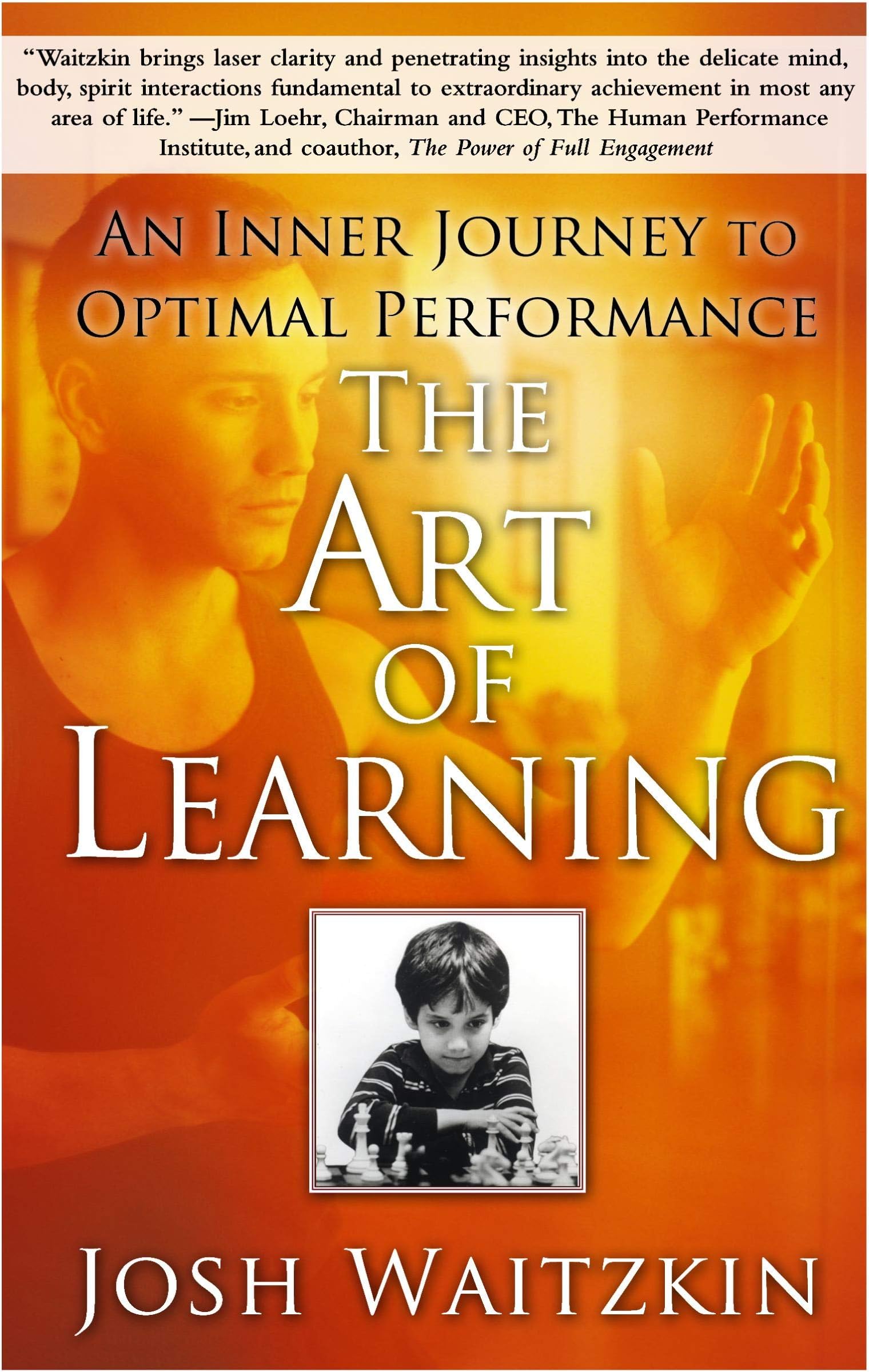
Art Of Learning
Product ID: 76777712
Desertcart purchases this item on your behalf and handles shipping, customs, and support to Hong Kong.
In his riveting new book, The Art of Learning, Waitzkin tells his remarkable story of personal achievement and shares the principles of learning and performance that have propelled him to the top—twice.Josh Waitzkin knows what it means to be at the top of his game. A public figure since winning his first National Chess Championship at the age of nine, Waitzkin was catapulted into a media whirlwind as a teenager when his father’s book Searching for Bobby Fischer was made into a major motion picture. After dominating the scholastic chess world for ten years, Waitzkin expanded his horizons, taking on the martial art Tai Chi Chuan and ultimately earning the title of World Champion. How was he able to reach the pinnacle of two disciplines that on the surface seem so different? “I’ve come to realize that what I am best at is not Tai Chi, and it is not chess,” he says. “What I am best at is the art of learning.” With a narrative that combines heart-stopping martial arts wars and tense chess face-offs with life lessons that speak to all of us, The Art of Learning takes readers through Waitzkin’s unique journey to excellence. He explains in clear detail how a well-thought-out, principled approach to learning is what separates success from failure. Waitzkin believes that achievement, even at the championship level, is a function of a lifestyle that fuels a creative, resilient growth process. Rather than focusing on climactic wins, Waitzkin reveals the inner workings of his everyday method, from systematically triggering intuitive breakthroughs, to honing techniques into states of remarkable potency, to mastering the art of performance psychology. Through his own example, Waitzkin explains how to embrace defeat and make mistakes work for you. Does your opponent make you angry? Waitzkin describes how to channel emotions into creative fuel. As he explains it, obstacles are not obstacles but challenges to overcome, to spur the growth process by turning weaknesses into strengths. He illustrates the exact routines that he has used in all of his competitions, whether mental or physical, so that you too can achieve your peak performance zone in any competitive or professional circumstance. In stories ranging from his early years taking on chess hustlers as a seven year old in New York City’s Washington Square Park, to dealing with the pressures of having a film made about his life, to International Chess Championships in India, Hungary, and Brazil, to gripping battles against powerhouse fighters in Taiwan in the Push Hands World Championships, The Art of Learning encapsulates an extraordinary competitor’s life lessons in a page-turning narrative. Review: Engaging read - the love of learning and pursuit of excellence - Things and the self are governed by the same principle. If you understand one, you understand the other, for the truth within and the truth without are identical (Er Cheng Yishu, 11th century) . . The theme is depth over breadth. The learning principle is to plunge into the detailed mystery of the micro in order to understand what makes the macro tick. Our obstacle is that we live in an attention-deficit culture. . There are clear distinctions between what it takes to be decent, what it takes to be good, what it takes to be great and what it takes to be among the best. . When aiming for the top, your path requires an engaged, searching mind. Make obstacles spur you to creative new angles in the learning process. Let setbacks deepen your resolve. Make adversity a tremendous source of creative inspiration Review: Read this if you are in pursuit of mastery in any domain - This book is memoir on personal experiences and learning of Josh Waitzkin. This guy has mastered two competitive sports- one intellectual and another physical. He has explained the methods and learning philosophy followed and found useful by him. If you are looking for easy to digest tidbits then you will disappointed. The pearls of wisdom are scattered through out the book and mixed with personal experiences. That makes it cumbersome to get his learning out of this book. You will read this book for his learning methods and not what he did or did not. I need to read this book again to understand few concepts better. I found some concepts based on Eastern tradition very powerful if applied properly. Especially these things are very powerful if you are trying become expert in any domain....especially where you need to compete with other people.
| Best Sellers Rank | #7,341 in Books ( See Top 100 in Books ) #79 in Games & Quizzes (Books) #180 in Motivational Self-Help #227 in Biographies & Autobiographies (Books) |
| Customer Reviews | 4.4 out of 5 stars 5,248 Reviews |
M**K
Engaging read - the love of learning and pursuit of excellence
Things and the self are governed by the same principle. If you understand one, you understand the other, for the truth within and the truth without are identical (Er Cheng Yishu, 11th century) . . The theme is depth over breadth. The learning principle is to plunge into the detailed mystery of the micro in order to understand what makes the macro tick. Our obstacle is that we live in an attention-deficit culture. . There are clear distinctions between what it takes to be decent, what it takes to be good, what it takes to be great and what it takes to be among the best. . When aiming for the top, your path requires an engaged, searching mind. Make obstacles spur you to creative new angles in the learning process. Let setbacks deepen your resolve. Make adversity a tremendous source of creative inspiration
G**D
Read this if you are in pursuit of mastery in any domain
This book is memoir on personal experiences and learning of Josh Waitzkin. This guy has mastered two competitive sports- one intellectual and another physical. He has explained the methods and learning philosophy followed and found useful by him. If you are looking for easy to digest tidbits then you will disappointed. The pearls of wisdom are scattered through out the book and mixed with personal experiences. That makes it cumbersome to get his learning out of this book. You will read this book for his learning methods and not what he did or did not. I need to read this book again to understand few concepts better. I found some concepts based on Eastern tradition very powerful if applied properly. Especially these things are very powerful if you are trying become expert in any domain....especially where you need to compete with other people.
D**V
Inspirational and Educational book
I got my book delivered on Time. Great Services from Amazon. I have read many things about authors on Internet and it is aspiring and valuable .So i decided to Buy a book. Currently i am reading this book and i enjoy it. Thanks to JOSH and Amazon again!!!!
S**H
Wow
I was lacking the finesse, this book has opened my eyes. By going through the intricate thought process, which if understood properly one can fine tune himself to be really successful.
N**K
Awesome
This book is not a single read and this is not a self help book.It goes beyond that .The author s greatest achievement is it makes reader think about him/her .Read and re read as much you can it will help you go deeper & deeper inside you.
N**H
Nice book but paper quality is too bad
Book is absolutely best but paper quality is very poor. It’s made of ruff paper.
A**L
God read
It's a good read. Quality of pages should have been better. But if you get it cheap go for it
K**R
Amazing book. Great tips for Athletes
I am a national level athlete and This book gave me wonderful insights to take my skill to the next level which no other player or coach could have given me. Noted down important points which I am going to follow this season. Thanks JOSH
N**I
Must read
the best book I have read this year so far. Those who want to be the best should read and follow what he has felt and gone through in the process to reach the top.
M**T
Not what you're expecting.
I almost didn't buy this book. It was recommended by another author and I assumed it would be a brilliant book. But after reading many of the disappointed reviewers, I decided not to purchase it. However, after listening to a podcast with the author, I immediately bought the book. It's now among my favourite books. This book is NOT a step by step science of learning. I think many of the reviewers were hoping for something like that. It really is the ART of learning, and Josh shares this art from his life experiences (through chess and Tai Chi). I've taken my learning to the next level thanks to Josh. If you're the type of person who loves to explore and learn in unexpected ways, buy the book!
P**A
Awesome Read
For anyone who's passionate about learning, this book has great insights. And it doesn't pretend to have a recipe, but very elegantly suggests ways to approach learning based on our unique strengths. Easy 5 stars!
E**4
Vraiment un incontournable plein d'humilité, du vécu et un livre vibrant jusque la dernière page!!!!
Dans la lignée de Mastery(aïkido) ici c'est dans la pratique des échecs puis par la suite de Tai Chi que l'auteur comment d'un novice tout le monde peut parvenir à un niveau d'excellence en nous donnant des conseils très concrets, vécus. Notre cœur bat à 100 à l'heure quand il décrit c'est tournoi de Tai Chi jusqu'à la dernière page. Comme Mastery mais à un niveau plus faible, ce livre est vivant, plein d'humilité un must have! Après Mastery c'est bien le second qui m'a fait vibré avec autant d'intensité, avec en aparté la pratique de la méditation atheiste comme moyen de limiter son stress et être plus focus. Acheter le vous ne saurez pas déçu !
F**E
Must Read!
"Once he had won my confidence, Bruce began our study with a barren chessboard. We took on positions of reduced complexity and clear principles." "I was also gradually internalising a marvellous methodology of learning - the play between knowledge, intuition, and creativity. From both educational and technical perspectives, i learned from the foundation up." "there will be nothing learned from any challenge in which we don't try our hardest. We learn by pushing ourselves and finding what really lies at the outer reaches of our abilities." "Mental resilience is arguably the most critical trait of a world-class performer, and it should be nurtured continuously." "I believe that one of the most critical factors in the transition to becoming a conscious high performer is the degree to which your relationship to your pursuit stays in harmony with your unique disposition. There will inevitably be times when we need to try new ideas, release our current knowledge to take in new information - but it is critical to integrate this new information in a manner that does not violate who we are. By taking away our natural voice, we leave ourselves without a center of gravity to balance us as we navigate the countless obstacles along our way." "Vibrant, creative idealism needs to be tempered by a practical, technical awareness." "The Tao Te Ching's wisdom centers on releasing obstructions to our natural insight, seeing false constructs for what they are and leaving them behind." "Depth beats breadth any day of the week, because it opens a channel for the intangible, unconscious, creative components of our hidden potential." "When aiming for the top, your path requires an engaged, searching mind. You have to make obstacles spur you to creative new angles in the learning process. Let setbacks deepen your resolve." "Once we learn how to use adversity to our advantage, we can manufacture the helpful growth opportunity without actual danger of injury." "In my opinion, intuition is our most valuable compass in this world. It is the bridge between the unconscious and the conscious mind, and it is hugely important to keep in touch with what makes us tick." "the road to mastery - start with fundamentals, get a solid foundation fuelled by understanding the principles of your discipline, then you expand and refine your repertoire, guided by your individual predispositions, while keeping in touch, however abstractly, with what you feel to be the essential core of the art. What results is a network of deeply internalised, interconnected knowledge that expands from a central, personal locus point. The question os intuition relates to how that network is navigated and used as fuel for creative insight." "The key to this process is understanding that the conscious mind, for all its magnificence, can only take in and work with a certain limited amount of information in a unit of time" "When two highly trained minds square off, in any field, the players are in a fight to enter each other's heads." "In every discipline, the ability to be clearheaded, present cool under fire is much of what separates the best from the mediocre." "In the absence of continual external reinforcement, we must be our own monitor, and quality of presence is often the best gauge." "The secret is that everything is always on the line." "The physiologists at LGE had discovered that in virtually every discipline, one of the most telling features of a dominant performer is the routine use of recovery periods. Players who are able to relax in brief moments of inactivity are almost always the ones who end up coming through when the game is on the line." "The unconscious mind is a powerful tool, and learning how to relax under pressure is a key first step to tapping into its potential." "I believe an appreciation for simplicity, the everyday - the ability to dive deeply into the banal and discover life's hidden richness - is where success, let alone happiness, emerges." "I believe that at the highest levels, performers and artists must be true to themselves. There can be no denial, no repression of the personality, or else the creation will be false - the performer will be alienated from his or her intuitive voice." "If you think about the high-end learning principles that i have discussed in this book, they all spring out of the deep, creative plunge into an initially small pool of information. In the early chapters, I described the importance of a chess player laying a solid foundation by studying positions of reduced complexity (endgame before opening). Then we apply the internalised principles to increasingly complex scenarios. In Making Smaller Circles we take a single technique or idea and practice it until we feel its essence. Then we gradually condense the movements while maintaining their power, until we are left with an extremely potent and nearly invisible arsenal. In Slowing Down Time, we again focus on a select group of techniques and internalise them until the mind perceives them in tremendous detail. After training in this manner, we can see more frames in an equal amount of time, so things feel slowed down. In the Illusion of the Mystical, we use our cultivation of the last two principles (Making smaller circles and slowing down time) to control the intention of the opponent - and again, we do this by zooming in on very small details to which others are completely oblivious." "Imagine that you are building a pyramid of knowledge. Every level is constructed of technical information and principles that explain that information and condense it into chunks (as i explained in the chapter Slowing Down Time). Once you have internalized enough information to complete one level of the pyramid, you move on to the next." "There is a connection between that discovery and what you know - or else you wouldn't have discovered it - and you can find that connection if you try. The next step is to figure out the technical components of your creation. Figure out what makes the "magic tick." Qualquer atividade que faça ou habilidade que desenvolva, o caminho é dominar a técnica e os princípios básicos e fundamentos de forma a tê-los automatizados, assim pode-se adotar um estilo que seja coerente com a sua personalidade. Tudo é uma forma de expressão, e diversos obstáculos nos mostram que precisamos liberar o caminho (bloqueios internos e externos) para nos expressarmos melhor. Estamos assim num nível. Em certos momentos de inspiração, agimos acima do nosso nível. Josh mostra que pensar e analisar esses momentos (ele filmava treinos e competições e assistia, partes chave em camera lenta) nos permite compreender o que foi de fato a inspiração, e como elevar minha habilidade de forma a este ser o meu novo patamar. Como compreender e crescer com esse "insight", e não deixar que seja apenas a sorte do momento. Não eleve sua voz, melhore seu argumento. Josh exemplifica muito bem essa ideia ao não reclamar das situações como ombro machucado ou juízes corruptos, apenas pensando no que fazer. Em geral, ser melhor, subir o nível do jogo. O obstáculo é o caminho. Nesse sentido, aprender a fluir com os obstáculos tanto externos como internos - o terremoto, chutes do adversário, fumaça, falatório e etc, e a música interna, o fato de estar com saudades de casa e etc. Não negar as emoções (isso serve em algumas condições, mas nos topo as situações extremas te empurram para além disso) e sim fluir com elas, usá-las como combustível, aprender a jogar com elas, cada uma. Uma característica fundamental de qualquer atleta de alta performance é a capacidade de relaxar. Dominar a relação entre tensão e relaxamento. Muscular, mental, em diversos níveis. É isso que separa os bons dos medíocres. Dominar a técnica completamente, absorvê-la de forma a que não mais precise passar pela mente racional, deixando esta liberada para focar em outras coisas. Os jogos mentais beiram a hipnose. Trabalhar estados alterados, fora da zona consciente, como momentos de piscar o olho, movimentos mínimos de ceder a uma pressão para cadenciar o oponente, controlá-lo, de forma que ele se sinta confiante (se essa for a estratégia). A batalha ocorre em diversos níveis. Quem controla o tom da luta vence. Quem entra na cabeça do outro vence. A visualização é citada algumas vezes. Não em detalhes, mas claramente com fortes resultados. Para a cura do braço quebrado em tempo menor e sem atrofiar, visualizando vitórias e etc. Mais uma ponte com o inconsciente. Várias pontes são feitas e usadas. A aceitação da bússola interna, de jogar a sua maneira, de investigar cada falha e compreender o que isso significa em termos de técnica, estratégia, psicologia, do oponente e etc. Aprender com os erros é um ensinamento evidente no livro. A capacidade de analisar os erros em detalhe, perceber a falha no pensamento (por ter começado com o xadrez, um jogo mental e lento, que tem essa análise já na cultura do jogo). Essa estratégia se mostra útil na vida, a clareza de objetivos, intensificados pela profundidade do foco, pelos poucos objetivos e obsessões de cada vez, que permitem ter uma meta e estudar e aprender com cada obstáculo, levando o tempo necessário, absorvendo tudo organicamente. Cada vez mais consciente, especialmente pelo hábito de analisar, entender o que fazia intuitivamente (outro reforço à ponte entre consciente e inconsciente). Como trabalhar pontos fracos, ou simplesmente no extremo, fora da zona de conforto, fomenta o crescimento. Especialmente com esse mindset. Como o momento de vida e os objetivos, as dificuldades se mesclam, os obstáculos fluem e também suas resoluções. Estar presente, atento, e relaxar. A importância de retiros (mesmo que no meio de um período onde outros treinam intensamente) para voltar renovado, com o tanque cheio e novas ideias - usar o subconsciente para trabalhar em questões enquanto a mente consciente foca em outras. A mentalidade do processo e não do resultado, mas sem desmerecer a importância do resultado. O importante é aprender e crescer, saber que o esforço é mais importante, mas se permitir o sofrimento quando fracassa, e depois levantar de novo, pois sua identidade não foi ferida, vc é mais e não se sente ameaçado pela derrota (ela não faz de vc um perdedor). A observação constante. O mundo dá dicas, como no exemplo da moça indo atravessar a rua, está desatenta e um ciclista esbarra nela (com grande esforço e evitando uma colisão muito pior). Ela ao invés de perceber o sinal, continua com os headphones e se vira pra xingar o ciclista. Nisso, um taxi a atropela. Estar num estado de consciência que te permita perceber esses sinais e reagir a tempo, voltar ao seu centro. Aprender é um processo, e cada um deve seguir o seu caminho.
Trustpilot
1 month ago
3 weeks ago