We remain fully operational. Our teams are working around the clock to ensure your deliveries continue safely.

下载应用程序


Buy anything from 5,000+ international stores. One checkout price. No surprise fees. Join 2M+ shoppers on Desertcart.
Desertcart purchases this item on your behalf and handles shipping, customs, and support to Hong Kong.
🌀 Unlock the book that bends reality and rewires your mind.
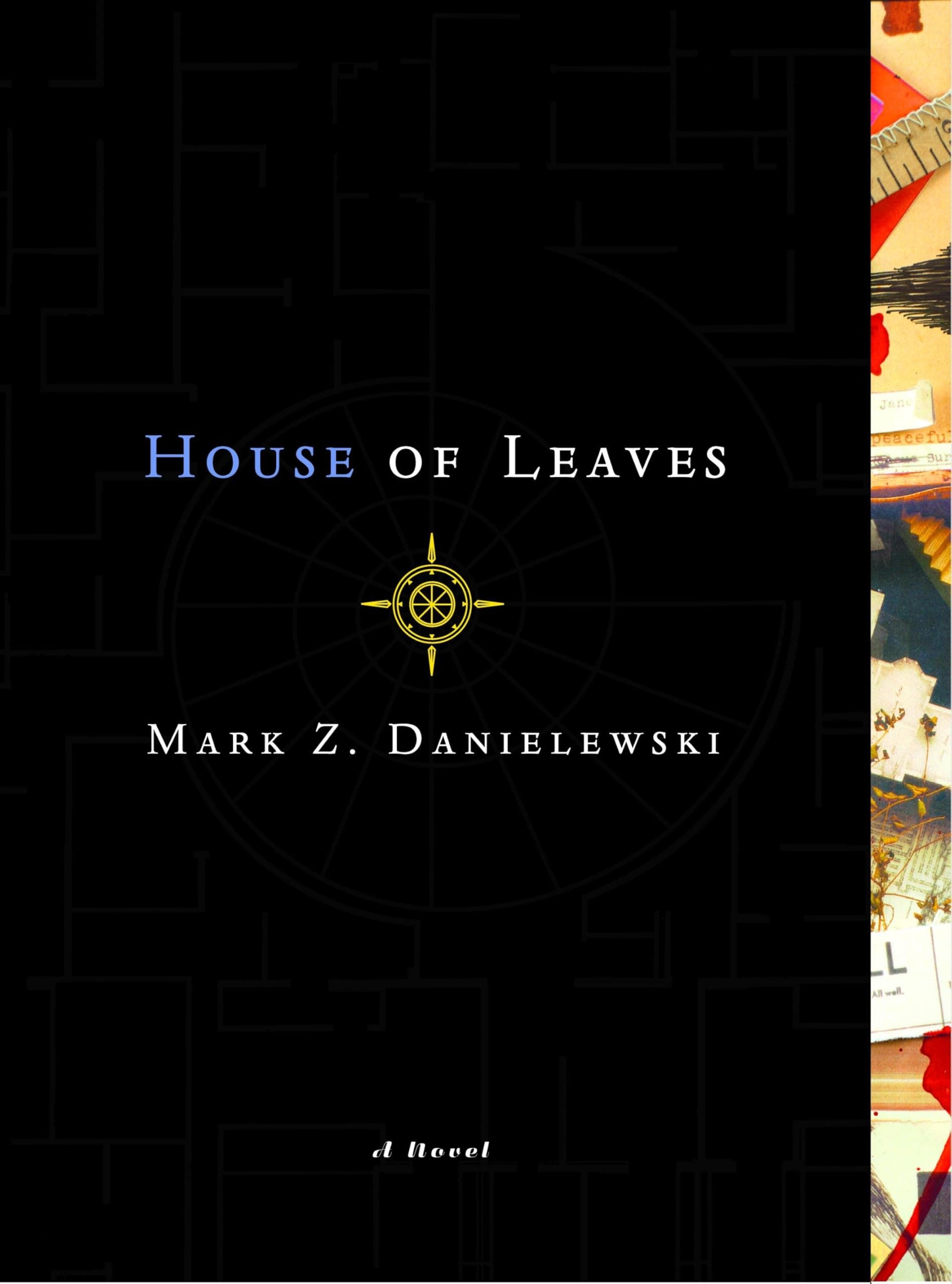
House of Leaves: The Remastered Full-Color Edition is a 528-page postmodern novel by Mark Z. Danielewski that blends experimental narrative, multi-layered storytelling, and visual design. Featuring three narrators and coded footnotes, it challenges traditional reading with a complex, puzzle-like structure. This edition enhances the experience with full-color visuals, making it a must-have for literary adventurers seeking a unique, mind-bending journey.


| Best Sellers Rank | #479 in Books ( See Top 100 in Books ) #8 in Contemporary Literature & Fiction #114 in Literary Fiction (Books) #148 in Suspense Thrillers |
| Customer Reviews | 4.6 out of 5 stars 14,207 Reviews |
D**D
Do the words meta, post-modern, or experimental make you cringe when used to describe books? Then turn back now.
Do the words meta, post-modern, or experimental make you cringe when used to describe books? Then turn back now. I feel the need to say that up front because many people seem to go into this book expecting a horror novel and wind up wasting their money. Just take a look at the genres that goodreads lists this as. Horror, fiction, fantasy, and mystery. With inapt labels like that, it's easy to see how people could get the wrong idea. This is not a horror novel, nor is it a mystery novel or a fantasy novel. This book is, among many other things, a personal story about the author's parents presented as experimental literary fiction that's thinly veiled as a horror novel. Confused? Good, stay that way for now, and don't think too hard about what I just said. I'm not that into horror novels, and I generally like post-modern and experimental stuff, and I knew what I was getting into when I bought this. Know what you're getting into, that's all I'm trying to say. Here's the basic concept as clear and concise as I can tell it. There are essentially three narrators that will be addressing you, the reader. 1) Zampano, an old blind man 2) Johnny Truant, a thirty-something druggie 3) The "editors" Johnny's friend, Lude, knows Zampano because he lives in the same apartment building. The old man, ominously, tells Lude he's going to die soon, and does. After the body is gone, Lude and Johnny sneak into the apartment to take a look around at Zampano's things. They find a crazy manuscript, which Johnny takes home with him. The manuscript is a non-fiction book/dissertation about a documentary called "The Navidson Record." The Navidson Record is about a famous photojournalist named Will Navidson and his family moving into a new house that is bigger on the inside. When I say non-fiction, I mean it. It reads like a textbook. On every page there are footnotes about other articles and other books that reference this documentary that, by all accounts, doesn't exist (I'll get to this in a second). It starts out simple at first. After the family returns home from vacation they notice a hallway on the second floor connecting two bedrooms that wasn't there before. They track down a blueprint of the building and see that there is a space between the walls, although it's not supposed to be a finished hallway with doors. Okay, no big deal, maybe they didn't notice the doors before, it's a new house after all and they had just moved in before going on vacation. Then comes the realization that measuring the house through that hallway results in an extra inch that shouldn't exist, and that can't be explained. Then a new door appears, on the first floor this time, that should lead to an empty back yard but instead leads to a long, dark hallway that extends into an endless labyrinth of cavernous, thousand-foot rooms that leads to god knows where and contains god knows what, and the exploration of this door is the main focus of the documentary. So Johnny finds this manuscript, reads it, edits it, adds his own footnotes relating to research he's done on Zampano's life and the manuscript contents (translations of foreign phrases, for instance), but also personal tangents about his own life and stream of consciousness ramblings. In the prologue where he explains how he found the manuscript, he also says that The Navidson Record doesn't actually exist. Johnny's editors also appear in footnotes and in the first say they have never met Johnny Truant in person, only communicating via letters and rare phone calls. Weird, right? What follows is 528 pages of an interwoven, multi-layered story. On the one hand, you have Zampano's non-fiction book about this fictitious documentary, which simmers as a slow-paced "found-footage" horror novel that can be unsettling, thought-provoking, but is likely to disappoint hardcore horror fans looking for adrenaline-pumping scares. Then you have Johnny's story, told through long footnotes, which is more vague and slow to reveal itself, but the basic idea is that although he knows the manuscript is fiction, the act of reading it causes him to lose his marbles. Whether the manuscript or Johnny's brain chemistry is to blame is up to the reader. Whether Johnny is even telling the truth is up to the reader. And, to be honest, Johnny's parts can sometimes be hard to read because he's just pitiable and depressing and the stream of consciousness prose can wear down your focus. It gets Joyce-esque at times, though only for short stretches, because Danielewski is a nice man who wants you to have a good time, unlike Joyce, who hates you and hates fun. Then the "story" part ends, and you have 130 pages of appendices (which you should read) which include things like: Zampano's writings which are not a part of The Navidson Record The obituary of Johnny's dad Childhood letters from Johnny's crazy, institutionalized, long dead mother Poems So what does it all mean? Well, it means a clever and perhaps over-educated man named Mark Danielewski decided to write a novel that experiments with the format of the novel, that pushes the boundaries of what a novel can be and what it can do. While much of it could quite fairly be called a gimmick, and it won't be redefining how all novels are written going forward, it's a gimmick that works, that is unique, that is stimulating, that is discussion-worthy, that makes the world more interesting by existing, and isn't that what good art is supposed to do? It is an unmitigated success at being singular, and because it is singular it will inspire intense love and intense hatred from different people. It means that while there are answers, you will have to work for them. I mean this both figuratively and literally. On the literal side, there is a letter in the appendices that is written in a simple code, which you will have to translate into a coherent message with pen and paper. And that's a code that is plainly said to be a code. There are other codes that are truly hidden. Many sections have weird, cluttered layouts that make the act of reading them hard, and make tracking down the right footnote a scavenger hunt. You'll be presented with footnotes that make no sense until you realize the text is broken up over several pages and presented backwards. There are a lot of elements to the story, little throwaway lines and facts that you need to remember, or write down. How did Johnny's dad die. How did Navidson's dad die. Stuff like that. While it's not absolutely necessary, I'd recommend having a notebook handy starting on page one. I have an amazing memory, took notes here and there, and still wish I'd taken more. Like I said, this book is work. It's fun work though, depending on your tastes and personality. I'm an INTP and I loved it. Your mileage may vary. On the figurative side, the book still won't hold your hand and spell out what it all means in flashing neon. That's up to you to figure out by gathering all the evidence together and deconstructing the book on several different levels by asking yourself what's true and what isn't, what matters and what doesn't, what's literal and what's figurative, what's the metanarrative, what's the subtext. Ultimately it's up to you to decide when you're satisfied with your answer. While this is nowhere near as open to interpretation as most books you'd label as post-modern or modernist, it is still open to interpretation compared to a typical novel, which isn't open to interpretation at all. There are no easy answers, no definitive answers, but there are satisfying answers that I firmly believe are more or less what the author intended, if you're willing to put in the effort to discover them and have a flexible mind that delights in abstract concepts. Alternatively there are, of course, existing breakdowns of it on the internet that you can turn to for some help, although none I've read have gone far enough into speculation. They present facts and evidence, point out what's true or not, but none of them have drawn the kind of final conclusion that I've drawn. That's how it should be. You should decide for yourself. If none of this sounds like fun to you, I recommend giving this one a pass
J**N
Worth it if you put in the effort, like any good novel.
What makes a good book is how much you put into it. Most good books don't tell you their meaning up front. You have to invest in the book to get something out of it. Mark Danielewski takes a radical approach in challenging the conventions of writing with this postmodern read. The very structure of the book creates visual experiences that convey meaning (even if it's small) in addition to the content of the book. This book explores structure and the style of writing, not just the content. The perfect blend of the two makes it a novel experience in enjoying both the challenging story, narration styles, and structure/form of the story to create a unique experience unlike most other novels you will read. This is not by any means even a moderate read - it is a hard read. But any good book is worth it if you stick with it and really try to understand it. Most people rate it poorly, even if they are avid readers, because it is not an easy read. It takes effort, but so does all good reading. Reading is not always so light and easy. There are books to enjoy that are more towards that end of the spectrum, but this is a highly rewarding text for its complexity. It is highly worth it if you understand that books don't always have immediate sense to it. That is what makes it a postmodern book, a book that challenges everything we know to be true and sensible in a "novel." I have read the entirety once and will do it two times again this next quarter in university and I look forward to it so much. Allow yourself to fall down the rabbit hole and discover a radical challenge to every convention of writing you know. An amazing book if you understand that you have to give yourself to a book in order to be impacted and changed by it. An amazing text if you approach it with an open mind. That is the only thing that is constant in this novel - open to the chaos, madness, and sheer beauty we find in Danielewski's vision of what is possible in a piece of written art. Art does not always make sense. Just as Oscar Wilde writes in his prologue to The Picture of Dorian Gray, "All art is rather useless." If you seek to understand the wicked truth in this novel, you will look into the abyss and the abyss will look back into you. There is beauty in the ugliness, there is peace in the chaos, and logic in the nonsensical rollercoaster of a ride this text is. It is a postmodern text that uses the conventions of the English language/syntax/grammar to break the conventions of English, showing its absurdity. It is truly amazing. So worth it if you allow yourself to be humbled and open to learning from a text as an intellectually honest person. A lot of people who read a lot of books become arrogant and lose their ability to have a growth mindset that can adapt and learn the value (or create value where you can't seem to find it readily) of a text that challenges what they expect or want out of a text. In school, college, university, and throughout life we learn to be skeptical, cynical, and rebellious to all things we encounter. While this can be useful and healthy, most everybody never learns to balance it out with an inquisitive, open, and empathetic side to it which helps you to not just tear down everything you don't understand but helps you to see the value in something novel. I feel bad for the other people who did not have a good experience reading this text and rated it poorly. A lot of them sound like they either gave up because it is a difficult text to read (not a very healthy way to read, which is to challenge and grow yourself while also enjoying the pleasure of prose and verse) or they were unable to see the value of something that seems immediately harmful because it challenges your worldview and assumptions as to what "good" (or what is safe) to read. Not all of them, but some of them are close-minded and do not allow themselves to adapt and change, to learn and grow from this text, even if it challenges everything you know to be true and good. Identify yourself with our amazing ability to change and adapt and to be smart, and you can't go wrong. Even "bad" texts can teach us something. Take the leap if you dare. With the right mindset, there is so much in this text to experience and to learn from. A truly challenging and amazing text to read. TLDR: it is so worth it. Open your mind to it, and let it break down everything you know to be true and good in our Western mindset, and in our limited English sense of grammar. Have the growth mindset and an inquisitive attitude and you will be fundamentally changed by the power of this book to restructure the way you think, freeing you from the captivity of our modern conventions of thinking. Radically changing book.
P**9
Challenging, But Worth Persevering
I’d read House of Leaves when it was released and loved it then, but after revisiting it now, I’m even more enthralled. It comes as no surprise that reviews for Danielewski’s weighty tome are rather sharply divided, but I think this perhaps says more about the reader than the book itself. As we witness the inevitable effects that technology, and the instant gratification and high stimulation that go hand in hand with it, have made the expectation in our lives, it can hardly come as any surprise that the way that we read, as well as our expectations and preferences from our literature, have insidiously changed, too. House of Leaves is not “fast food fiction” to be gulped down as a quick, tasty snack, but rather a luxurious “fine dining” experience that requires time to consume and digest. For readers who have an appreciation for a book that immerses them body and soul, and the patience to allow the story to fully develop, House of Leaves will be a deeply satisfying and fully immersive reading experience. For those who prefer more bells and whistles and a beeline trip to the finish line, the story will seem painfully tedious and slow. As always, books all have their target audiences, and the challenge will always be getting them into hands where they will be most appreciated. I also think that books can strike us very differently depending on what’s going on in our personal lives, so recognizing that simple reality is something we need to consider when we pick up any new book. Sometimes those quick, tasty snacks hit the spot! That, however, is not the kind of book that House of Leaves is. It is a book that requires your commitment and patience, and ultimately rewards the persistent reader with a unique and memorable experience. And should you find that it’s not connecting with you right now for some reason, set it aside and try it again some future day. It’s a challenge worth attempting again.
K**R
Best book go read
House of Leaves by Mark Danielewski is very hard to define in terms of genres. It is most often attributed to horror books because of the story's mysterious nature but House of Leaves can be classified as anything from fantasy, mystery, or even a nonfiction book if read through the right lenses. There are several reasons why House of Leaves is so difficult to define, but one of the most prevalent reasons has to do with the book's overarching narratives. Essentially, the book switches between a report written about a film called The Navidson Record and the perspective of a character named Johnny Truant. The report was originally written by a character named Zampanò. Zampanò is an old blind man who lived as a hermit, and through the use of transcribers has created a report on a possibly fictional documentary called The Navidson Record. Zampanò has died from unclear causes and his report was found by the character Johnny Truant. Johnny starts to edit the report back together and as the book goes on we start to see Johnny slowly fall into mental instability. Johnny is both the main editor of the book and the main protagonist. To convey both of these storylines simultaneously Zampanò’s report is written in times new roman and is the main focus of the book, while Johnny writes in courier and keeps the majority of his story in the footnotes section of each page. While this form of writing is unorthodox, it helps convey a sense of mystery, while also preventing the audience from getting disorientated. The Navidson Record, as described by Zampanò, focuses on Will Navidson and his family moving into a new home in Virginia. The house starts normally, but as time goes on, the house starts to grow in a way that defies laws of space. After a trip to Seattle, Navidson realizes that the interior of the house is larger than the exterior of the house (rooms of the house are larger on the inside than they are on the outside). At first, this phenomenon is confined to only a small portion of the house, but it soon grows. One day, the family finds a new door on an external wall of the living room. The door should lead outside, but instead, it goes to a cold, dark hallway that seems to go on forever. Navidson and his family hire a group of explorers to go into the hallway, to get a deeper understanding. Going into any further detail on the Navidson Record would lead to spoilers, thus, instead of going on with detail, I will go into detail on how parts of the book made me feel. The book is very confusing. The book asks plenty of questions and the book never answers the juicy ones and that can annoy some of the readers. Other than that, both of the main storylines will often invoke a feeling of intrigue. For example, as the Navidson Record progresses, I never got bored. There was always something that gave me the drive to read on. The same is true for Johnny’s storyline. The audience gets to see how Johnny’s mind is slowly degrading and how he starts to develop symptoms of mental instability, leaving the audience to wonder if he’ll be able to finish his work on the report before he loses his mind. All in all, I would recommend that you read House of Leaves. The book is by far one of the more interesting novels I’ve ever read and was one of the few books that kept me engaged from cover to cover. On top of that, House of Leaves is one of the few books that you can read multiple times and still discover new secrets hidden within the text. Secret messages and hidden meaning can be found throughout the book, making it one of the best bang for your buck books that you can buy. However, House of Leaves will leave you with more questions than answers, and you always be wondering about what happened at that house on Ash Tree Lane.
A**H
Didn't finish it - and why.
I was disappointed with this book. I'm sure some people will love it, but it was REALLY not my thing. I will explain why, so that you can decide whether it's your kind of thing or not. This is a piece of Highbrow Literature, of the kind people used to write in my graduate-level creative writing classes. For that genre, it is interesting and well-written, and if you like that kind of thing, you will like this. But I can't stand most Highbrow Literature. This book is just flat-out depressing. The idea of the expanding house, the nested narratives, multiple narrators, and interesting typography are great. But everybody's got these horribly traumatic childhoods (especially the main editor/narrator), there is no possibility of a happy ending, and everything's just dark and depressing forever. I had some hope for this book, and kept reading - until I came to a character death on page 193 that really hurt and felt completely gratuitous. Just inflicting emotional pain for the point of it. Grimdark stuff. I'm not interested. There has been enough detailed foreshadowing in the first part of the book to know that nothing here is going to end well, and I don't feel like torturing myself through the remaining 469 pages. If you like literature that is interestingly set up; but incredibly dark and needlessly depressing; full of graphic, unnecessary, and unremitting sex scenes... then this book is for you. If you like happy endings or even something that just makes sense in the end without intentionally dragging the reader through hundreds of pages of unnecessary grimdark on the way... I think you should skip it. Definitely not my thing, but I hope you like it.
A**I
Slow ramp up, but stay with it ...
If a blackhole were to appear in our minds, would we walk into it, against our best judgment? Even after we confirm its nothingness and endlessness, would we still continue into its depths? Would we bring along others? Would we abandon life as we know it to seek meaning in it? The protagonist of Mr. Danielewski’s novel, Johnny, a tattoo parlor worker whose tenuous links to life comprise of Lude with whom he has “spent a good deal of time wandering all over this odd city [Los Angeles]. We both thrive in the late hours, appreciate its sad taste and never get in the way of each other’s dreams, even though Lude just wants more money, better parties and prettier girls…” and Thumper, not her real name, a stripper and a frequent customer to the tattoo shop who mesmerized our protagonist, “Her hair reminding me of a shiny gold desert wind brazed in a hot August sun, hips curving like coastal norths, tits rising and falling beneath her blue sweatshirt the way an ocean will do long after the storm has passed…” and calls her pussy “the Happiest Place on Earth,” inherits a blind recluse’s (Zampano’s) voluminous notes about a “film which doesn’t even exist,” in which a family have to reckon with a cavernous deprivation-tank-like hallways and staircases emerging in their idyllic Virginia country house (“House”). The narrative in the book occurs at different levels – the base is Zampano’s fictitious film, The Navidson Record, where Navidson, an accomplished photojournalist, loosely modeled on Kevin Carter, moves his family of 4 to the House together with a lot of video equipment that he first uses to capture daily life in the House, and then to explore its emerging dark hallways. While the base story has the unremarkable premise of a “haunted house,” complete with Navidson’s beautiful wife Karen, “a cold bitch, plain and simple. A high-fashion model, not much smarter than a radiator, who grew up thinking life revolved around club owners, cocaine, and credit card limits,” and their two young kids, it is done extremely well. The base story is way better than any haunted house story or horror flick, propelling the story forward. The action is nicely punctuated by philosophical asides, mostly appearing as fictitious commentary on the Navidson Record. The other narrative is the story of Johnny, moving forward from the point Johnny came in possession of Zampano’s materials and also backwards to trace his tumultuous childhood. Johnny’s story appears in his highly personal footnotes as he edits Zampano’s materials into the novel. As Johnny tries to edit Zampano’s materials comes in contact with folks who collaborated with Zampano, and we start tracing the story of Zampano as well. Though this third story line mostly focus on Zampano’s last years as he worked with a number of volunteer readers and scribes, most of whom happen to be attractive women, to pull together his work. These three stories of apparently distinct men, Navidson, the famous photojournalist, Johnny the aimless drifter, and Zampano the reclusive literary genius, intertwine amid commentary and discussions of fundamental questions of philosophy. Here are some examples: On reality versus fiction: “La Belle Nicoise et Le Beau Chien [a fictitious movie] … portrayed the murder of a little girl in such comic reality it was instantly hailed as the belle of the ball in the palace of the grotesque, receiving wares at Sundance and Cannes,… until of course it was discovered that there really was such a little Lithuanian girl and she really was murdered and by none other than the wealthy filmmaker himself. It was a slickly produced snuff film sold as an art house flick. Emir Kustrica’s Underground finally replaced Nicoise as the winner of Cannes Palm d’Or; an equally absurd and terrifying film though gratefully fictitious.” On physical reality of perceptions: “Can Navidson’s house exist without the experience of itself? Is it possible to think of that as ‘unshaped’ by human perceptions? Especially since everyone entering there finds a vision almost completely – though pointedly not completely – different from anyone else’s? Leonard [a fictitious commentator] claimed people create a ‘sensation of space’ where the final result ‘in the perceptual process is a single sensation – ‘a feeling’ about that particular place…’” As well lyric poetry: “Myth makes Echo the subject of longing and desire. Physics makes Echo the subject of distance and design. Where emotion and reason are concerned both claims are accurate. And where there is no Echo there is no description of space or love. There is only silence.” The layout of the book has some innovative designs which elevates the novel above pure text, adds a visual dimension, but this is a novel idea and a new art form. In House of Leaves different layout designs appear in different sections, never to reappear. I found them a bit forced. Yet the book in its full color edition is aesthetically pleasing. Finally, the overabundance of footnotes works to convey the sense of the mockumentary, but at certain points they pile up to break the flow of the narrative. With so many different academics or critics commenting on the Navidson Record, I quickly lost interest in tracking them. Perhaps it would have been better to streamline those to a handful and include them as additional characters. All in all, this is a great book, an artful post-modern narrative structure, with innovative layout designs, but most importantly some great, good old story telling.
A**H
A Unique, Rewarding Horror Experience (Note the Lack of the Word Novel; This Book is an EXPERIENCE)
If you don't have much patience, this book is not for you. If, on the other hand, you enjoy browsing and reading some books several times--particularly books like this, where at least a couple of readings are required, since there's so much to discover--then this IS for you. "House of Leaves" is indeed an experimental novel, but it's not precisely avant-garde. Everything follows a single cohesive storyline, even if it doesn't seem like it. Every digression and footnote is relevant, and enriches the experience. However, again, you must be patient, and you have to enjoy perusing a book at leisure--speed-reading does no good here (trust me, I'mm a speed reader). I don't want to go too much into the storyline (it's way too easy to offer spoilers) but basically, "House of Leaves" follows one man's discovery of a another man's archives documenting truly horrifying events chronicled by a pair of films that do not exist. These films were supposedly created by a professional photographer who was documenting his family's experience moving into a new house. Worse--or better, if you're into horror--those horrifying events are not really under the constraints of place or even time. It if sounds convoluted, it's really not. Or, at least, it's easy to understand; you might have to read the above sentences a couple of times, but you absorb these facts almost by osmosis when you're reading "House of Leaves." I'm afraid to say too much, because spoilers are much to easy to give away here, and while there's probably enough surprises and revelations in this novel that revealing a couple wouldn't make much difference on the book's impact, I don't feel like spitting anything out. I will say this is a very scary novel. If you're any kind of horror fan who longs, at least on occasion, for something beyond the usual spatter and gore, then "House of Leaves" is a must. If you're a reader looking for the next big thing--or at least the next talked-about thing--in literary forms, you, also, should read it. If, however, you're into perfectly streamlined, evenly chapter-divided stories that do not digress and get themselves over with quickly--or at least cleanly-- skip it. "House of Leaves" is a worthwhile experience--extremely worthwhile, in my opinion--but it is not easy, and it is often frustrating. This is not because it is difficult to read; rather, it is because you want to know every answer as soon as the question pops up. At times, it feels like it can't possibly make any sense, like the footnotes and notes and side stories can't possibly add to the story, like it's a waste of time. Trust me, though. It's not. This book isn't a runaway, blockbuster, billion dollar bestseller, and for several reasons. The form does put some people off. Also,it is genuinely frightening, and many people, contrary to what they say, do not actually like being afraid. However, the fact that it's been in steady print says something. "House of Leaves" will continue to develop a cult following; however, that should not be the sole factor in your decision to read or not read this book. It doesn't matter who likes or doesn't like "House of Leaves." It is unique enough that both its fans and detractors are all kinds of people, from all walks of life and learning and experience. This book does not appeal to any one type of person. If you read it, you'll probably understand why. "House of Leaves" is one of the most unique, enthralling, confusing, frustrating, infuriating, and rich reading experiences I've had in the last couple of years. With the former caveats in mind--it doesn't get itself over with quickly, it is often frustrating, the digressions are almost like non sequiturs in places, and it's very frightening-- I would still reccommend this novel to most.
T**W
A review from the trenches, 14 years later...
This book came into my possession in 2003. I was stationed in Iraq, hanging out with a battle buddy. He and I were hanging out in the recreation tent at Baghdad International Airport (BIAP, aka Camp Sather) watching DVDs and perusing books. Sam, my battle buddy, hands me a battered copy of this book, and says, "I tried reading this-- but I think it's more your speed." We parted ways in November. I was headed home, he went to another location. I was on a layover at an airbase in Al Udeid when I started reading this book. And by "reading this book", I meant devouring it, like Bastian did as he holed himself in the attic of his primary school, surrounded by food, covered in a rough blanket, sequestered from the rest of the world, pouring through a mighty tome about a story without an end. I didn't put the book down save to sleep and trek out to the latrine to do what needed to be done every few hours or so. I usually burn through a book in a few hours, but this one demanded time and attention, lest I run over vital. I was taken by the unreliable narrator of Johnny Truant, and I was enthralled by the journey Navidson endured in reclaiming his life from the horrifying macguffin that was the house his family lived in (and people died horribly in). Navy and Johnny were two sides of the same coin, bound together by the mysterious scratches of a dead, Milton-esque man. Their stories were so disparate and yet so interconnected. The fabric between them was everywhere from rough and roughly hewn to diaphanous and metaphysical. The footnotes of footnotes were layers upon layers -- toying with the reality in which the contents of the book existed. Rules were set up and broken, and yet, everything was cohesive as long as the reader had the endurance to follow along. I've seen a LOT of the One-Star reviews complain that they weren't snagged within the first 100 pages. Pity-- Not everything is a slamming action-fast-paced piece of NASCAR fiction that grabs one by the genitals and rips them off in the first two pages. If you aren't in for the slow burn, then the first five words of the book ring true: This is not for you. House of Leaves became a seminal event in my life when I finished reading it. The darkness in my life, punctuated with walking away from a war with my life and body in tact, became that much clearer from the light-- and I somehow began finding awe and inspiration with greater ease. Some have said that it's a story about people coming to grips with loneliness and/or depression. Some have said it's a love story. No one is wrong in their discovery. The only wrong that may be done is to criticize a book unread. To that end, I've ended up buying different copies of this book, like a madman collecting any copy of JD Salinger's "Catcher in the Rye" they could get their hands on, or a person who absolutely could not would not leave the house without a pair of gloves to shield their hands from the world. Whenever I mentioned the book to a friend, they usually ended up being the recipient of the copy I bought. The original copy I received, the one Sam gave me, is in a fireproof safe. Well-worn with a hand-written note scribbled on the front page, I refuse to part with it. But at this point, I'm considering buying a new copy so that I can read it again.