Desert Online General Trading LLC
Dubai, United Arab Emirates
Desert Online General Trading LLC
Dubai, United Arab Emirates

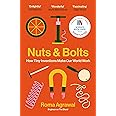
Nuts and Bolts: How Tiny Inventions Make Our World Work
A**A
TRULY … REVOLUTIONARY!
Arthur C. Clarke, Isaac Asimov and Carl Sagan were distinguished scientists who explained a wide range of scientific topics in their books meant for general readers. Roma Agarwal, the author of ‘Nuts and Bolts’, follows in their footsteps, but with two important differences:- Firstly, she is not a scientist but a qualified engineer. Hence, she does not write about the stars in the sky or tiny electrons moving in their orbits; instead, she focuses on seven simple devices which can be found in the core of most of complex products around us, namely, the nail, spring, wheel, lens, magnet, string and pump.- Secondly, as a woman from a minority background in British society, she proudly upholds diversity in the engineering profession (more about this later).The author is a highly successful structural engineer, but in this book, she shuns complicated drawings and equations. Instead, she explains that “engineering is the meeting of science, design and history.” Each of the seven objects selected for this book are “wonders of design that went through many different iterations and forms, and continue to do so.” While the chapter headings indicate the simplest versions of each device, multiple variants and developments are described. The first chapter on nails, for example, covers many types of fasteners including rivets, screws and bolts; with insights on the usage of diverse materials in different periods. Similarly, the chapter on lenses touches upon spectacles, microscopes, telescopes, lasers and cameras. Certain passages are extremely witty, for instance, the following comment on the development of wheels and axles “the idea of a spinning object interacting with a non-spinning object to create a device has no natural precedent. It was truly… revolutionary”!This book contains elaborate descriptions of many different devices, for example, “bolts are, in some ways, an amalgamation of screws and rivets. They have a long cylindrical shaft topped by a hexagonal head, so shaped to be tightened by a wrench. All, or sometimes just the end of the shaft, is threaded – so far, it mostly resembles a chunky screw.” There are no illustrations apart from some simple sketches with handwritten notes.The author shares several personal memories in the course of this book, including anecdotes about her grandparents, the television set in her childhood home, her achievements in Bharatnatyam and her experiences of pregnancy and motherhood. Of course, such memories are linked to the topics being discussed – for example, in an emotionally charged letter addressed to her daughter Zarya, born through IVF, the author says, “You wouldn’t exist without a seemingly simple little curved piece of glass, called a lens.”Roma Agrawal was born in India and she seems acutely conscious of her Indian heritage. The ‘charkha’ is mentioned in the chapter on wheels, and again in the chapter on string, where she says, “The British East India Company used its colonies, particularly India, as a market for its industrially produced textiles, slapping high tariffs on to Indian handmade exports and purchasing raw materials like cotton at exploitatively low prices to drive profit into Britain’s economy while crippling its colony’s.”Despite the overall excellence of this book, I am concerned that the following sentence might get misunderstood by readers: “The steam-powered train could, through a system of gears, use fuel in its engine to turn wheels on its carriage.” Having spent about four decades in the railway industry, let me clarify that there is no gearbox on a typical steam locomotive and the term ‘gear’ used in this context does not refer to a toothed wheel. Hence the valve gear, brake gear, reversing gear, sanding gear, etc. are specialized mechanisms, akin to the ‘landing gear’ of an aircraft.This is a book which should be read by all young engineers. Even experienced engineers (like this reviewer) can learn a lot from this book. I must confess, for example, that I did not know about the design of spacesuits or the challenges of creating an artificial heart – or even the arrangement of spokes on bicycle wheels – till I read this book.
D**Y
One of the best books I ever read...
Nobody thought that these 7 things would basically altar the scenario on earth! What is more important is that the Author has done it exceedingly well to present this in a nutshell and very simple language... Deserves award!
A**K
Little engineering explained
Seven"small" invention which changed the world. A must for personal library
Trustpilot
1 month ago
2 weeks ago